

267
Formation and Movement of Glacial Ice
normal rate again. The flow rates during surges are as much as
100 times the normal rate (FIGURE 11.9).
Budget of a Glacier
Snow is the raw material from which glacial ice originates; therefore,
glaciers form in areas where more snow falls in winter than melts during the summer. Glaciers are constantly gaining and losing ice.
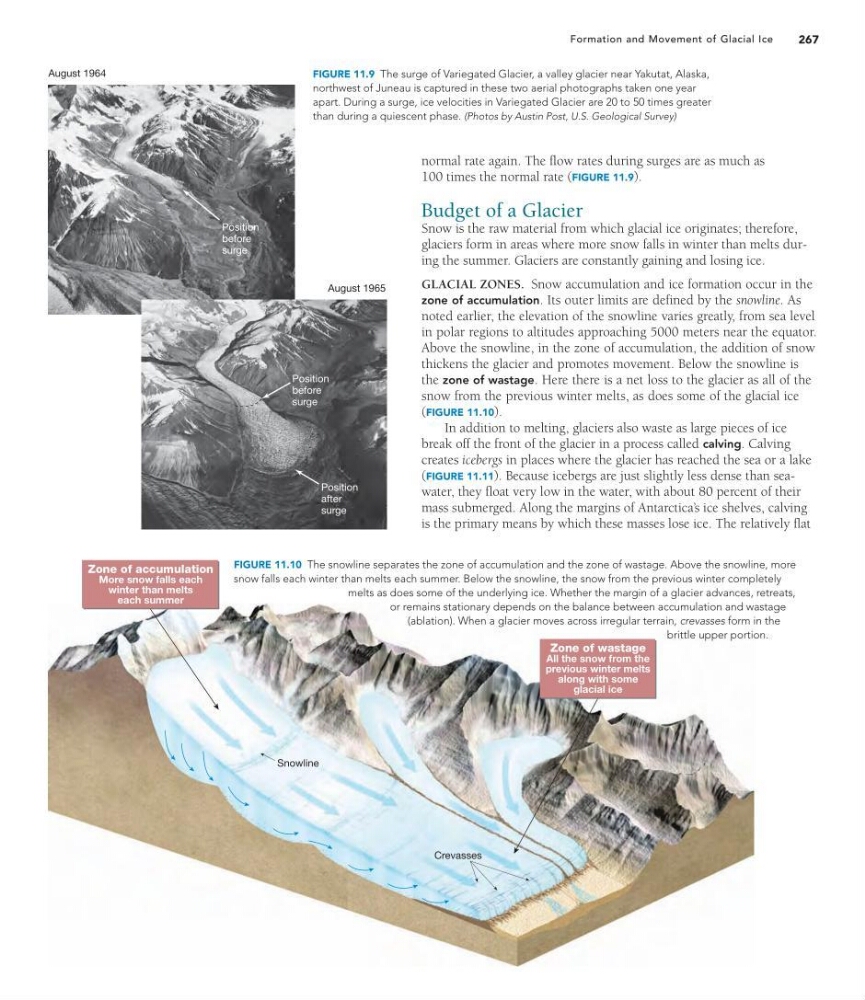
GLACIAL ZONES. Snow accumulation and ice formation occur in the
zone of accumulation. Its outer limits are defined by the snowline. As
noted earlier, the elevation of the snowline varies greatly, from sea level
in polar regions to altitudes approaching 5000 meters near the equator.
Above the snowline, in the zone of accumulation, the addition of snow
thickens the glacier and promotes movement. Below the snowline is
the zone of wastage. Here there is a net loss to the glacier as all of the
snow from the previous winter melts, as does some of the glacial ice
(FIGURE 11.10).
In addition to melting, glaciers also waste as large pieces of ice
break off the front of the glacier in a process called calving. Calving
creates icebergs in places where the glacier has reached the sea or a lake
(FIGURE 11.11). Because icebergs are just slightly less dense than seawater, they float very low in the water, with about 80 percent of their
mass submerged. Along the margins of Antarctica’ s ice shelves, calving
is the primary means by which these masses lose ice. The relatively flat
Position
before
surge
Position
after
surge
Position
before
surge
August 1964
August 1965
FIGURE 11.9 The surge of Variegated Glacier, a valley glacier near Yakutat, Alaska,
northwest of Juneau is captured in these two aerial photographs taken one year
apart. During a surge, ice velocities in Variegated Glacier are 20 to 50 times greater
than during a quiescent phase. (Photos by Austin Post, U.S. Geological Survey)
Snowline
Crevasses
Zone of accumulation
More snow falls each
winter than melts
each summer
Zone of wastage
All the snow from the
previous winter melts
along with some
glacial ice
FIGURE 11.10 The snowline separates the zone of accumulation and the zone of wastage. Above the snowline, more
snow falls each winter than melts each summer. Below the snowline, the snow from the previous winter completely
melts as does some of the underlying ice. Whether the margin of a glacier advances, retreats,
or remains stationary depends on the balance between accumulation and wastage
(ablation). When a glacier moves across irregular terrain, crevasses form in the
brittle upper portion.
Formation and Movement of Glacial Ice
normal rate again. The flow rates during surges are as much as
100 times the normal rate (FIGURE 11.9).
Budget of a Glacier
Snow is the raw material from which glacial ice originates; therefore,
glaciers form in areas where more snow falls in winter than melts during the summer. Glaciers are constantly gaining and losing ice.
GLACIAL ZONES. Snow accumulation and ice formation occur in the
zone of accumulation. Its outer limits are defined by the snowline. As
noted earlier, the elevation of the snowline varies greatly, from sea level
in polar regions to altitudes approaching 5000 meters near the equator.
Above the snowline, in the zone of accumulation, the addition of snow
thickens the glacier and promotes movement. Below the snowline is
the zone of wastage. Here there is a net loss to the glacier as all of the
snow from the previous winter melts, as does some of the glacial ice
(FIGURE 11.10).
In addition to melting, glaciers also waste as large pieces of ice
break off the front of the glacier in a process called calving. Calving
creates icebergs in places where the glacier has reached the sea or a lake
(FIGURE 11.11). Because icebergs are just slightly less dense than seawater, they float very low in the water, with about 80 percent of their
mass submerged. Along the margins of Antarctica’ s ice shelves, calving
is the primary means by which these masses lose ice. The relatively flat
Position
before
surge
Position
after
surge
Position
before
surge
August 1964
August 1965
FIGURE 11.9 The surge of Variegated Glacier, a valley glacier near Yakutat, Alaska,
northwest of Juneau is captured in these two aerial photographs taken one year
apart. During a surge, ice velocities in Variegated Glacier are 20 to 50 times greater
than during a quiescent phase. (Photos by Austin Post, U.S. Geological Survey)
Snowline
Crevasses
Zone of accumulation
More snow falls each
winter than melts
each summer
Zone of wastage
All the snow from the
previous winter melts
along with some
glacial ice
FIGURE 11.10 The snowline separates the zone of accumulation and the zone of wastage. Above the snowline, more
snow falls each winter than melts each summer. Below the snowline, the snow from the previous winter completely
melts as does some of the underlying ice. Whether the margin of a glacier advances, retreats,
or remains stationary depends on the balance between accumulation and wastage
(ablation). When a glacier moves across irregular terrain, crevasses form in the
brittle upper portion.