

CHAPTER 11 Glaciers and Glaciation
266
T o ta l
m o v e m e n t
In te rn a l
fl o w
Sliding
Bedrock
Z o n e o f fr a c tu re
FIGURE 11.7 A vertical cross section through a
glacier illustrates ice movement. Glacial
movement is divided into two components. Below
about 50 meters (160 feet), ice behaves plastically
and flows. In addition, the entire mass of ice may
slide along the ground. The ice in the zone of
fracture is carried along “piggyback” style. Notice
that the rate of movement is slowest at the base
of the glacier, where frictional drag is greatest.
How Glaciers Move
The movement of glacial ice is generally
referred to as flow. The fact that glacial
movement is described in this way seems
paradoxical—how can a solid flow? The
way in which ice flows is complex and is
of two basic types. The first of these, plastic
flow, involves movement within the ice. Ice
behaves as a brittle solid until the pressure
upon it is equivalent to the weight of about
50 meters (165 feet) of ice. Once that load
is surpassed, ice behaves as a plastic material, and flow begins. A second and often
equally important mechanism of glacial
movement consists of the entire ice mass
slipping along the ground. The lowest
portions of most glaciers are thought to
move by this sliding process called basal
slip (FIGURE 11.7).
The upper 50 meters or so of a glacier
is not under sufficient pressure to exhibit
plastic flow. Rather, the ice in this uppermost zone is brittle and is appropriately
referred to as the zone of fracture. The ice in
this zone is carried along “piggyback” style
by the ice below. When the glacier moves
over irregular terrain, the zone of fracture is
subjected to tension, resulting in cracks
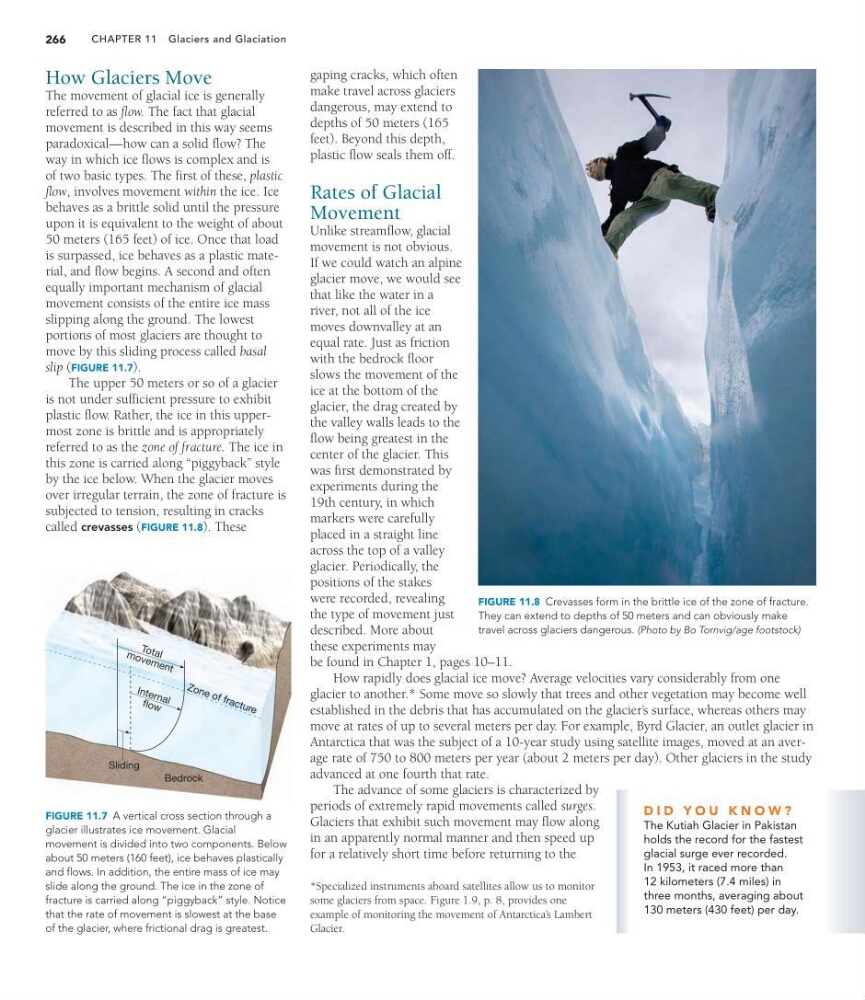
called crevasses (FIGURE 11.8). These
gaping cracks, which often
make travel across glaciers
dangerous, may extend to
depths of 50 meters (165
feet). Beyond this depth,
plastic flow seals them off.
Rates of Glacial
Movement
Unlike streamflow, glacial
movement is not obvious.
If we could watch an alpine
glacier move, we would see
that like the water in a
river, not all of the ice
moves downvalley at an
equal rate. Just as friction
with the bedrock floor
slows the movement of the
ice at the bottom of the
glacier, the drag created by
the valley walls leads to the
flow being greatest in the
center of the glacier. This
was first demonstrated by
experiments during the
19th century, in which
markers were carefully
placed in a straight line
across the top of a valley
glacier. Periodically, the
positions of the stakes
were recorded, revealing
the type of movement just
described. More about
these experiments may
be found in Chapter 1, pages 10–11.
How rapidly does glacial ice move? Average velocities vary considerably from one
glacier to another.* Some move so slowly that trees and other vegetation may become well
established in the debris that has accumulated on the glacier’ s surface, whereas others may
move at rates of up to several meters per day. For example, Byrd Glacier, an outlet glacier in
Antarctica that was the subject of a 10-year study using satellite images, moved at an average rate of 750 to 800 meters per year (about 2 meters per day). Other glaciers in the study
advanced at one fourth that rate.
The advance of some glaciers is characterized by
periods of extremely rapid movements called surges.
Glaciers that exhibit such movement may flow along
in an apparently normal manner and then speed up
for a relatively short time before returning to the
*Specialized instruments aboard satellites allow us to monitor
some glaciers from space. Figure 1.9, p. 8, provides one
example of monitoring the movement of Antarctica’ s Lambert
Glacier.
FIGURE 11.8 Crevasses form in the brittle ice of the zone of fracture.
They can extend to depths of 50 meters and can obviously make
travel across glaciers dangerous. (Photo by Bo Tornvig/age footstock)
D I D Y O U K N O W ?
The Kutiah Glacier in Pakistan
holds the record for the fastest
glacial surge ever recorded.
In 1953, it raced more than
12 kilometers (7.4 miles) in
three months, averaging about
130 meters (430 feet) per day.
266
T o ta l
m o v e m e n t
In te rn a l
fl o w
Sliding
Bedrock
Z o n e o f fr a c tu re
FIGURE 11.7 A vertical cross section through a
glacier illustrates ice movement. Glacial
movement is divided into two components. Below
about 50 meters (160 feet), ice behaves plastically
and flows. In addition, the entire mass of ice may
slide along the ground. The ice in the zone of
fracture is carried along “piggyback” style. Notice
that the rate of movement is slowest at the base
of the glacier, where frictional drag is greatest.
How Glaciers Move
The movement of glacial ice is generally
referred to as flow. The fact that glacial
movement is described in this way seems
paradoxical—how can a solid flow? The
way in which ice flows is complex and is
of two basic types. The first of these, plastic
flow, involves movement within the ice. Ice
behaves as a brittle solid until the pressure
upon it is equivalent to the weight of about
50 meters (165 feet) of ice. Once that load
is surpassed, ice behaves as a plastic material, and flow begins. A second and often
equally important mechanism of glacial
movement consists of the entire ice mass
slipping along the ground. The lowest
portions of most glaciers are thought to
move by this sliding process called basal
slip (FIGURE 11.7).
The upper 50 meters or so of a glacier
is not under sufficient pressure to exhibit
plastic flow. Rather, the ice in this uppermost zone is brittle and is appropriately
referred to as the zone of fracture. The ice in
this zone is carried along “piggyback” style
by the ice below. When the glacier moves
over irregular terrain, the zone of fracture is
subjected to tension, resulting in cracks
called crevasses (FIGURE 11.8). These
gaping cracks, which often
make travel across glaciers
dangerous, may extend to
depths of 50 meters (165
feet). Beyond this depth,
plastic flow seals them off.
Rates of Glacial
Movement
Unlike streamflow, glacial
movement is not obvious.
If we could watch an alpine
glacier move, we would see
that like the water in a
river, not all of the ice
moves downvalley at an
equal rate. Just as friction
with the bedrock floor
slows the movement of the
ice at the bottom of the
glacier, the drag created by
the valley walls leads to the
flow being greatest in the
center of the glacier. This
was first demonstrated by
experiments during the
19th century, in which
markers were carefully
placed in a straight line
across the top of a valley
glacier. Periodically, the
positions of the stakes
were recorded, revealing
the type of movement just
described. More about
these experiments may
be found in Chapter 1, pages 10–11.
How rapidly does glacial ice move? Average velocities vary considerably from one
glacier to another.* Some move so slowly that trees and other vegetation may become well
established in the debris that has accumulated on the glacier’ s surface, whereas others may
move at rates of up to several meters per day. For example, Byrd Glacier, an outlet glacier in
Antarctica that was the subject of a 10-year study using satellite images, moved at an average rate of 750 to 800 meters per year (about 2 meters per day). Other glaciers in the study
advanced at one fourth that rate.
The advance of some glaciers is characterized by
periods of extremely rapid movements called surges.
Glaciers that exhibit such movement may flow along
in an apparently normal manner and then speed up
for a relatively short time before returning to the
*Specialized instruments aboard satellites allow us to monitor
some glaciers from space. Figure 1.9, p. 8, provides one
example of monitoring the movement of Antarctica’ s Lambert
Glacier.
FIGURE 11.8 Crevasses form in the brittle ice of the zone of fracture.
They can extend to depths of 50 meters and can obviously make
travel across glaciers dangerous. (Photo by Bo Tornvig/age footstock)
D I D Y O U K N O W ?
The Kutiah Glacier in Pakistan
holds the record for the fastest
glacial surge ever recorded.
In 1953, it raced more than
12 kilometers (7.4 miles) in
three months, averaging about
130 meters (430 feet) per day.