

disasters produced by unknown causes that no longer operate. This
philosophy was an attempt to fit the rates of Earth processes to the
then current ideas on the age of Earth.
The Birth of Modern Geology
Against this backdrop of Aristotle’ s views and an Earth created in
4004 BC, a Scottish physician and gentleman farmer named James
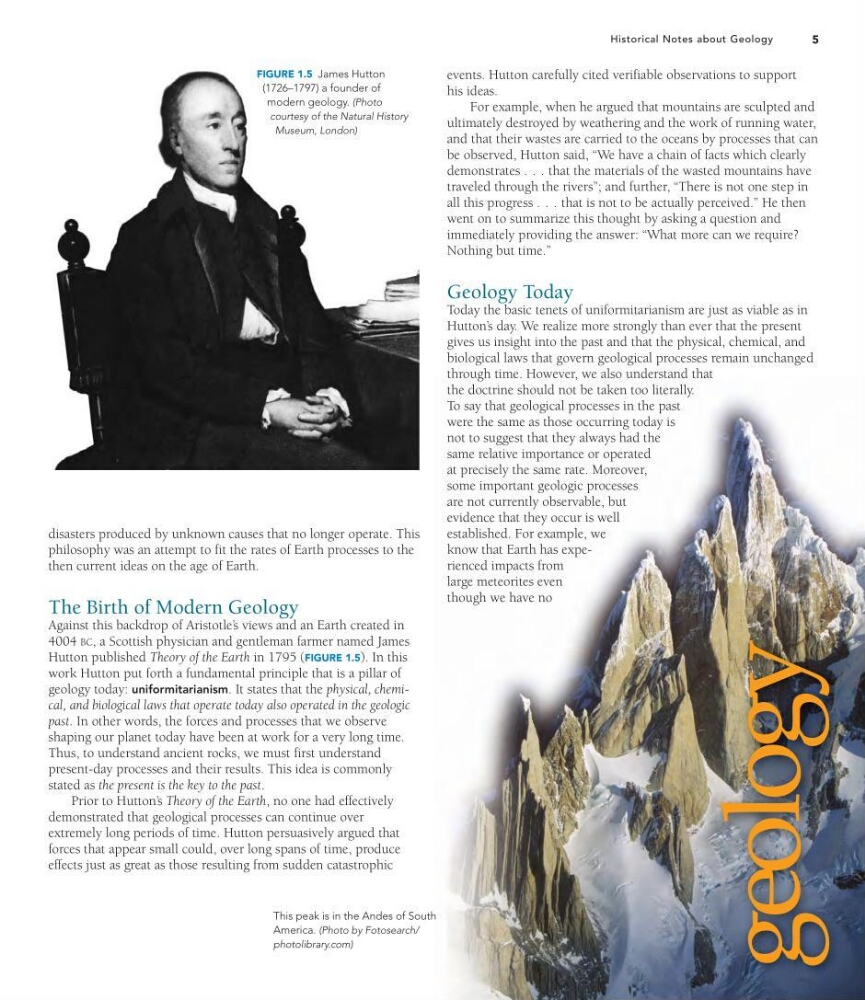
Hutton published Theory of the Earth in 1795 (FIGURE 1.5). In this
work Hutton put forth a fundamental principle that is a pillar of
geology today: uniformitarianism. It states that the physical, chemical, and biological laws that operate today also operated in the geologic
past. In other words, the forces and processes that we observe
shaping our planet today have been at work for a very long time.
Thus, to understand ancient rocks, we must first understand
present-day processes and their results. This idea is commonly
stated as the present is the key to the past.
Prior to Hutton’ s Theory of the Earth, no one had effectively
demonstrated that geological processes can continue over
extremely long periods of time. Hutton persuasively argued that
forces that appear small could, over long spans of time, produce
effects just as great as those resulting from sudden catastrophic
5
Historical Notes about Geology
FIGURE 1.5 James Hutton
(1726–1797) a founder of
modern geology. (Photo
courtesy of the Natural History
Museum, London)
geology
This peak is in the Andes of South
America. (Photo by Fotosearch/
photolibrary.com)
events. Hutton carefully cited verifiable observations to support
his ideas.
For example, when he argued that mountains are sculpted and
ultimately destroyed by weathering and the work of running water,
and that their wastes are carried to the oceans by processes that can
be observed, Hutton said, “We have a chain of facts which clearly
demonstrates . . . that the materials of the wasted mountains have
traveled through the rivers”; and further, “There is not one step in
all this progress . . . that is not to be actually perceived.” He then
went on to summarize this thought by asking a question and
immediately providing the answer: “What more can we require?
Nothing but time.”
Geology Today
Today the basic tenets of uniformitarianism are just as viable as in
Hutton’ s day. We realize more strongly than ever that the present
gives us insight into the past and that the physical, chemical, and
biological laws that govern geological processes remain unchanged
through time. However, we also understand that
the doctrine should not be taken too literally.
To say that geological processes in the past
were the same as those occurring today is
not to suggest that they always had the
same relative importance or operated
at precisely the same rate. Moreover,
some important geologic processes
are not currently observable, but
evidence that they occur is well
established. For example, we
know that Earth has experienced impacts from
large meteorites even
though we have no
philosophy was an attempt to fit the rates of Earth processes to the
then current ideas on the age of Earth.
The Birth of Modern Geology
Against this backdrop of Aristotle’ s views and an Earth created in
4004 BC, a Scottish physician and gentleman farmer named James
Hutton published Theory of the Earth in 1795 (FIGURE 1.5). In this
work Hutton put forth a fundamental principle that is a pillar of
geology today: uniformitarianism. It states that the physical, chemical, and biological laws that operate today also operated in the geologic
past. In other words, the forces and processes that we observe
shaping our planet today have been at work for a very long time.
Thus, to understand ancient rocks, we must first understand
present-day processes and their results. This idea is commonly
stated as the present is the key to the past.
Prior to Hutton’ s Theory of the Earth, no one had effectively
demonstrated that geological processes can continue over
extremely long periods of time. Hutton persuasively argued that
forces that appear small could, over long spans of time, produce
effects just as great as those resulting from sudden catastrophic
5
Historical Notes about Geology
FIGURE 1.5 James Hutton
(1726–1797) a founder of
modern geology. (Photo
courtesy of the Natural History
Museum, London)
geology
This peak is in the Andes of South
America. (Photo by Fotosearch/
photolibrary.com)
events. Hutton carefully cited verifiable observations to support
his ideas.
For example, when he argued that mountains are sculpted and
ultimately destroyed by weathering and the work of running water,
and that their wastes are carried to the oceans by processes that can
be observed, Hutton said, “We have a chain of facts which clearly
demonstrates . . . that the materials of the wasted mountains have
traveled through the rivers”; and further, “There is not one step in
all this progress . . . that is not to be actually perceived.” He then
went on to summarize this thought by asking a question and
immediately providing the answer: “What more can we require?
Nothing but time.”
Geology Today
Today the basic tenets of uniformitarianism are just as viable as in
Hutton’ s day. We realize more strongly than ever that the present
gives us insight into the past and that the physical, chemical, and
biological laws that govern geological processes remain unchanged
through time. However, we also understand that
the doctrine should not be taken too literally.
To say that geological processes in the past
were the same as those occurring today is
not to suggest that they always had the
same relative importance or operated
at precisely the same rate. Moreover,
some important geologic processes
are not currently observable, but
evidence that they occur is well
established. For example, we
know that Earth has experienced impacts from
large meteorites even
though we have no