

Well 1 delivering
contaminated water
Septic
tank
A.
Tim e: Day s or wee ks
Tim e: Mon ths or yea rs
B.
Well 2 delivering
clean water
Contaminated
water
Contaminated
water
Permeable
sandstone
Water
table
Water
table
Cavernous
limestone
Septic
tank
In the low-lying coastal area between Houston and Galveston, land subsidence
ranges from 1.5 to 3 meters (5 to 9 feet). The result is that about 78 square kilometers (30 square miles) are permanently flooded.
Outside the United States, one of the most spectacular examples of subsidence occurred in Mexico City, which is built on a former lake bed. In the first
half of the 20th century, thousands of wells were sunk into the water-saturated
sediments beneath the city. As water was withdrawn, portions of the city subsided by as much as 6 to 7 meters. In some places buildings have sunk to such
a point that access to them from the street is located at what used to be the
second-floor level!
Groundwater Contamination
The pollution of groundwater is a serious matter, particularly in areas where
aquifers provide a large part of the water supply. One common source of
groundwater pollution is sewage. Its sources include an ever-increasing number
of septic tanks, as well as inadequate or broken sewer systems and farm waste.
If sewage water that is contaminated with bacteria enters the groundwater
system, it may become purified through natural processes. The harmful bacteria
may be mechanically filtered by the sediment through which the water percolates, destroyed by chemical oxidation, and/or assimilated by other organisms.
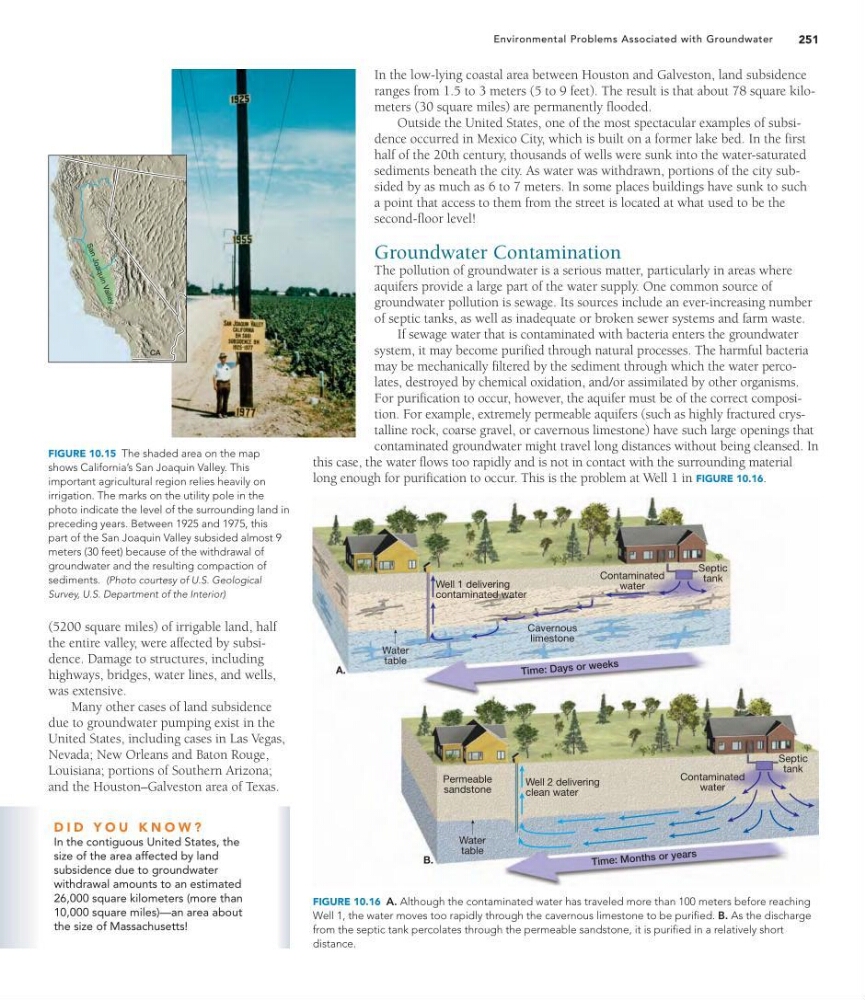
For purification to occur, however, the aquifer must be of the correct composition. For example, extremely permeable aquifers (such as highly fractured crystalline rock, coarse gravel, or cavernous limestone) have such large openings that
contaminated groundwater might travel long distances without being cleansed. In
this case, the water flows too rapidly and is not in contact with the surrounding material
long enough for purification to occur. This is the problem at Well 1 in FIGURE 10.16.
251
Environmental Problems Associated with Groundwater
S
a
n
J
o
a
q
u
in
V
a
lle
y
CA
FIGURE 10.15 The shaded area on the map
shows California’s San Joaquin Valley. This
important agricultural region relies heavily on
irrigation. The marks on the utility pole in the
photo indicate the level of the surrounding land in
preceding years. Between 1925 and 1975, this
part of the San Joaquin Valley subsided almost 9
meters (30 feet) because of the withdrawal of
groundwater and the resulting compaction of
sediments. (Photo courtesy of U.S. Geological
Survey, U.S. Department of the Interior)
D I D Y O U K N O W ?
In the contiguous United States, the
size of the area affected by land
subsidence due to groundwater
withdrawal amounts to an estimated
26,000 square kilometers (more than
10,000 square miles)—an area about
the size of Massachusetts!
(5200 square miles) of irrigable land, half
the entire valley, were affected by subsidence. Damage to structures, including
highways, bridges, water lines, and wells,
was extensive.
Many other cases of land subsidence
due to groundwater pumping exist in the
United States, including cases in Las Vegas,
Nevada; New Orleans and Baton Rouge,
Louisiana; portions of Southern Arizona;
and the Houston–Galveston area of Texas.
FIGURE 10.16 A. Although the contaminated water has traveled more than 100 meters before reaching
Well 1, the water moves too rapidly through the cavernous limestone to be purified. B. As the discharge
from the septic tank percolates through the permeable sandstone, it is purified in a relatively short
distance.
contaminated water
Septic
tank
A.
Tim e: Day s or wee ks
Tim e: Mon ths or yea rs
B.
Well 2 delivering
clean water
Contaminated
water
Contaminated
water
Permeable
sandstone
Water
table
Water
table
Cavernous
limestone
Septic
tank
In the low-lying coastal area between Houston and Galveston, land subsidence
ranges from 1.5 to 3 meters (5 to 9 feet). The result is that about 78 square kilometers (30 square miles) are permanently flooded.
Outside the United States, one of the most spectacular examples of subsidence occurred in Mexico City, which is built on a former lake bed. In the first
half of the 20th century, thousands of wells were sunk into the water-saturated
sediments beneath the city. As water was withdrawn, portions of the city subsided by as much as 6 to 7 meters. In some places buildings have sunk to such
a point that access to them from the street is located at what used to be the
second-floor level!
Groundwater Contamination
The pollution of groundwater is a serious matter, particularly in areas where
aquifers provide a large part of the water supply. One common source of
groundwater pollution is sewage. Its sources include an ever-increasing number
of septic tanks, as well as inadequate or broken sewer systems and farm waste.
If sewage water that is contaminated with bacteria enters the groundwater
system, it may become purified through natural processes. The harmful bacteria
may be mechanically filtered by the sediment through which the water percolates, destroyed by chemical oxidation, and/or assimilated by other organisms.
For purification to occur, however, the aquifer must be of the correct composition. For example, extremely permeable aquifers (such as highly fractured crystalline rock, coarse gravel, or cavernous limestone) have such large openings that
contaminated groundwater might travel long distances without being cleansed. In
this case, the water flows too rapidly and is not in contact with the surrounding material
long enough for purification to occur. This is the problem at Well 1 in FIGURE 10.16.
251
Environmental Problems Associated with Groundwater
S
a
n
J
o
a
q
u
in
V
a
lle
y
CA
FIGURE 10.15 The shaded area on the map
shows California’s San Joaquin Valley. This
important agricultural region relies heavily on
irrigation. The marks on the utility pole in the
photo indicate the level of the surrounding land in
preceding years. Between 1925 and 1975, this
part of the San Joaquin Valley subsided almost 9
meters (30 feet) because of the withdrawal of
groundwater and the resulting compaction of
sediments. (Photo courtesy of U.S. Geological
Survey, U.S. Department of the Interior)
D I D Y O U K N O W ?
In the contiguous United States, the
size of the area affected by land
subsidence due to groundwater
withdrawal amounts to an estimated
26,000 square kilometers (more than
10,000 square miles)—an area about
the size of Massachusetts!
(5200 square miles) of irrigable land, half
the entire valley, were affected by subsidence. Damage to structures, including
highways, bridges, water lines, and wells,
was extensive.
Many other cases of land subsidence
due to groundwater pumping exist in the
United States, including cases in Las Vegas,
Nevada; New Orleans and Baton Rouge,
Louisiana; portions of Southern Arizona;
and the Houston–Galveston area of Texas.
FIGURE 10.16 A. Although the contaminated water has traveled more than 100 meters before reaching
Well 1, the water moves too rapidly through the cavernous limestone to be purified. B. As the discharge
from the septic tank percolates through the permeable sandstone, it is purified in a relatively short
distance.