

CHAPTER 10 Groundwater
252
In contrast, when the aquifer is composed of sand or permeable sandstone, the
water can sometimes be purified after traveling only a few dozen meters through it.
The openings between sand grains are large
enough to permit water movement, yet the
movement of the water is slow enough to
allow ample time for its purification
(Well 2, Figure 10.16).
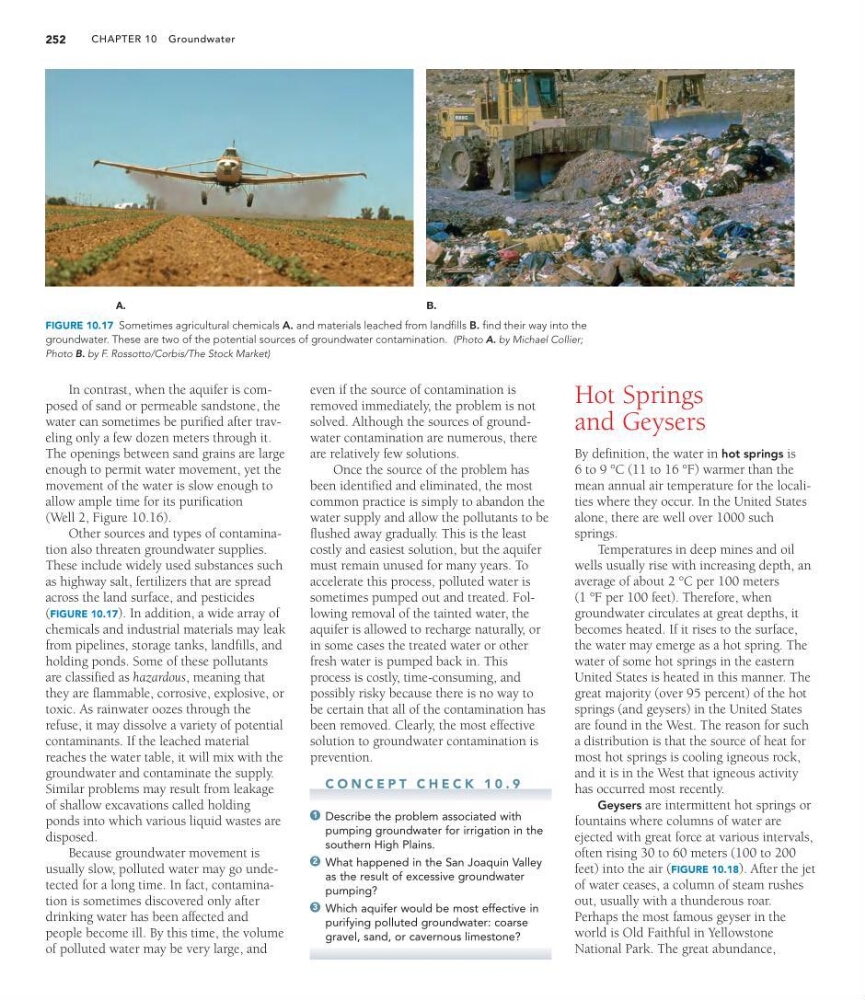
Other sources and types of contamination also threaten groundwater supplies.
These include widely used substances such
as highway salt, fertilizers that are spread
across the land surface, and pesticides
(FIGURE 10.17). In addition, a wide array of
chemicals and industrial materials may leak
from pipelines, storage tanks, landfills, and
holding ponds. Some of these pollutants
are classified as hazardous, meaning that
they are flammable, corrosive, explosive, or
toxic. As rainwater oozes through the
refuse, it may dissolve a variety of potential
contaminants. If the leached material
reaches the water table, it will mix with the
groundwater and contaminate the supply.
Similar problems may result from leakage
of shallow excavations called holding
ponds into which various liquid wastes are
disposed.
Because groundwater movement is
usually slow, polluted water may go undetected for a long time. In fact, contamination is sometimes discovered only after
drinking water has been affected and
people become ill. By this time, the volume
of polluted water may be very large, and
even if the source of contamination is
removed immediately, the problem is not
solved. Although the sources of groundwater contamination are numerous, there
are relatively few solutions.
Once the source of the problem has
been identified and eliminated, the most
common practice is simply to abandon the
water supply and allow the pollutants to be
flushed away gradually. This is the least
costly and easiest solution, but the aquifer
must remain unused for many years. To
accelerate this process, polluted water is
sometimes pumped out and treated. Following removal of the tainted water, the
aquifer is allowed to recharge naturally, or
in some cases the treated water or other
fresh water is pumped back in. This
process is costly, time-consuming, and
possibly risky because there is no way to
be certain that all of the contamination has
been removed. Clearly, the most effective
solution to groundwater contamination is
prevention.
C O N C E P T C H E C K 1 0 . 9
Describe the problem associated with
pumping groundwater for irrigation in the
southern High Plains.
What happened in the San Joaquin Valley
as the result of excessive groundwater
pumping?
Which aquifer would be most effective in
purifying polluted groundwater: coarse
gravel, sand, or cavernous limestone?
3
2
1
Hot Springs
and Geysers
By definition, the water in hot springs is
6 to 9 °C (11 to 16 °F) warmer than the
mean annual air temperature for the localities where they occur. In the United States
alone, there are well over 1000 such
springs.
Temperatures in deep mines and oil
wells usually rise with increasing depth, an
average of about 2 °C per 100 meters
(1 °F per 100 feet). Therefore, when
groundwater circulates at great depths, it
becomes heated. If it rises to the surface,
the water may emerge as a hot spring. The
water of some hot springs in the eastern
United States is heated in this manner. The
great majority (over 95 percent) of the hot
springs (and geysers) in the United States
are found in the West. The reason for such
a distribution is that the source of heat for
most hot springs is cooling igneous rock,
and it is in the West that igneous activity
has occurred most recently.
Geysers are intermittent hot springs or
fountains where columns of water are
ejected with great force at various intervals,
often rising 30 to 60 meters (100 to 200
feet) into the air (FIGURE 10.18). After the jet
of water ceases, a column of steam rushes
out, usually with a thunderous roar.
Perhaps the most famous geyser in the
world is Old Faithful in Yellowstone
National Park. The great abundance,
A.
B.
FIGURE 10.17 Sometimes agricultural chemicals A. and materials leached from landfills B. find their way into the
groundwater. These are two of the potential sources of groundwater contamination. (Photo A. by Michael Collier;
Photo B. by F. Rossotto/Corbis/The Stock Market)
252
In contrast, when the aquifer is composed of sand or permeable sandstone, the
water can sometimes be purified after traveling only a few dozen meters through it.
The openings between sand grains are large
enough to permit water movement, yet the
movement of the water is slow enough to
allow ample time for its purification
(Well 2, Figure 10.16).
Other sources and types of contamination also threaten groundwater supplies.
These include widely used substances such
as highway salt, fertilizers that are spread
across the land surface, and pesticides
(FIGURE 10.17). In addition, a wide array of
chemicals and industrial materials may leak
from pipelines, storage tanks, landfills, and
holding ponds. Some of these pollutants
are classified as hazardous, meaning that
they are flammable, corrosive, explosive, or
toxic. As rainwater oozes through the
refuse, it may dissolve a variety of potential
contaminants. If the leached material
reaches the water table, it will mix with the
groundwater and contaminate the supply.
Similar problems may result from leakage
of shallow excavations called holding
ponds into which various liquid wastes are
disposed.
Because groundwater movement is
usually slow, polluted water may go undetected for a long time. In fact, contamination is sometimes discovered only after
drinking water has been affected and
people become ill. By this time, the volume
of polluted water may be very large, and
even if the source of contamination is
removed immediately, the problem is not
solved. Although the sources of groundwater contamination are numerous, there
are relatively few solutions.
Once the source of the problem has
been identified and eliminated, the most
common practice is simply to abandon the
water supply and allow the pollutants to be
flushed away gradually. This is the least
costly and easiest solution, but the aquifer
must remain unused for many years. To
accelerate this process, polluted water is
sometimes pumped out and treated. Following removal of the tainted water, the
aquifer is allowed to recharge naturally, or
in some cases the treated water or other
fresh water is pumped back in. This
process is costly, time-consuming, and
possibly risky because there is no way to
be certain that all of the contamination has
been removed. Clearly, the most effective
solution to groundwater contamination is
prevention.
C O N C E P T C H E C K 1 0 . 9
Describe the problem associated with
pumping groundwater for irrigation in the
southern High Plains.
What happened in the San Joaquin Valley
as the result of excessive groundwater
pumping?
Which aquifer would be most effective in
purifying polluted groundwater: coarse
gravel, sand, or cavernous limestone?
3
2
1
Hot Springs
and Geysers
By definition, the water in hot springs is
6 to 9 °C (11 to 16 °F) warmer than the
mean annual air temperature for the localities where they occur. In the United States
alone, there are well over 1000 such
springs.
Temperatures in deep mines and oil
wells usually rise with increasing depth, an
average of about 2 °C per 100 meters
(1 °F per 100 feet). Therefore, when
groundwater circulates at great depths, it
becomes heated. If it rises to the surface,
the water may emerge as a hot spring. The
water of some hot springs in the eastern
United States is heated in this manner. The
great majority (over 95 percent) of the hot
springs (and geysers) in the United States
are found in the West. The reason for such
a distribution is that the source of heat for
most hot springs is cooling igneous rock,
and it is in the West that igneous activity
has occurred most recently.
Geysers are intermittent hot springs or
fountains where columns of water are
ejected with great force at various intervals,
often rising 30 to 60 meters (100 to 200
feet) into the air (FIGURE 10.18). After the jet
of water ceases, a column of steam rushes
out, usually with a thunderous roar.
Perhaps the most famous geyser in the
world is Old Faithful in Yellowstone
National Park. The great abundance,
A.
B.
FIGURE 10.17 Sometimes agricultural chemicals A. and materials leached from landfills B. find their way into the
groundwater. These are two of the potential sources of groundwater contamination. (Photo A. by Michael Collier;
Photo B. by F. Rossotto/Corbis/The Stock Market)