

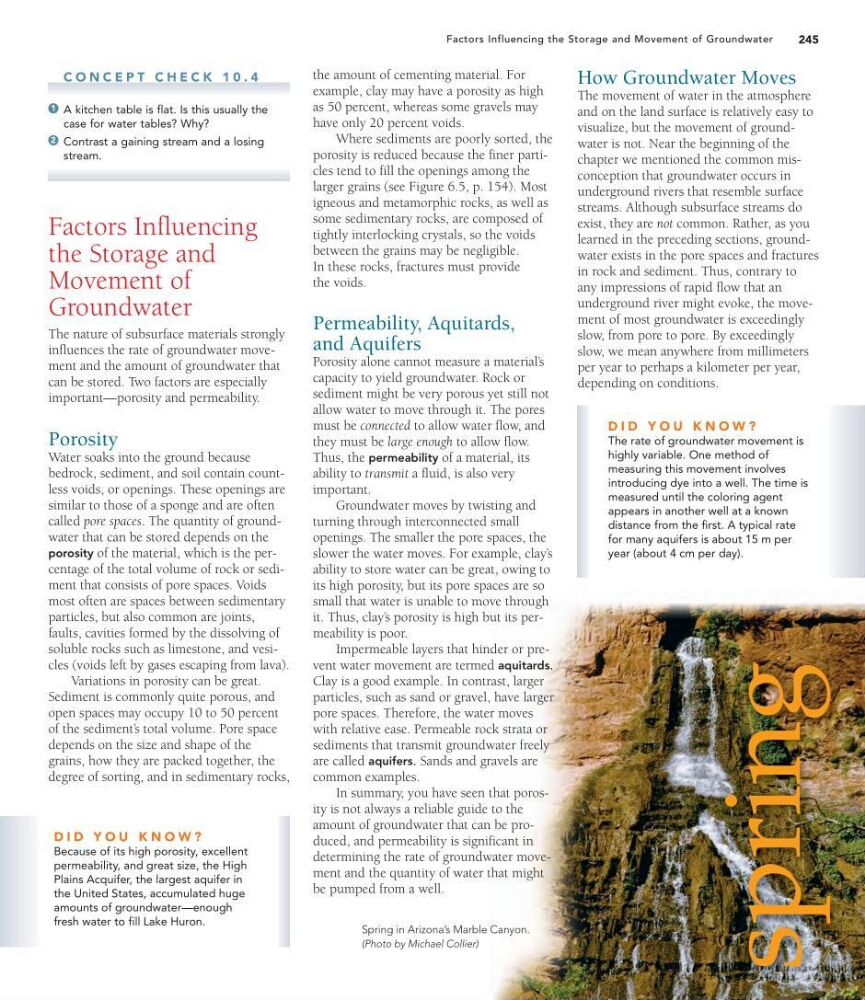
spring
245
Factors Influencing the Storage and Movement of Groundwater
C O N C E P T C H E C K 1 0 . 4
A kitchen table is flat. Is this usually the
case for water tables? Why?
Contrast a gaining stream and a losing
stream.
Factors Influencing
the Storage and
Movement of
Groundwater
The nature of subsurface materials strongly
influences the rate of groundwater movement and the amount of groundwater that
can be stored. Two factors are especially
important—porosity and permeability.
Porosity
Water soaks into the ground because
bedrock, sediment, and soil contain countless voids, or openings. These openings are
similar to those of a sponge and are often
called pore spaces. The quantity of groundwater that can be stored depends on the
porosity of the material, which is the percentage of the total volume of rock or sediment that consists of pore spaces. Voids
most often are spaces between sedimentary
particles, but also common are joints,
faults, cavities formed by the dissolving of
soluble rocks such as limestone, and vesicles (voids left by gases escaping from lava).
Variations in porosity can be great.
Sediment is commonly quite porous, and
open spaces may occupy 10 to 50 percent
of the sediment’ s total volume. Pore space
depends on the size and shape of the
grains, how they are packed together, the
degree of sorting, and in sedimentary rocks,
2
1
the amount of cementing material. For
example, clay may have a porosity as high
as 50 percent, whereas some gravels may
have only 20 percent voids.
Where sediments are poorly sorted, the
porosity is reduced because the finer particles tend to fill the openings among the
larger grains (see Figure 6.5, p. 154). Most
igneous and metamorphic rocks, as well as
some sedimentary rocks, are composed of
tightly interlocking crystals, so the voids
between the grains may be negligible.
In these rocks, fractures must provide
the voids.
Permeability, Aquitards,
and Aquifers
Porosity alone cannot measure a material’ s
capacity to yield groundwater. Rock or
sediment might be very porous yet still not
allow water to move through it. The pores
must be connected to allow water flow, and
they must be large enough to allow flow.
Thus, the permeability of a material, its
ability to transmit a fluid, is also very
important.
Groundwater moves by twisting and
turning through interconnected small
openings. The smaller the pore spaces, the
slower the water moves. For example, clay’ s
ability to store water can be great, owing to
its high porosity, but its pore spaces are so
small that water is unable to move through
it. Thus, clay’ s porosity is high but its permeability is poor.
Impermeable layers that hinder or prevent water movement are termed aquitards.
Clay is a good example. In contrast, larger
particles, such as sand or gravel, have larger
pore spaces. Therefore, the water moves
with relative ease. Permeable rock strata or
sediments that transmit groundwater freely
are called aquifers. Sands and gravels are
common examples.
In summary, you have seen that porosity is not always a reliable guide to the
amount of groundwater that can be produced, and permeability is significant in
determining the rate of groundwater movement and the quantity of water that might
be pumped from a well.
How Groundwater Moves
The movement of water in the atmosphere
and on the land surface is relatively easy to
visualize, but the movement of groundwater is not. Near the beginning of the
chapter we mentioned the common misconception that groundwater occurs in
underground rivers that resemble surface
streams. Although subsurface streams do
exist, they are not common. Rather, as you
learned in the preceding sections, groundwater exists in the pore spaces and fractures
in rock and sediment. Thus, contrary to
any impressions of rapid flow that an
underground river might evoke, the movement of most groundwater is exceedingly
slow, from pore to pore. By exceedingly
slow, we mean anywhere from millimeters
per year to perhaps a kilometer per year,
depending on conditions.
Spring in Arizona’s Marble Canyon.
(Photo by Michael Collier)
D I D Y O U K N O W ?
Because of its high porosity, excellent
permeability, and great size, the High
Plains Acquifer, the largest aquifer in
the United States, accumulated huge
amounts of groundwater—enough
fresh water to fill Lake Huron.
D I D Y O U K N O W ?
The rate of groundwater movement is
highly variable. One method of
measuring this movement involves
introducing dye into a well. The time is
measured until the coloring agent
appears in another well at a known
distance from the first. A typical rate
for many aquifers is about 15 m per
year (about 4 cm per day).
245
Factors Influencing the Storage and Movement of Groundwater
C O N C E P T C H E C K 1 0 . 4
A kitchen table is flat. Is this usually the
case for water tables? Why?
Contrast a gaining stream and a losing
stream.
Factors Influencing
the Storage and
Movement of
Groundwater
The nature of subsurface materials strongly
influences the rate of groundwater movement and the amount of groundwater that
can be stored. Two factors are especially
important—porosity and permeability.
Porosity
Water soaks into the ground because
bedrock, sediment, and soil contain countless voids, or openings. These openings are
similar to those of a sponge and are often
called pore spaces. The quantity of groundwater that can be stored depends on the
porosity of the material, which is the percentage of the total volume of rock or sediment that consists of pore spaces. Voids
most often are spaces between sedimentary
particles, but also common are joints,
faults, cavities formed by the dissolving of
soluble rocks such as limestone, and vesicles (voids left by gases escaping from lava).
Variations in porosity can be great.
Sediment is commonly quite porous, and
open spaces may occupy 10 to 50 percent
of the sediment’ s total volume. Pore space
depends on the size and shape of the
grains, how they are packed together, the
degree of sorting, and in sedimentary rocks,
2
1
the amount of cementing material. For
example, clay may have a porosity as high
as 50 percent, whereas some gravels may
have only 20 percent voids.
Where sediments are poorly sorted, the
porosity is reduced because the finer particles tend to fill the openings among the
larger grains (see Figure 6.5, p. 154). Most
igneous and metamorphic rocks, as well as
some sedimentary rocks, are composed of
tightly interlocking crystals, so the voids
between the grains may be negligible.
In these rocks, fractures must provide
the voids.
Permeability, Aquitards,
and Aquifers
Porosity alone cannot measure a material’ s
capacity to yield groundwater. Rock or
sediment might be very porous yet still not
allow water to move through it. The pores
must be connected to allow water flow, and
they must be large enough to allow flow.
Thus, the permeability of a material, its
ability to transmit a fluid, is also very
important.
Groundwater moves by twisting and
turning through interconnected small
openings. The smaller the pore spaces, the
slower the water moves. For example, clay’ s
ability to store water can be great, owing to
its high porosity, but its pore spaces are so
small that water is unable to move through
it. Thus, clay’ s porosity is high but its permeability is poor.
Impermeable layers that hinder or prevent water movement are termed aquitards.
Clay is a good example. In contrast, larger
particles, such as sand or gravel, have larger
pore spaces. Therefore, the water moves
with relative ease. Permeable rock strata or
sediments that transmit groundwater freely
are called aquifers. Sands and gravels are
common examples.
In summary, you have seen that porosity is not always a reliable guide to the
amount of groundwater that can be produced, and permeability is significant in
determining the rate of groundwater movement and the quantity of water that might
be pumped from a well.
How Groundwater Moves
The movement of water in the atmosphere
and on the land surface is relatively easy to
visualize, but the movement of groundwater is not. Near the beginning of the
chapter we mentioned the common misconception that groundwater occurs in
underground rivers that resemble surface
streams. Although subsurface streams do
exist, they are not common. Rather, as you
learned in the preceding sections, groundwater exists in the pore spaces and fractures
in rock and sediment. Thus, contrary to
any impressions of rapid flow that an
underground river might evoke, the movement of most groundwater is exceedingly
slow, from pore to pore. By exceedingly
slow, we mean anywhere from millimeters
per year to perhaps a kilometer per year,
depending on conditions.
Spring in Arizona’s Marble Canyon.
(Photo by Michael Collier)
D I D Y O U K N O W ?
Because of its high porosity, excellent
permeability, and great size, the High
Plains Acquifer, the largest aquifer in
the United States, accumulated huge
amounts of groundwater—enough
fresh water to fill Lake Huron.
D I D Y O U K N O W ?
The rate of groundwater movement is
highly variable. One method of
measuring this movement involves
introducing dye into a well. The time is
measured until the coloring agent
appears in another well at a known
distance from the first. A typical rate
for many aquifers is about 15 m per
year (about 4 cm per day).