

CHAPTER 10 Groundwater
242
Surface water
77%
270 billion gallons
per day
Groundwater
23%
79 billion gallons
per day
Sources of fresh
water in the
United States
Groundwater – Use by Category
Public supply
19.3%
Irrigation
68.4%
Thermoelectric 0.05%
Mining 0.92%
Aquaculture 1.3%
Livestock 1.3%
Industrial 4.3%
Domestic 4.2%
Per capita use (gallons)
Percent of daily use
20
15
10
5
30
25
20
15
10
5
Showers
& baths
Clothes
washers
Dishwashers
Toilets
Leaks
Faucets
Other uses
FIGURE 10.4 According to the American Water
Works Association, daily indoor per capita use in
an average single family home is 69.3 gallons. By
installing more efficient water fixtures and
regularly checking for leaks, households could
reduce this figure by about one third.
Groundwater—A Basic Resource
Water is basic to life. It has been called the “bloodstream” of both the biosphere and society.
Each day in the United States we use about 349 billion gallons of fresh water.* About
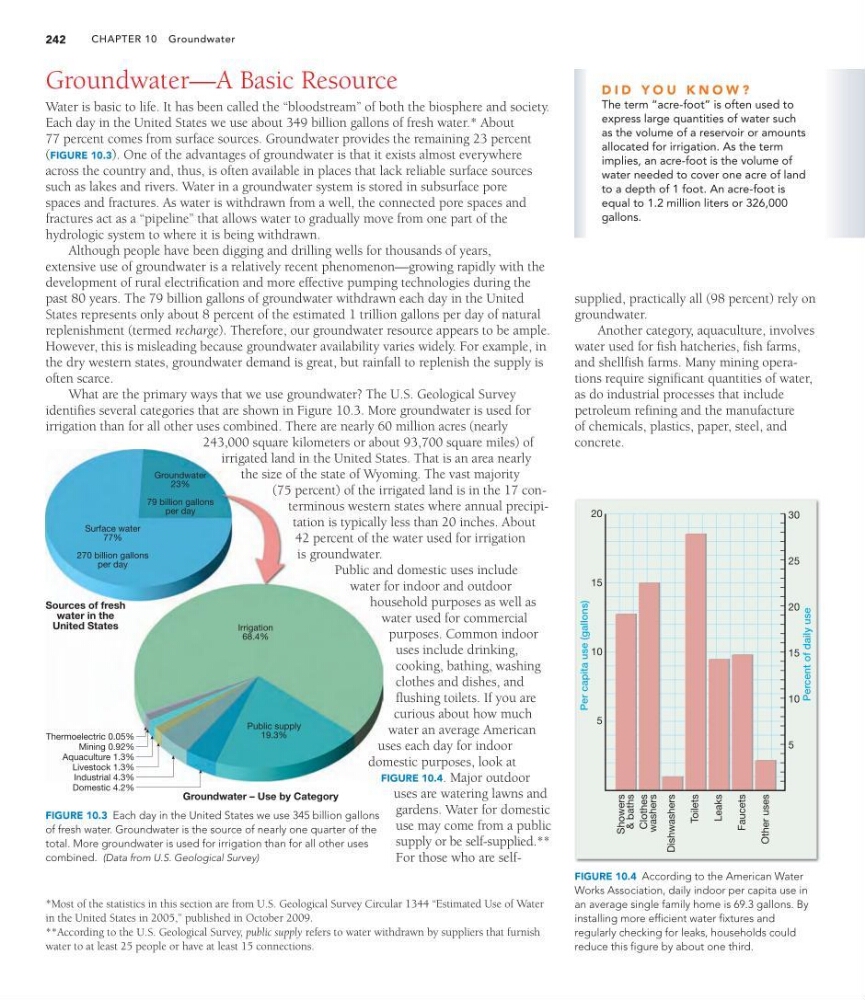
77 percent comes from surface sources. Groundwater provides the remaining 23 percent
(FIGURE 10.3). One of the advantages of groundwater is that it exists almost everywhere
across the country and, thus, is often available in places that lack reliable surface sources
such as lakes and rivers. Water in a groundwater system is stored in subsurface pore
spaces and fractures. As water is withdrawn from a well, the connected pore spaces and
fractures act as a “pipeline” that allows water to gradually move from one part of the
hydrologic system to where it is being withdrawn.
Although people have been digging and drilling wells for thousands of years,
extensive use of groundwater is a relatively recent phenomenon—growing rapidly with the
development of rural electrification and more effective pumping technologies during the
past 80 years. The 79 billion gallons of groundwater withdrawn each day in the United
States represents only about 8 percent of the estimated 1 trillion gallons per day of natural
replenishment (termed recharge). Therefore, our groundwater resource appears to be ample.
However, this is misleading because groundwater availability varies widely. For example, in
the dry western states, groundwater demand is great, but rainfall to replenish the supply is
often scarce.
What are the primary ways that we use groundwater? The U.S. Geological Survey
identifies several categories that are shown in Figure 10.3. More groundwater is used for
irrigation than for all other uses combined. There are nearly 60 million acres (nearly
243,000 square kilometers or about 93,700 square miles) of
irrigated land in the United States. That is an area nearly
the size of the state of Wyoming. The vast majority
(75 percent) of the irrigated land is in the 17 conterminous western states where annual precipitation is typically less than 20 inches. About
42 percent of the water used for irrigation
is groundwater.
Public and domestic uses include
water for indoor and outdoor
household purposes as well as
water used for commercial
purposes. Common indoor
uses include drinking,
cooking, bathing, washing
clothes and dishes, and
flushing toilets. If you are
curious about how much
water an average American
uses each day for indoor
domestic purposes, look at
FIGURE 10.4. Major outdoor
uses are watering lawns and
gardens. Water for domestic
use may come from a public
supply or be self-supplied.**
For those who are selfsupplied, practically all (98 percent) rely on
groundwater.
Another category, aquaculture, involves
water used for fish hatcheries, fish farms,
and shellfish farms. Many mining operations require significant quantities of water,
as do industrial processes that include
petroleum refining and the manufacture
of chemicals, plastics, paper, steel, and
concrete.
**According to the U.S. Geological Survey, public supply refers to water withdrawn by suppliers that furnish
water to at least 25 people or have at least 15 connections.
FIGURE 10.3 Each day in the United States we use 345 billion gallons
of fresh water. Groundwater is the source of nearly one quarter of the
total. More groundwater is used for irrigation than for all other uses
combined. (Data from U.S. Geological Survey)
*Most of the statistics in this section are from U.S. Geological Survey Circular 1344 “Estimated Use of Water
in the United States in 2005,” published in October 2009.
D I D Y O U K N O W ?
The term “acre-foot” is often used to
express large quantities of water such
as the volume of a reservoir or amounts
allocated for irrigation. As the term
implies, an acre-foot is the volume of
water needed to cover one acre of land
to a depth of 1 foot. An acre-foot is
equal to 1.2 million liters or 326,000
gallons.
242
Surface water
77%
270 billion gallons
per day
Groundwater
23%
79 billion gallons
per day
Sources of fresh
water in the
United States
Groundwater – Use by Category
Public supply
19.3%
Irrigation
68.4%
Thermoelectric 0.05%
Mining 0.92%
Aquaculture 1.3%
Livestock 1.3%
Industrial 4.3%
Domestic 4.2%
Per capita use (gallons)
Percent of daily use
20
15
10
5
30
25
20
15
10
5
Showers
& baths
Clothes
washers
Dishwashers
Toilets
Leaks
Faucets
Other uses
FIGURE 10.4 According to the American Water
Works Association, daily indoor per capita use in
an average single family home is 69.3 gallons. By
installing more efficient water fixtures and
regularly checking for leaks, households could
reduce this figure by about one third.
Groundwater—A Basic Resource
Water is basic to life. It has been called the “bloodstream” of both the biosphere and society.
Each day in the United States we use about 349 billion gallons of fresh water.* About
77 percent comes from surface sources. Groundwater provides the remaining 23 percent
(FIGURE 10.3). One of the advantages of groundwater is that it exists almost everywhere
across the country and, thus, is often available in places that lack reliable surface sources
such as lakes and rivers. Water in a groundwater system is stored in subsurface pore
spaces and fractures. As water is withdrawn from a well, the connected pore spaces and
fractures act as a “pipeline” that allows water to gradually move from one part of the
hydrologic system to where it is being withdrawn.
Although people have been digging and drilling wells for thousands of years,
extensive use of groundwater is a relatively recent phenomenon—growing rapidly with the
development of rural electrification and more effective pumping technologies during the
past 80 years. The 79 billion gallons of groundwater withdrawn each day in the United
States represents only about 8 percent of the estimated 1 trillion gallons per day of natural
replenishment (termed recharge). Therefore, our groundwater resource appears to be ample.
However, this is misleading because groundwater availability varies widely. For example, in
the dry western states, groundwater demand is great, but rainfall to replenish the supply is
often scarce.
What are the primary ways that we use groundwater? The U.S. Geological Survey
identifies several categories that are shown in Figure 10.3. More groundwater is used for
irrigation than for all other uses combined. There are nearly 60 million acres (nearly
243,000 square kilometers or about 93,700 square miles) of
irrigated land in the United States. That is an area nearly
the size of the state of Wyoming. The vast majority
(75 percent) of the irrigated land is in the 17 conterminous western states where annual precipitation is typically less than 20 inches. About
42 percent of the water used for irrigation
is groundwater.
Public and domestic uses include
water for indoor and outdoor
household purposes as well as
water used for commercial
purposes. Common indoor
uses include drinking,
cooking, bathing, washing
clothes and dishes, and
flushing toilets. If you are
curious about how much
water an average American
uses each day for indoor
domestic purposes, look at
FIGURE 10.4. Major outdoor
uses are watering lawns and
gardens. Water for domestic
use may come from a public
supply or be self-supplied.**
For those who are selfsupplied, practically all (98 percent) rely on
groundwater.
Another category, aquaculture, involves
water used for fish hatcheries, fish farms,
and shellfish farms. Many mining operations require significant quantities of water,
as do industrial processes that include
petroleum refining and the manufacture
of chemicals, plastics, paper, steel, and
concrete.
**According to the U.S. Geological Survey, public supply refers to water withdrawn by suppliers that furnish
water to at least 25 people or have at least 15 connections.
FIGURE 10.3 Each day in the United States we use 345 billion gallons
of fresh water. Groundwater is the source of nearly one quarter of the
total. More groundwater is used for irrigation than for all other uses
combined. (Data from U.S. Geological Survey)
*Most of the statistics in this section are from U.S. Geological Survey Circular 1344 “Estimated Use of Water
in the United States in 2005,” published in October 2009.
D I D Y O U K N O W ?
The term “acre-foot” is often used to
express large quantities of water such
as the volume of a reservoir or amounts
allocated for irrigation. As the term
implies, an acre-foot is the volume of
water needed to cover one acre of land
to a depth of 1 foot. An acre-foot is
equal to 1.2 million liters or 326,000
gallons.