

241
Importance of Groundwater
D I D Y O U K N O W ?
Although most caves and sinkholes are
associated with regions underlain by
limestone, these features can also form
in gypsum and rock salt (halite)
because these rocks are highly soluble
and readily dissolved.
reservoir of fresh water that is readily available
to humans. Its value in terms of economics
and human well-being is incalculable.
Geologically, groundwater is important
as an erosional agent. The dissolving action
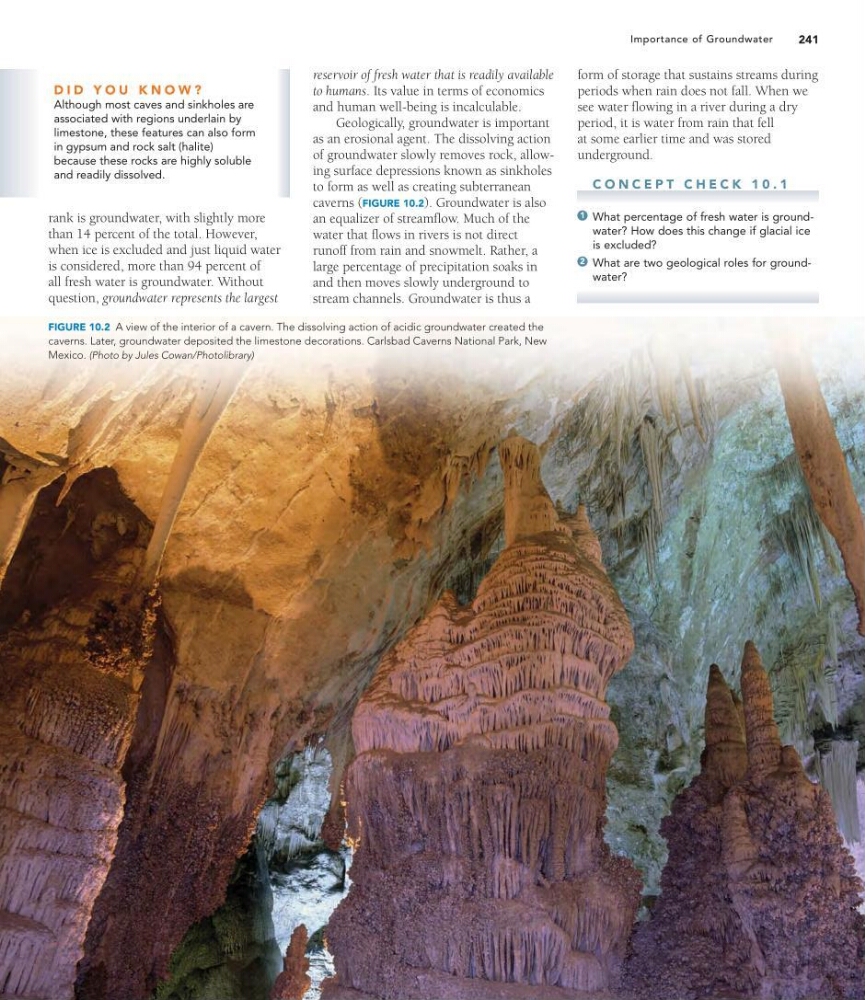
of groundwater slowly removes rock, allowing surface depressions known as sinkholes
to form as well as creating subterranean
caverns (FIGURE 10.2). Groundwater is also
an equalizer of streamflow. Much of the
water that flows in rivers is not direct
runoff from rain and snowmelt. Rather, a
large percentage of precipitation soaks in
and then moves slowly underground to
stream channels. Groundwater is thus a
form of storage that sustains streams during
periods when rain does not fall. When we
see water flowing in a river during a dry
period, it is water from rain that fell
at some earlier time and was stored
underground.
C O N C E P T C H E C K 1 0 . 1
What percentage of fresh water is groundwater? How does this change if glacial ice
is excluded?
What are two geological roles for groundwater?
2
1
FIGURE 10.2 A view of the interior of a cavern. The dissolving action of acidic groundwater created the
caverns. Later, groundwater deposited the limestone decorations. Carlsbad Caverns National Park, New
Mexico. (Photo by Jules Cowan/Photolibrary)
rank is groundwater, with slightly more
than 14 percent of the total. However,
when ice is excluded and just liquid water
is considered, more than 94 percent of
all fresh water is groundwater. Without
question, groundwater represents the largest
Importance of Groundwater
D I D Y O U K N O W ?
Although most caves and sinkholes are
associated with regions underlain by
limestone, these features can also form
in gypsum and rock salt (halite)
because these rocks are highly soluble
and readily dissolved.
reservoir of fresh water that is readily available
to humans. Its value in terms of economics
and human well-being is incalculable.
Geologically, groundwater is important
as an erosional agent. The dissolving action
of groundwater slowly removes rock, allowing surface depressions known as sinkholes
to form as well as creating subterranean
caverns (FIGURE 10.2). Groundwater is also
an equalizer of streamflow. Much of the
water that flows in rivers is not direct
runoff from rain and snowmelt. Rather, a
large percentage of precipitation soaks in
and then moves slowly underground to
stream channels. Groundwater is thus a
form of storage that sustains streams during
periods when rain does not fall. When we
see water flowing in a river during a dry
period, it is water from rain that fell
at some earlier time and was stored
underground.
C O N C E P T C H E C K 1 0 . 1
What percentage of fresh water is groundwater? How does this change if glacial ice
is excluded?
What are two geological roles for groundwater?
2
1
FIGURE 10.2 A view of the interior of a cavern. The dissolving action of acidic groundwater created the
caverns. Later, groundwater deposited the limestone decorations. Carlsbad Caverns National Park, New
Mexico. (Photo by Jules Cowan/Photolibrary)
rank is groundwater, with slightly more
than 14 percent of the total. However,
when ice is excluded and just liquid water
is considered, more than 94 percent of
all fresh water is groundwater. Without
question, groundwater represents the largest