

227
Base Level and Graded Streams
C O N C E P T C H E C K 9 . 5
Are bedrock channels more likely to be
found near the head or near the mouth
of a stream?
Describe or sketch the evolution of a
meander, including how an oxbow lake
forms.
Describe a situation that might cause a
stream channel to become braided.
Base Level and
Graded Streams
In 1875 John Wesley Powell, the pioneering
geologist who first explored the Grand
Canyon and later headed the U.S. Geological Survey, introduced the concept of a
downward limit to stream erosion, which he
called base level. A fundamental concept in
the study of stream activity, base level is
defined as the lowest elevation to which a
stream can erode its channel. Essentially
this is the level at which the mouth of a
stream enters the ocean, a lake, or a trunk
stream. Powell determined that two types of
base level exist: “We may consider the level
of the sea to be a grand base level, below
which the dry lands cannot be eroded; but
we may also have, for local and temporary
purposes, other base levels of erosion.”*
Sea level, which Powell called “grand
base level,” is now referred to as ultimate
base level. Local or temporary base levels
include lakes, resistant layers of rock, and
rivers that act as base levels for their tributaries. All limit a stream’ s ability to downcut
its channel.
Changes in base level cause
corresponding adjustments in the “work”
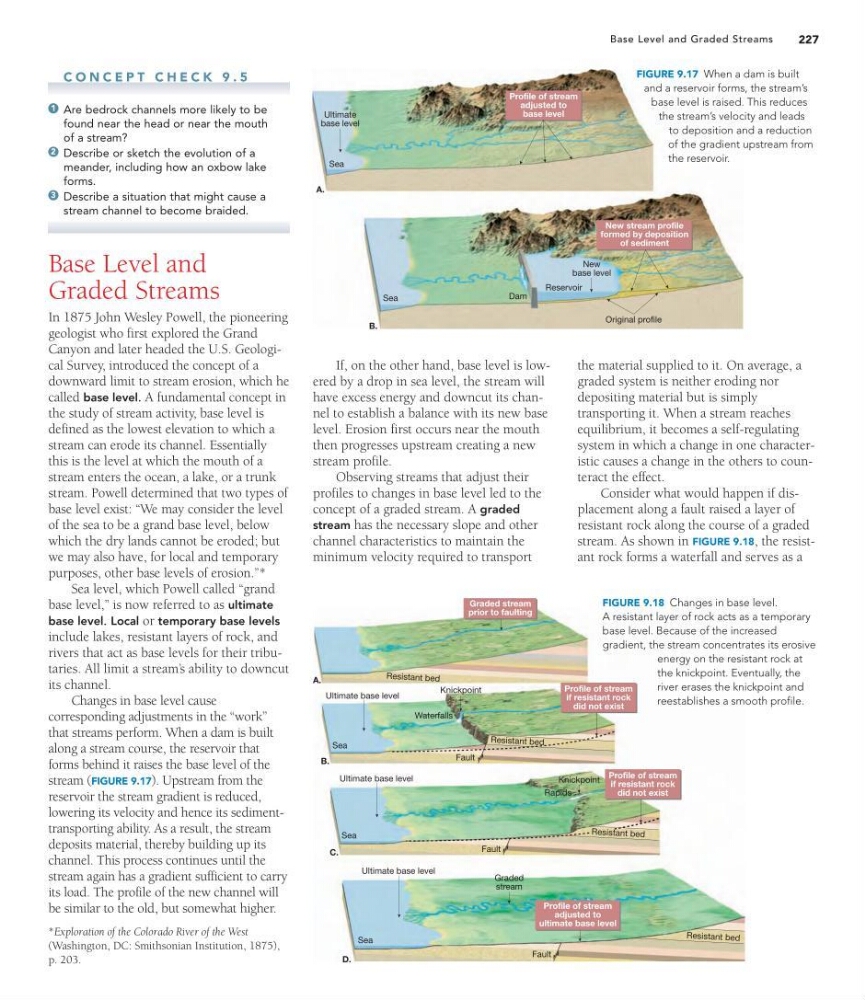
that streams perform. When a dam is built
along a stream course, the reservoir that
forms behind it raises the base level of the
stream (FIGURE 9.17). Upstream from the
reservoir the stream gradient is reduced,
lowering its velocity and hence its sedimenttransporting ability. As a result, the stream
deposits material, thereby building up its
channel. This process continues until the
stream again has a gradient sufficient to carry
its load. The profile of the new channel will
be similar to the old, but somewhat higher.
3
2
1
If, on the other hand, base level is lowered by a drop in sea level, the stream will
have excess energy and downcut its channel to establish a balance with its new base
level. Erosion first occurs near the mouth
then progresses upstream creating a new
stream profile.
Observing streams that adjust their
profiles to changes in base level led to the
concept of a graded stream. A graded
stream has the necessary slope and other
channel characteristics to maintain the
minimum velocity required to transport
the material supplied to it. On average, a
graded system is neither eroding nor
depositing material but is simply
transporting it. When a stream reaches
equilibrium, it becomes a self-regulating
system in which a change in one characteristic causes a change in the others to counteract the effect.
Consider what would happen if displacement along a fault raised a layer of
resistant rock along the course of a graded
stream. As shown in FIGURE 9.18, the resistant rock forms a waterfall and serves as a
Dam
Original profile
New stream profile
formed by deposition
of sediment
Sea
Sea
Ultimate
base level
Profile of stream
adjusted to
base level
Reservoir
New
base level
A.
B.
FIGURE 9.17 When a dam is built
and a reservoir forms, the stream’s
base level is raised. This reduces
the stream’s velocity and leads
to deposition and a reduction
of the gradient upstream from
the reservoir.
Profile of stream
if resistant rock
did not exist
Profile of stream
if resistant rock
did not exist
Resista nt bed
Resista nt bed
Knickpoint
Knickpoint
Waterfalls
Ultimate base level
B.
A.
C.
D.
Graded stream
prior to faulting
Graded
stream
Rapids
Fault
Fault
Fault
Resista nt bed
Sea
Profile of stream
adjusted to
ultimate base level
Sea
Resista nt bed
Sea
Ultimate base level
Ultimate base level
FIGURE 9.18 Changes in base level.
A resistant layer of rock acts as a temporary
base level. Because of the increased
gradient, the stream concentrates its erosive
energy on the resistant rock at
the knickpoint. Eventually, the
river erases the knickpoint and
reestablishes a smooth profile.
*Exploration of the Colorado River of the West
(Washington, DC: Smithsonian Institution, 1875),
p. 203.
Base Level and Graded Streams
C O N C E P T C H E C K 9 . 5
Are bedrock channels more likely to be
found near the head or near the mouth
of a stream?
Describe or sketch the evolution of a
meander, including how an oxbow lake
forms.
Describe a situation that might cause a
stream channel to become braided.
Base Level and
Graded Streams
In 1875 John Wesley Powell, the pioneering
geologist who first explored the Grand
Canyon and later headed the U.S. Geological Survey, introduced the concept of a
downward limit to stream erosion, which he
called base level. A fundamental concept in
the study of stream activity, base level is
defined as the lowest elevation to which a
stream can erode its channel. Essentially
this is the level at which the mouth of a
stream enters the ocean, a lake, or a trunk
stream. Powell determined that two types of
base level exist: “We may consider the level
of the sea to be a grand base level, below
which the dry lands cannot be eroded; but
we may also have, for local and temporary
purposes, other base levels of erosion.”*
Sea level, which Powell called “grand
base level,” is now referred to as ultimate
base level. Local or temporary base levels
include lakes, resistant layers of rock, and
rivers that act as base levels for their tributaries. All limit a stream’ s ability to downcut
its channel.
Changes in base level cause
corresponding adjustments in the “work”
that streams perform. When a dam is built
along a stream course, the reservoir that
forms behind it raises the base level of the
stream (FIGURE 9.17). Upstream from the
reservoir the stream gradient is reduced,
lowering its velocity and hence its sedimenttransporting ability. As a result, the stream
deposits material, thereby building up its
channel. This process continues until the
stream again has a gradient sufficient to carry
its load. The profile of the new channel will
be similar to the old, but somewhat higher.
3
2
1
If, on the other hand, base level is lowered by a drop in sea level, the stream will
have excess energy and downcut its channel to establish a balance with its new base
level. Erosion first occurs near the mouth
then progresses upstream creating a new
stream profile.
Observing streams that adjust their
profiles to changes in base level led to the
concept of a graded stream. A graded
stream has the necessary slope and other
channel characteristics to maintain the
minimum velocity required to transport
the material supplied to it. On average, a
graded system is neither eroding nor
depositing material but is simply
transporting it. When a stream reaches
equilibrium, it becomes a self-regulating
system in which a change in one characteristic causes a change in the others to counteract the effect.
Consider what would happen if displacement along a fault raised a layer of
resistant rock along the course of a graded
stream. As shown in FIGURE 9.18, the resistant rock forms a waterfall and serves as a
Dam
Original profile
New stream profile
formed by deposition
of sediment
Sea
Sea
Ultimate
base level
Profile of stream
adjusted to
base level
Reservoir
New
base level
A.
B.
FIGURE 9.17 When a dam is built
and a reservoir forms, the stream’s
base level is raised. This reduces
the stream’s velocity and leads
to deposition and a reduction
of the gradient upstream from
the reservoir.
Profile of stream
if resistant rock
did not exist
Profile of stream
if resistant rock
did not exist
Resista nt bed
Resista nt bed
Knickpoint
Knickpoint
Waterfalls
Ultimate base level
B.
A.
C.
D.
Graded stream
prior to faulting
Graded
stream
Rapids
Fault
Fault
Fault
Resista nt bed
Sea
Profile of stream
adjusted to
ultimate base level
Sea
Resista nt bed
Sea
Ultimate base level
Ultimate base level
FIGURE 9.18 Changes in base level.
A resistant layer of rock acts as a temporary
base level. Because of the increased
gradient, the stream concentrates its erosive
energy on the resistant rock at
the knickpoint. Eventually, the
river erases the knickpoint and
reestablishes a smooth profile.
*Exploration of the Colorado River of the West
(Washington, DC: Smithsonian Institution, 1875),
p. 203.