

Geologist’s Sketch
Braided
stream
Bars
Green River, WY
Geologist’s Sketch
Meanders
Before the
formation
of a
cutoff
After the
formation
of a
cutoff
Cutoff
Neck
Oxbow lake
material. This allows the next meander upstream
to gradually erode the material between the two
meanders as shown in FIGURE 9.15. Eventually,
the river may erode through the narrow neck of
land forming a new, shorter channel segment
called a cutoff. Because of its shape, the
abandoned bend is called an oxbow lake.
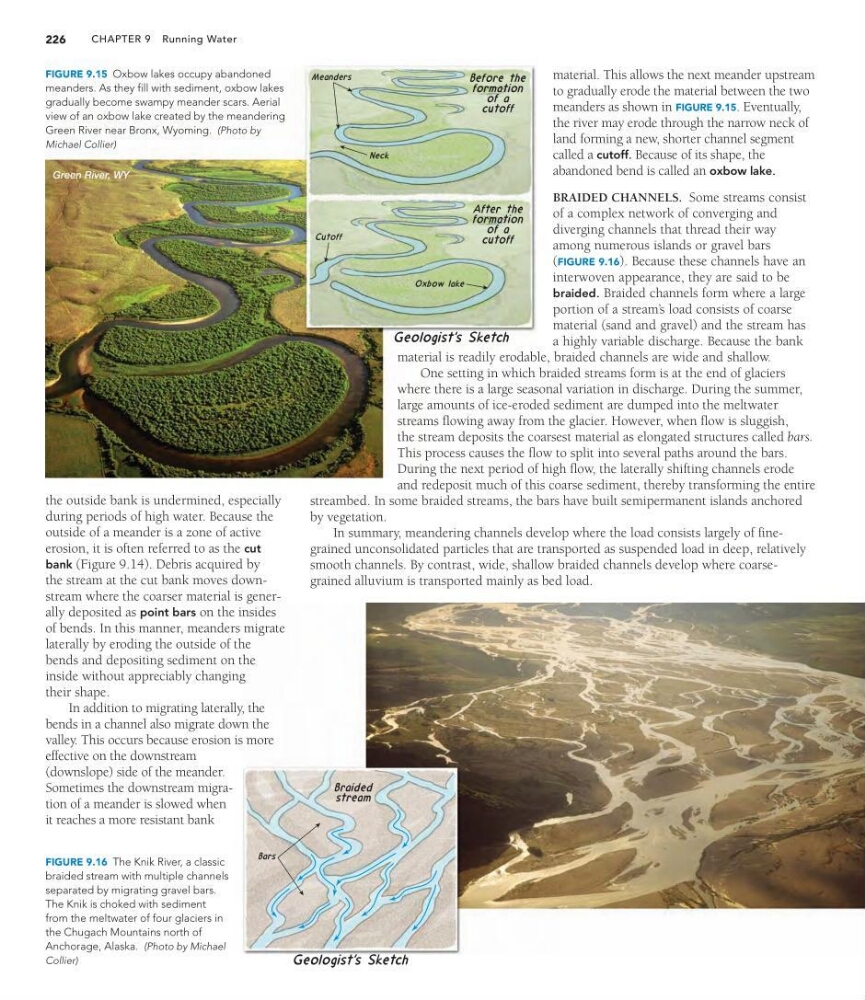
BRAIDED CHANNELS. Some streams consist
of a complex network of converging and
diverging channels that thread their way
among numerous islands or gravel bars
(FIGURE 9.16). Because these channels have an
interwoven appearance, they are said to be
braided. Braided channels form where a large
portion of a stream’ s load consists of coarse
material (sand and gravel) and the stream has
a highly variable discharge. Because the bank
material is readily erodable, braided channels are wide and shallow.
One setting in which braided streams form is at the end of glaciers
where there is a large seasonal variation in discharge. During the summer,
large amounts of ice-eroded sediment are dumped into the meltwater
streams flowing away from the glacier. However, when flow is sluggish,
the stream deposits the coarsest material as elongated structures called bars.
This process causes the flow to split into several paths around the bars.
During the next period of high flow, the laterally shifting channels erode
and redeposit much of this coarse sediment, thereby transforming the entire
streambed. In some braided streams, the bars have built semipermanent islands anchored
by vegetation.
In summary, meandering channels develop where the load consists largely of finegrained unconsolidated particles that are transported as suspended load in deep, relatively
smooth channels. By contrast, wide, shallow braided channels develop where coarsegrained alluvium is transported mainly as bed load.
CHAPTER 9 Running Water
226
the outside bank is undermined, especially
during periods of high water. Because the
outside of a meander is a zone of active
erosion, it is often referred to as the cut
bank (Figure 9.14). Debris acquired by
the stream at the cut bank moves downstream where the coarser material is generally deposited as point bars on the insides
of bends. In this manner, meanders migrate
laterally by eroding the outside of the
bends and depositing sediment on the
inside without appreciably changing
their shape.
In addition to migrating laterally, the
bends in a channel also migrate down the
valley. This occurs because erosion is more
effective on the downstream
(downslope) side of the meander.
Sometimes the downstream migration of a meander is slowed when
it reaches a more resistant bank
FIGURE 9.15 Oxbow lakes occupy abandoned
meanders. As they fill with sediment, oxbow lakes
gradually become swampy meander scars. Aerial
view of an oxbow lake created by the meandering
Green River near Bronx, Wyoming. (Photo by
Michael Collier)
FIGURE 9.16 The Knik River, a classic
braided stream with multiple channels
separated by migrating gravel bars.
The Knik is choked with sediment
from the meltwater of four glaciers in
the Chugach Mountains north of
Anchorage, Alaska. (Photo by Michael
Collier)
Braided
stream
Bars
Green River, WY
Geologist’s Sketch
Meanders
Before the
formation
of a
cutoff
After the
formation
of a
cutoff
Cutoff
Neck
Oxbow lake
material. This allows the next meander upstream
to gradually erode the material between the two
meanders as shown in FIGURE 9.15. Eventually,
the river may erode through the narrow neck of
land forming a new, shorter channel segment
called a cutoff. Because of its shape, the
abandoned bend is called an oxbow lake.
BRAIDED CHANNELS. Some streams consist
of a complex network of converging and
diverging channels that thread their way
among numerous islands or gravel bars
(FIGURE 9.16). Because these channels have an
interwoven appearance, they are said to be
braided. Braided channels form where a large
portion of a stream’ s load consists of coarse
material (sand and gravel) and the stream has
a highly variable discharge. Because the bank
material is readily erodable, braided channels are wide and shallow.
One setting in which braided streams form is at the end of glaciers
where there is a large seasonal variation in discharge. During the summer,
large amounts of ice-eroded sediment are dumped into the meltwater
streams flowing away from the glacier. However, when flow is sluggish,
the stream deposits the coarsest material as elongated structures called bars.
This process causes the flow to split into several paths around the bars.
During the next period of high flow, the laterally shifting channels erode
and redeposit much of this coarse sediment, thereby transforming the entire
streambed. In some braided streams, the bars have built semipermanent islands anchored
by vegetation.
In summary, meandering channels develop where the load consists largely of finegrained unconsolidated particles that are transported as suspended load in deep, relatively
smooth channels. By contrast, wide, shallow braided channels develop where coarsegrained alluvium is transported mainly as bed load.
CHAPTER 9 Running Water
226
the outside bank is undermined, especially
during periods of high water. Because the
outside of a meander is a zone of active
erosion, it is often referred to as the cut
bank (Figure 9.14). Debris acquired by
the stream at the cut bank moves downstream where the coarser material is generally deposited as point bars on the insides
of bends. In this manner, meanders migrate
laterally by eroding the outside of the
bends and depositing sediment on the
inside without appreciably changing
their shape.
In addition to migrating laterally, the
bends in a channel also migrate down the
valley. This occurs because erosion is more
effective on the downstream
(downslope) side of the meander.
Sometimes the downstream migration of a meander is slowed when
it reaches a more resistant bank
FIGURE 9.15 Oxbow lakes occupy abandoned
meanders. As they fill with sediment, oxbow lakes
gradually become swampy meander scars. Aerial
view of an oxbow lake created by the meandering
Green River near Bronx, Wyoming. (Photo by
Michael Collier)
FIGURE 9.16 The Knik River, a classic
braided stream with multiple channels
separated by migrating gravel bars.
The Knik is choked with sediment
from the meltwater of four glaciers in
the Chugach Mountains north of
Anchorage, Alaska. (Photo by Michael
Collier)