

Deposition
of point bar
Point bar
Cut bank
Point bar
Maximum
velocity
Maximum
velocity
Maximum
velocity
Erosion of
cut bank
Erosion of
cut bank
225
Stream Channels
rock. In contrast, when the bed and banks
are composed mainly of unconsolidated
sediment or alluvium, the channel is called
an alluvial channel.
Bedrock Channels
As the name suggests, bedrock channels
are cut into the underlying strata and
typically form in the headwaters of river
systems where streams have steep slopes.
The energetic flow tends to transport coarse
particles that actively abrade the bedrock
channel. Potholes are often visible evidence
of the erosional forces at work.
Steep bedrock channels often develop a
sequence of pools and steps, relatively flat
segments (pools) where alluvium tends to
accumulate, and steep segments (steps)
where bedrock is exposed. The steep areas
contain rapids or, occasionally, waterfalls.
The channel pattern exhibited by
streams cutting into bedrock is controlled
by the underlying geologic structure. Even
when flowing over rather uniform bedrock,
streams tend to exhibit winding or irregular
patterns rather than flowing in straight
channels. Anyone who has gone whitewater rafting has observed the steep,
winding nature of a stream flowing in a
bedrock channel.
Alluvial Channels
Alluvial channels form in sediment that was
previously deposited in the valley. When
the valley floor reaches sufficient width,
material deposited by the stream can form
a floodplain that borders the channel.
Because the banks and beds of alluvial
channels are composed of unconsolidated
sediment (alluvium) they can undergo
major changes in shape as material is
continually being eroded, transported, and
redeposited. The major factors affecting
the shapes of these channels are the average
size of the sediment being transported,
the channel’ s gradient, and discharge.
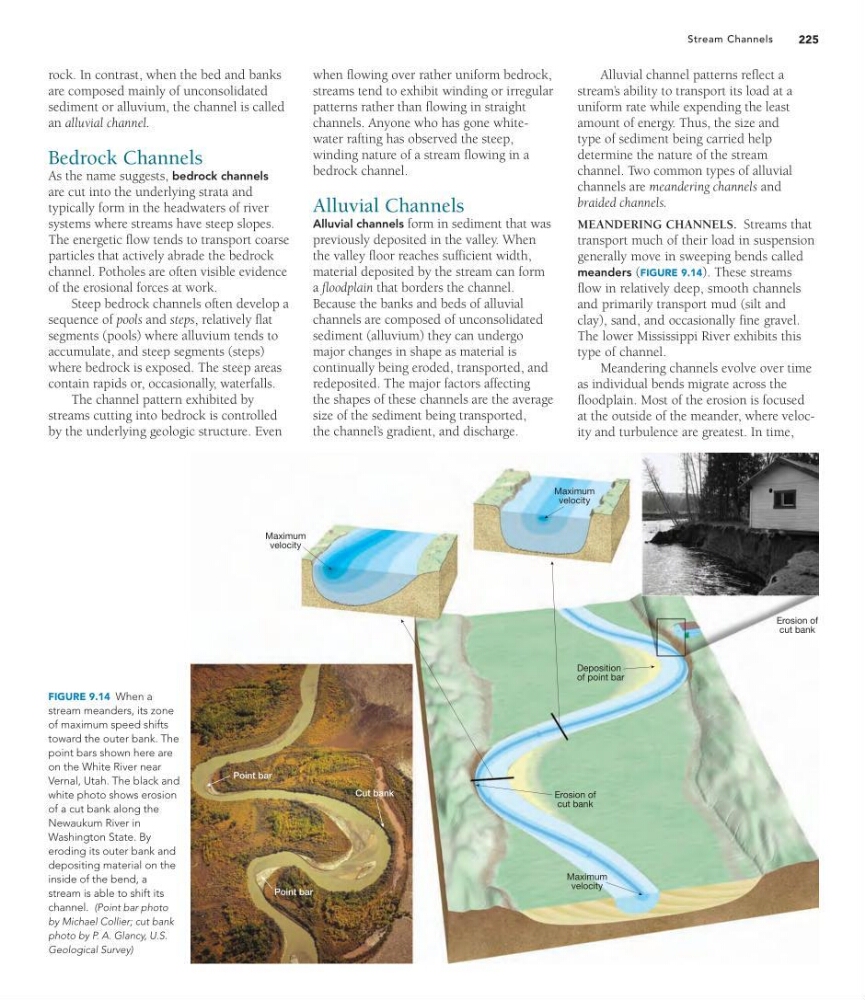
FIGURE 9.14 When a
stream meanders, its zone
of maximum speed shifts
toward the outer bank. The
point bars shown here are
on the White River near
Vernal, Utah. The black and
white photo shows erosion
of a cut bank along the
Newaukum River in
Washington State. By
eroding its outer bank and
depositing material on the
inside of the bend, a
stream is able to shift its
channel. (Point bar photo
by Michael Collier; cut bank
photo by P. A. Glancy, U.S.
Geological Survey)
Alluvial channel patterns reflect a
stream’ s ability to transport its load at a
uniform rate while expending the least
amount of energy. Thus, the size and
type of sediment being carried help
determine the nature of the stream
channel. Two common types of alluvial
channels are meandering channels and
braided channels.
MEANDERING CHANNELS. Streams that
transport much of their load in suspension
generally move in sweeping bends called
meanders (FIGURE 9.14). These streams
flow in relatively deep, smooth channels
and primarily transport mud (silt and
clay), sand, and occasionally fine gravel.
The lower Mississippi River exhibits this
type of channel.
Meandering channels evolve over time
as individual bends migrate across the
floodplain. Most of the erosion is focused
at the outside of the meander, where velocity and turbulence are greatest. In time,
of point bar
Point bar
Cut bank
Point bar
Maximum
velocity
Maximum
velocity
Maximum
velocity
Erosion of
cut bank
Erosion of
cut bank
225
Stream Channels
rock. In contrast, when the bed and banks
are composed mainly of unconsolidated
sediment or alluvium, the channel is called
an alluvial channel.
Bedrock Channels
As the name suggests, bedrock channels
are cut into the underlying strata and
typically form in the headwaters of river
systems where streams have steep slopes.
The energetic flow tends to transport coarse
particles that actively abrade the bedrock
channel. Potholes are often visible evidence
of the erosional forces at work.
Steep bedrock channels often develop a
sequence of pools and steps, relatively flat
segments (pools) where alluvium tends to
accumulate, and steep segments (steps)
where bedrock is exposed. The steep areas
contain rapids or, occasionally, waterfalls.
The channel pattern exhibited by
streams cutting into bedrock is controlled
by the underlying geologic structure. Even
when flowing over rather uniform bedrock,
streams tend to exhibit winding or irregular
patterns rather than flowing in straight
channels. Anyone who has gone whitewater rafting has observed the steep,
winding nature of a stream flowing in a
bedrock channel.
Alluvial Channels
Alluvial channels form in sediment that was
previously deposited in the valley. When
the valley floor reaches sufficient width,
material deposited by the stream can form
a floodplain that borders the channel.
Because the banks and beds of alluvial
channels are composed of unconsolidated
sediment (alluvium) they can undergo
major changes in shape as material is
continually being eroded, transported, and
redeposited. The major factors affecting
the shapes of these channels are the average
size of the sediment being transported,
the channel’ s gradient, and discharge.
FIGURE 9.14 When a
stream meanders, its zone
of maximum speed shifts
toward the outer bank. The
point bars shown here are
on the White River near
Vernal, Utah. The black and
white photo shows erosion
of a cut bank along the
Newaukum River in
Washington State. By
eroding its outer bank and
depositing material on the
inside of the bend, a
stream is able to shift its
channel. (Point bar photo
by Michael Collier; cut bank
photo by P. A. Glancy, U.S.
Geological Survey)
Alluvial channel patterns reflect a
stream’ s ability to transport its load at a
uniform rate while expending the least
amount of energy. Thus, the size and
type of sediment being carried help
determine the nature of the stream
channel. Two common types of alluvial
channels are meandering channels and
braided channels.
MEANDERING CHANNELS. Streams that
transport much of their load in suspension
generally move in sweeping bends called
meanders (FIGURE 9.14). These streams
flow in relatively deep, smooth channels
and primarily transport mud (silt and
clay), sand, and occasionally fine gravel.
The lower Mississippi River exhibits this
type of channel.
Meandering channels evolve over time
as individual bends migrate across the
floodplain. Most of the erosion is focused
at the outside of the meander, where velocity and turbulence are greatest. In time,