

reservoir
into the flow. In addition, the
individual sediment grains are
also abraded by their many
impacts with the channel and
with one another. Thus, by
scraping, rubbing, and bumping, abrasion erodes a bedrock
channel and simultaneously
smoothes and rounds the
abrading particles. That is why
smooth, rounded rocks and
pebbles are found in streams.
Abrasion also results in a
reduction in the size of the sediments transported by streams.
Features common to some bedrock channels are circular depressions known as potholes
created by the abrasive action of particles swirling in fast-moving eddies (FIGURE 9.11). The
rotational motion of sand and pebbles acts like a drill to bore the holes. As the particles wear
down to nothing, they are replaced by new ones that continue to drill the stream bed. Eventually, smooth depressions several meters across and deep may result.
Transport of Sediment by Streams
All streams, regardless of size, transport some rock
material (FIGURE 9.12). Streams also sort the solid
sediment they transport because finer, lighter material is carried more readily than larger, heavier particles. Streams transport their load of sediment in
three ways: (1) in solution (dissolved load), (2) in
suspension (suspended load), and (3) sliding or
rolling along the bottom (bed load).
DISSOLVED LOAD. Most of the dissolved load is
brought to a stream by groundwater and is dispersed throughout the flow. When water percolates through the ground, it acquires soluble soil
compounds. Then it seeps through cracks and
pores in bedrock, dissolving additional mineral
matter. Eventually much of this mineral-rich
water finds its way into streams.
The velocity of streamflow has essentially no
effect on a stream’ s ability to carry its dissolved
load—material in the solution goes wherever the
stream goes. Precipitation of the dissolved mineral matter occurs when the chemistry of the
water changes or when the water enters an
inland “sea,” located in an arid climate where the
rate of evaporation is high.
SUSPENDED LOAD. Most streams carry the
largest part of their load in suspension. Indeed,
the muddy appearance created by suspended
sediment is the most obvious portion of a
stream’ s load (FIGURE 9.13). Usually only very
fine sand, silt, and clay particles are carried
this way, but during flood stage larger particles
can also be transported in suspension. During
223
The Work of Running Water
which in time can evolve into larger gullies
(see Figure 5.23 on p. 142).
Once flow is confined in a channel, the
erosional power of a stream is related to its
slope and discharge. The rate of erosion,
however, is also dependent on the relative
resistance of the bank and bed material. In
general, channels composed of unconsolidated materials are more easily eroded than
channels cut into bedrock.
When the channel is sandy, the particles are easily dislodged from the bed and
banks and lifted into the moving water.
Moreover, banks consisting of sandy material are often undercut, dumping even more
loose debris into the water to be carried
downstream. Banks that consist of coarse
gravels or cohesive clay and silt particles
tend to be relatively resistant to erosion.
Thus, channels with cohesive silty banks
are generally more narrow than comparable
ones with sandy banks.
Streams cut channels into bedrock
through quarrying and abrasion. Quarrying
involves the removal of blocks from the bed
of the channel. This process is aided by
fracturing and weathering that loosen the
blocks sufficiently so they are moveable
during times of high flow rates. Quarrying
is mainly the result of the impact forces
exerted by flowing water.
Abrasion is the process by which the
bed and banks of a bedrock channel are
ceaselessly bombarded by particles carried
FIGURE 9.11 Potholes in the bed of a stream.
The rotational motion of swirling pebbles acts like
a drill to create potholes. (Photo by Elmari
Joubert/Alamy)
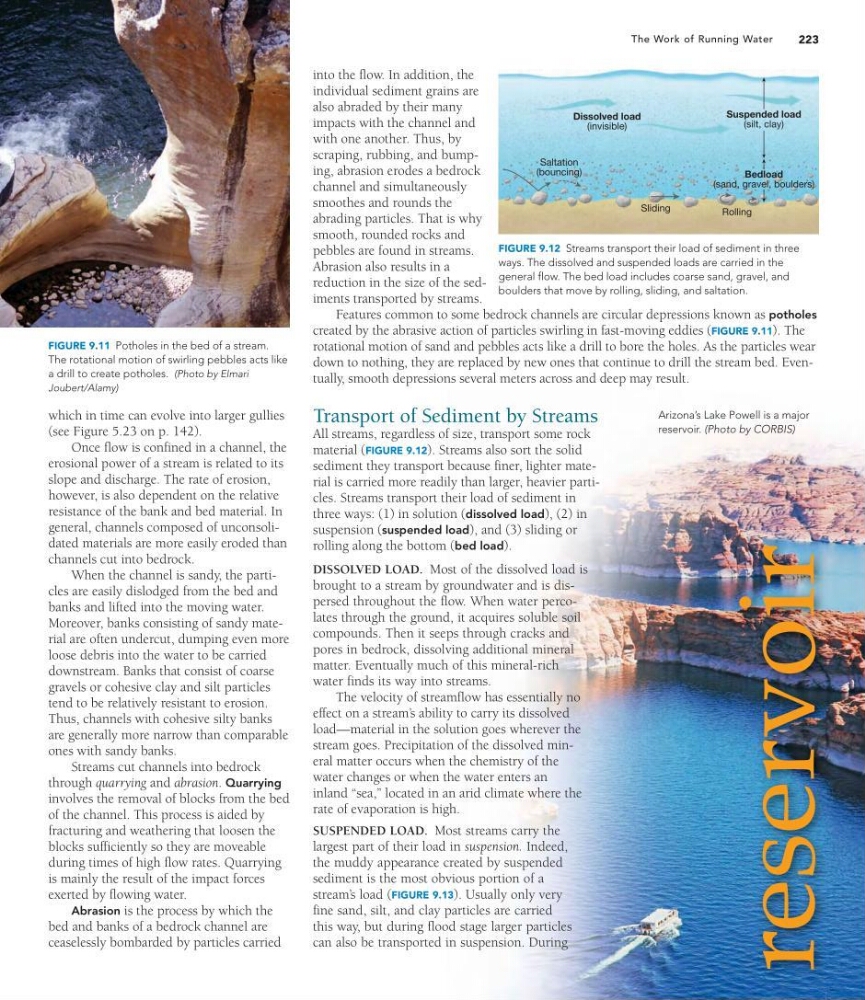
Arizona’s Lake Powell is a major
reservoir. (Photo by CORBIS)
Dissolved load
(invisible)
Rolling
Saltation
(bouncing)
Bedload
(sand, gravel, boulders)
Suspended load
(silt, clay)
Sliding
FIGURE 9.12 Streams transport their load of sediment in three
ways. The dissolved and suspended loads are carried in the
general flow. The bed load includes coarse sand, gravel, and
boulders that move by rolling, sliding, and saltation.
into the flow. In addition, the
individual sediment grains are
also abraded by their many
impacts with the channel and
with one another. Thus, by
scraping, rubbing, and bumping, abrasion erodes a bedrock
channel and simultaneously
smoothes and rounds the
abrading particles. That is why
smooth, rounded rocks and
pebbles are found in streams.
Abrasion also results in a
reduction in the size of the sediments transported by streams.
Features common to some bedrock channels are circular depressions known as potholes
created by the abrasive action of particles swirling in fast-moving eddies (FIGURE 9.11). The
rotational motion of sand and pebbles acts like a drill to bore the holes. As the particles wear
down to nothing, they are replaced by new ones that continue to drill the stream bed. Eventually, smooth depressions several meters across and deep may result.
Transport of Sediment by Streams
All streams, regardless of size, transport some rock
material (FIGURE 9.12). Streams also sort the solid
sediment they transport because finer, lighter material is carried more readily than larger, heavier particles. Streams transport their load of sediment in
three ways: (1) in solution (dissolved load), (2) in
suspension (suspended load), and (3) sliding or
rolling along the bottom (bed load).
DISSOLVED LOAD. Most of the dissolved load is
brought to a stream by groundwater and is dispersed throughout the flow. When water percolates through the ground, it acquires soluble soil
compounds. Then it seeps through cracks and
pores in bedrock, dissolving additional mineral
matter. Eventually much of this mineral-rich
water finds its way into streams.
The velocity of streamflow has essentially no
effect on a stream’ s ability to carry its dissolved
load—material in the solution goes wherever the
stream goes. Precipitation of the dissolved mineral matter occurs when the chemistry of the
water changes or when the water enters an
inland “sea,” located in an arid climate where the
rate of evaporation is high.
SUSPENDED LOAD. Most streams carry the
largest part of their load in suspension. Indeed,
the muddy appearance created by suspended
sediment is the most obvious portion of a
stream’ s load (FIGURE 9.13). Usually only very
fine sand, silt, and clay particles are carried
this way, but during flood stage larger particles
can also be transported in suspension. During
223
The Work of Running Water
which in time can evolve into larger gullies
(see Figure 5.23 on p. 142).
Once flow is confined in a channel, the
erosional power of a stream is related to its
slope and discharge. The rate of erosion,
however, is also dependent on the relative
resistance of the bank and bed material. In
general, channels composed of unconsolidated materials are more easily eroded than
channels cut into bedrock.
When the channel is sandy, the particles are easily dislodged from the bed and
banks and lifted into the moving water.
Moreover, banks consisting of sandy material are often undercut, dumping even more
loose debris into the water to be carried
downstream. Banks that consist of coarse
gravels or cohesive clay and silt particles
tend to be relatively resistant to erosion.
Thus, channels with cohesive silty banks
are generally more narrow than comparable
ones with sandy banks.
Streams cut channels into bedrock
through quarrying and abrasion. Quarrying
involves the removal of blocks from the bed
of the channel. This process is aided by
fracturing and weathering that loosen the
blocks sufficiently so they are moveable
during times of high flow rates. Quarrying
is mainly the result of the impact forces
exerted by flowing water.
Abrasion is the process by which the
bed and banks of a bedrock channel are
ceaselessly bombarded by particles carried
FIGURE 9.11 Potholes in the bed of a stream.
The rotational motion of swirling pebbles acts like
a drill to create potholes. (Photo by Elmari
Joubert/Alamy)
Arizona’s Lake Powell is a major
reservoir. (Photo by CORBIS)
Dissolved load
(invisible)
Rolling
Saltation
(bouncing)
Bedload
(sand, gravel, boulders)
Suspended load
(silt, clay)
Sliding
FIGURE 9.12 Streams transport their load of sediment in three
ways. The dissolved and suspended loads are carried in the
general flow. The bed load includes coarse sand, gravel, and
boulders that move by rolling, sliding, and saltation.