

217
Earth as a System: The Hydrologic Cycle
2.8%
Oceans
97.2%
Hydrosphere
Groundwater
0.62%
Glaciers
2.15%
Nonocean Component
(% of total hydrosphere)
Freshwater lakes
0.009%
Saline lakes and
inland seas
0.008%
Soil moisture
0.005%
Atmosphere
0.001%
Stream channels
0.0001%
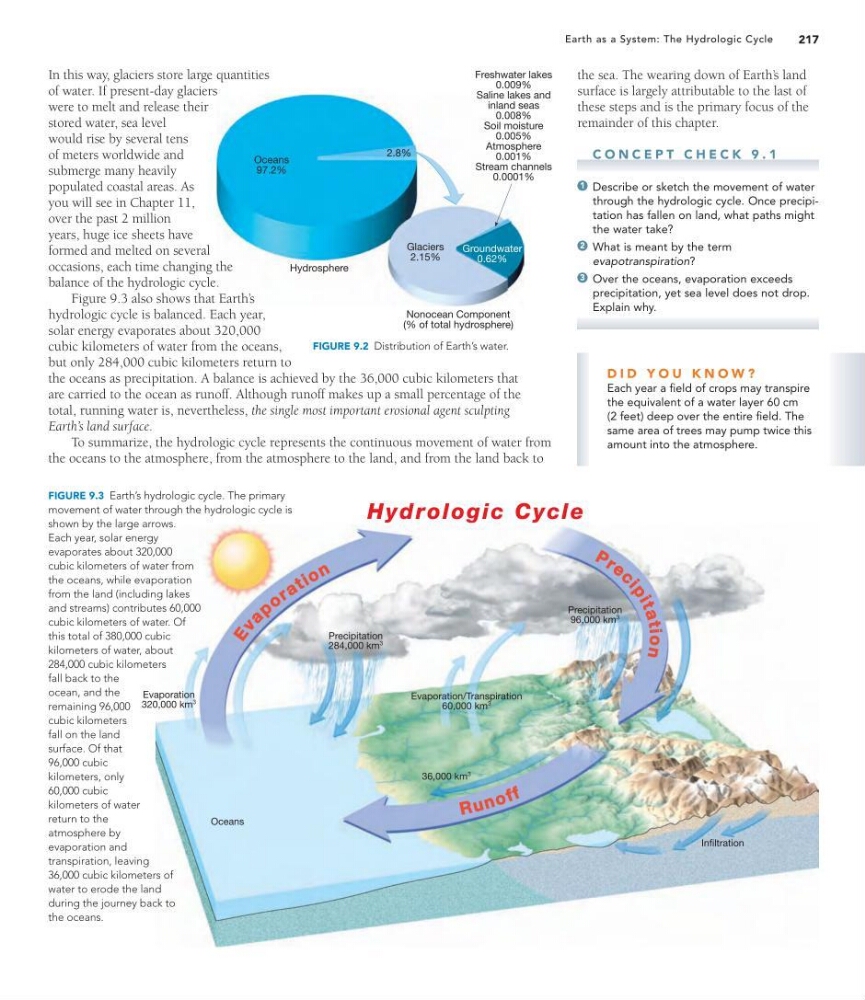
In this way, glaciers store large quantities
of water. If present-day glaciers
were to melt and release their
stored water, sea level
would rise by several tens
of meters worldwide and
submerge many heavily
populated coastal areas. As
you will see in Chapter 11,
over the past 2 million
years, huge ice sheets have
formed and melted on several
occasions, each time changing the
balance of the hydrologic cycle.
Figure 9.3 also shows that Earth’ s
hydrologic cycle is balanced. Each year,
solar energy evaporates about 320,000
cubic kilometers of water from the oceans,
but only 284,000 cubic kilometers return to
the oceans as precipitation. A balance is achieved by the 36,000 cubic kilometers that
are carried to the ocean as runoff. Although runoff makes up a small percentage of the
total, running water is, nevertheless, the single most important erosional agent sculpting
Earth’s land surface.
To summarize, the hydrologic cycle represents the continuous movement of water from
the oceans to the atmosphere, from the atmosphere to the land, and from the land back to
the sea. The wearing down of Earth’ s land
surface is largely attributable to the last of
these steps and is the primary focus of the
remainder of this chapter.
C O N C E P T C H E C K 9 . 1
Describe or sketch the movement of water
through the hydrologic cycle. Once precipitation has fallen on land, what paths might
the water take?
What is meant by the term
evapotranspiration?
Over the oceans, evaporation exceeds
precipitation, yet sea level does not drop.
Explain why.
3
2
1
D I D Y O U K N O W ?
Each year a field of crops may transpire
the equivalent of a water layer 60 cm
(2 feet) deep over the entire field. The
same area of trees may pump twice this
amount into the atmosphere.
E E v
a p o r a t i o n
P r e c
i p i t a ti on
R u n o f f
Hydrologic Cycle
Evaporation
320,000 km
3
Precipitation
284,000 km
3
Precipitation
96,000 km
3
Evaporation/Transpiration
60,000 km
3
36,000 km
3
Oceans
Infiltration
FIGURE 9.3 Earth’s hydrologic cycle. The primary
movement of water through the hydrologic cycle is
shown by the large arrows.
Each year, solar energy
evaporates about 320,000
cubic kilometers of water from
the oceans, while evaporation
from the land (including lakes
and streams) contributes 60,000
cubic kilometers of water. Of
this total of 380,000 cubic
kilometers of water, about
284,000 cubic kilometers
fall back to the
ocean, and the
remaining 96,000
cubic kilometers
fall on the land
surface. Of that
96,000 cubic
kilometers, only
60,000 cubic
kilometers of water
return to the
atmosphere by
evaporation and
transpiration, leaving
36,000 cubic kilometers of
water to erode the land
during the journey back to
the oceans.
FIGURE 9.2 Distribution of Earth’s water.
Earth as a System: The Hydrologic Cycle
2.8%
Oceans
97.2%
Hydrosphere
Groundwater
0.62%
Glaciers
2.15%
Nonocean Component
(% of total hydrosphere)
Freshwater lakes
0.009%
Saline lakes and
inland seas
0.008%
Soil moisture
0.005%
Atmosphere
0.001%
Stream channels
0.0001%
In this way, glaciers store large quantities
of water. If present-day glaciers
were to melt and release their
stored water, sea level
would rise by several tens
of meters worldwide and
submerge many heavily
populated coastal areas. As
you will see in Chapter 11,
over the past 2 million
years, huge ice sheets have
formed and melted on several
occasions, each time changing the
balance of the hydrologic cycle.
Figure 9.3 also shows that Earth’ s
hydrologic cycle is balanced. Each year,
solar energy evaporates about 320,000
cubic kilometers of water from the oceans,
but only 284,000 cubic kilometers return to
the oceans as precipitation. A balance is achieved by the 36,000 cubic kilometers that
are carried to the ocean as runoff. Although runoff makes up a small percentage of the
total, running water is, nevertheless, the single most important erosional agent sculpting
Earth’s land surface.
To summarize, the hydrologic cycle represents the continuous movement of water from
the oceans to the atmosphere, from the atmosphere to the land, and from the land back to
the sea. The wearing down of Earth’ s land
surface is largely attributable to the last of
these steps and is the primary focus of the
remainder of this chapter.
C O N C E P T C H E C K 9 . 1
Describe or sketch the movement of water
through the hydrologic cycle. Once precipitation has fallen on land, what paths might
the water take?
What is meant by the term
evapotranspiration?
Over the oceans, evaporation exceeds
precipitation, yet sea level does not drop.
Explain why.
3
2
1
D I D Y O U K N O W ?
Each year a field of crops may transpire
the equivalent of a water layer 60 cm
(2 feet) deep over the entire field. The
same area of trees may pump twice this
amount into the atmosphere.
E E v
a p o r a t i o n
P r e c
i p i t a ti on
R u n o f f
Hydrologic Cycle
Evaporation
320,000 km
3
Precipitation
284,000 km
3
Precipitation
96,000 km
3
Evaporation/Transpiration
60,000 km
3
36,000 km
3
Oceans
Infiltration
FIGURE 9.3 Earth’s hydrologic cycle. The primary
movement of water through the hydrologic cycle is
shown by the large arrows.
Each year, solar energy
evaporates about 320,000
cubic kilometers of water from
the oceans, while evaporation
from the land (including lakes
and streams) contributes 60,000
cubic kilometers of water. Of
this total of 380,000 cubic
kilometers of water, about
284,000 cubic kilometers
fall back to the
ocean, and the
remaining 96,000
cubic kilometers
fall on the land
surface. Of that
96,000 cubic
kilometers, only
60,000 cubic
kilometers of water
return to the
atmosphere by
evaporation and
transpiration, leaving
36,000 cubic kilometers of
water to erode the land
during the journey back to
the oceans.
FIGURE 9.2 Distribution of Earth’s water.