

CHAPTER 8 Mass Wasting: The Work of Gravity
212
(FIGURE 8.23A). Thawing produces unstable ground that may slide, slump, subside,
and undergo severe frost heaving. When a heated structure is built directly on permafrost that contains a high proportion of ice, thawing creates soggy material into
which a building can sink. One solution is to place buildings and other structures on
piles, like stilts. Such piles allow subfreezing air to circulate between the floor of the
building and the soil and thereby keep the ground frozen.
When oil was discovered on Alaska’ s North Slope, many
people were concerned about the building of a pipeline linking
the oil fields of Prudhoe Bay to the ice-free port of Valdez 1300
kilometers (800 miles) to the south. There was serious concern
that such a massive project might damage the sensitive permafrost environment. Many also worried about possible oil spills.
Because oil must be heated to about 60 °C (140 °F) to flow
properly, special engineering procedures had to be developed to
isolate this heat from the permafrost. Methods included
insulating the pipe, elevating portions of the pipeline above
ground level, and even placing cooling devices in the ground to
keep it frozen
(FIGURE 8.23B). The Alaska pipeline is
clearly one of the most complex and
costly projects ever built in the Arctic
tundra. Detailed studies and careful
engineering helped minimize adverse
effects resulting from the disturbance
of frozen ground.
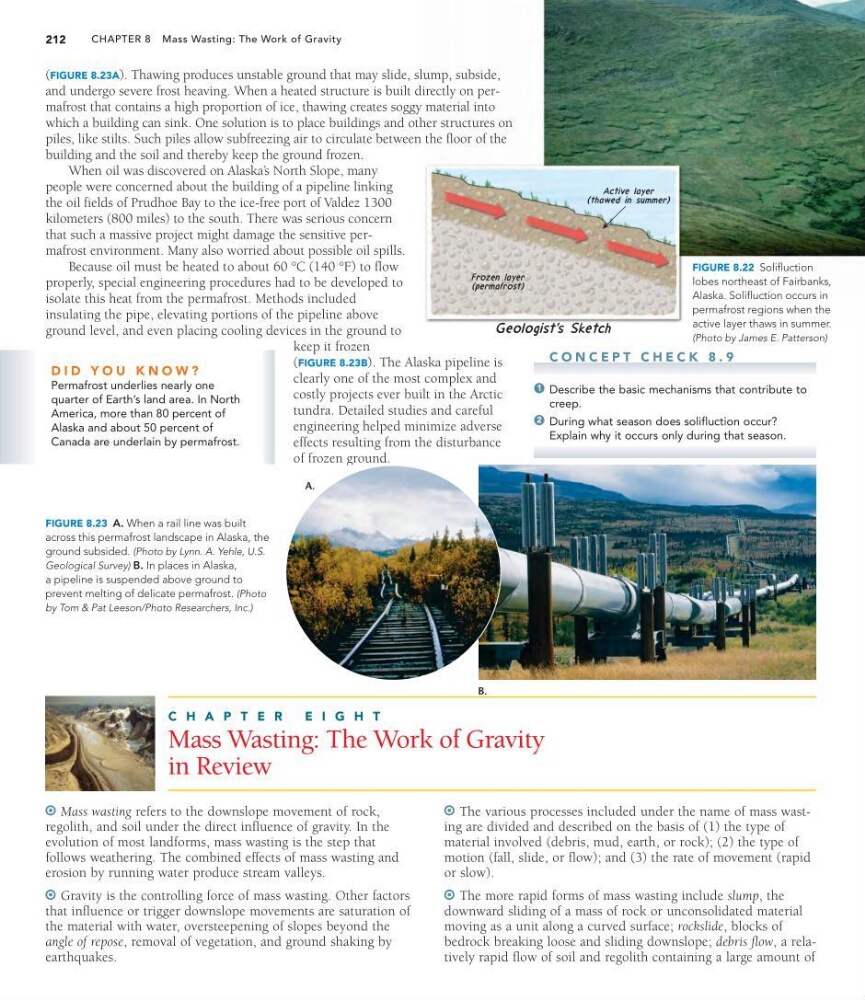
FIGURE 8.22 Solifluction
lobes northeast of Fairbanks,
Alaska. Solifluction occurs in
permafrost regions when the
active layer thaws in summer.
(Photo by James E. Patterson)
D I D Y O U K N O W ?
Permafrost underlies nearly one
quarter of Earth’s land area. In North
America, more than 80 percent of
Alaska and about 50 percent of
Canada are underlain by permafrost.
B.
A.
FIGURE 8.23 A. When a rail line was built
across this permafrost landscape in Alaska, the
ground subsided. (Photo by Lynn. A. Yehle, U.S.
Geological Survey) B. In places in Alaska,
a pipeline is suspended above ground to
prevent melting of delicate permafrost. (Photo
by Tom & Pat Leeson/Photo Researchers, Inc.)
C H A P T E R
E I G H T
Mass Wasting: The Work of Gravity
in Review
Mass wasting refers to the downslope movement of rock,
regolith, and soil under the direct influence of gravity. In the
evolution of most landforms, mass wasting is the step that
follows weathering. The combined effects of mass wasting and
erosion by running water produce stream valleys.
Gravity is the controlling force of mass wasting. Other factors
that influence or trigger downslope movements are saturation of
the material with water, oversteepening of slopes beyond the
angle of repose, removal of vegetation, and ground shaking by
earthquakes.
The various processes included under the name of mass wasting are divided and described on the basis of (1) the type of
material involved (debris, mud, earth, or rock); (2) the type of
motion (fall, slide, or flow); and (3) the rate of movement (rapid
or slow).
The more rapid forms of mass wasting include slump, the
downward sliding of a mass of rock or unconsolidated material
moving as a unit along a curved surface; rockslide, blocks of
bedrock breaking loose and sliding downslope; debris flow, a relatively rapid flow of soil and regolith containing a large amount of
C O N C E P T C H E C K 8 . 9
Describe the basic mechanisms that contribute to
creep.
During what season does solifluction occur?
Explain why it occurs only during that season.
2
1
212
(FIGURE 8.23A). Thawing produces unstable ground that may slide, slump, subside,
and undergo severe frost heaving. When a heated structure is built directly on permafrost that contains a high proportion of ice, thawing creates soggy material into
which a building can sink. One solution is to place buildings and other structures on
piles, like stilts. Such piles allow subfreezing air to circulate between the floor of the
building and the soil and thereby keep the ground frozen.
When oil was discovered on Alaska’ s North Slope, many
people were concerned about the building of a pipeline linking
the oil fields of Prudhoe Bay to the ice-free port of Valdez 1300
kilometers (800 miles) to the south. There was serious concern
that such a massive project might damage the sensitive permafrost environment. Many also worried about possible oil spills.
Because oil must be heated to about 60 °C (140 °F) to flow
properly, special engineering procedures had to be developed to
isolate this heat from the permafrost. Methods included
insulating the pipe, elevating portions of the pipeline above
ground level, and even placing cooling devices in the ground to
keep it frozen
(FIGURE 8.23B). The Alaska pipeline is
clearly one of the most complex and
costly projects ever built in the Arctic
tundra. Detailed studies and careful
engineering helped minimize adverse
effects resulting from the disturbance
of frozen ground.
FIGURE 8.22 Solifluction
lobes northeast of Fairbanks,
Alaska. Solifluction occurs in
permafrost regions when the
active layer thaws in summer.
(Photo by James E. Patterson)
D I D Y O U K N O W ?
Permafrost underlies nearly one
quarter of Earth’s land area. In North
America, more than 80 percent of
Alaska and about 50 percent of
Canada are underlain by permafrost.
B.
A.
FIGURE 8.23 A. When a rail line was built
across this permafrost landscape in Alaska, the
ground subsided. (Photo by Lynn. A. Yehle, U.S.
Geological Survey) B. In places in Alaska,
a pipeline is suspended above ground to
prevent melting of delicate permafrost. (Photo
by Tom & Pat Leeson/Photo Researchers, Inc.)
C H A P T E R
E I G H T
Mass Wasting: The Work of Gravity
in Review
Mass wasting refers to the downslope movement of rock,
regolith, and soil under the direct influence of gravity. In the
evolution of most landforms, mass wasting is the step that
follows weathering. The combined effects of mass wasting and
erosion by running water produce stream valleys.
Gravity is the controlling force of mass wasting. Other factors
that influence or trigger downslope movements are saturation of
the material with water, oversteepening of slopes beyond the
angle of repose, removal of vegetation, and ground shaking by
earthquakes.
The various processes included under the name of mass wasting are divided and described on the basis of (1) the type of
material involved (debris, mud, earth, or rock); (2) the type of
motion (fall, slide, or flow); and (3) the rate of movement (rapid
or slow).
The more rapid forms of mass wasting include slump, the
downward sliding of a mass of rock or unconsolidated material
moving as a unit along a curved surface; rockslide, blocks of
bedrock breaking loose and sliding downslope; debris flow, a relatively rapid flow of soil and regolith containing a large amount of
C O N C E P T C H E C K 8 . 9
Describe the basic mechanisms that contribute to
creep.
During what season does solifluction occur?
Explain why it occurs only during that season.
2
1