

Key Terms
angle of repose (p. 202)
creep (p. 211)
debris flow (p. 209)
debris slide (p. 208)
earthflows (p. 210)
fall (p. 205)
flow (p. 206)
lahars (p. 209)
mass wasting (p. 199)
mudflow (p. 209)
permafrosts (p. 211)
rock avalanches (p. 206)
rockslides (p. 208)
slides (p. 206)
slump (p. 207)
solifluction (p. 211)
talus slopes (p. 206)
G I V E I T S O M E T H O U G H T
Describe a type of mass wasting that might occur in your home
area. Remember to consider characteristics such as climate, surface
materials, and steepness of slopes. Does your example have a
trigger?
Rivers, groundwater, glaciers, wind, and waves can all move and
deposit sediment. Geologists refer to these phenomena as agents
of erosion. Mass wasting also involves the movement and deposition of sediment, yet it is not classified as an agent of erosion.
How is mass wasting different?
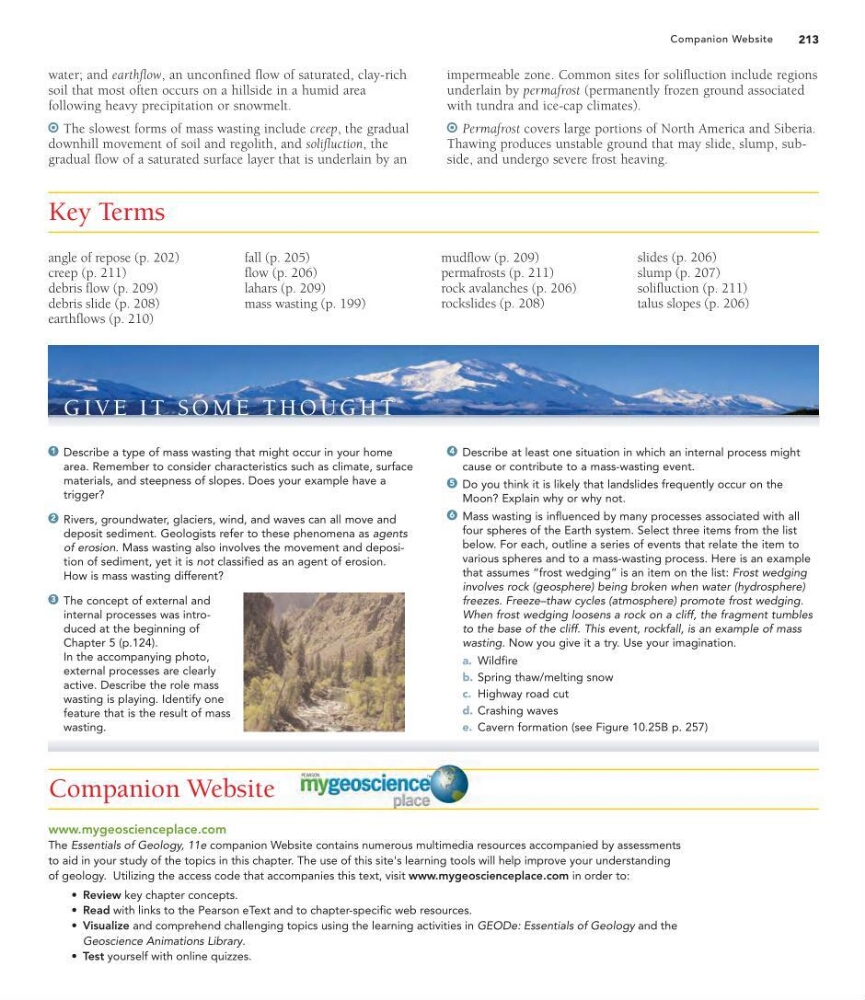
The concept of external and
internal processes was introduced at the beginning of
Chapter 5 (p.124).
In the accompanying photo,
external processes are clearly
active. Describe the role mass
wasting is playing. Identify one
feature that is the result of mass
wasting.
3
2
1
Describe at least one situation in which an internal process might
cause or contribute to a mass-wasting event.
Do you think it is likely that landslides frequently occur on the
Moon? Explain why or why not.
Mass wasting is influenced by many processes associated with all
four spheres of the Earth system. Select three items from the list
below. For each, outline a series of events that relate the item to
various spheres and to a mass-wasting process. Here is an example
that assumes “frost wedging” is an item on the list: Frost wedging
involves rock (geosphere) being broken when water (hydrosphere)
freezes. Freeze–thaw cycles (atmosphere) promote frost wedging.
When frost wedging loosens a rock on a cliff, the fragment tumbles
to the base of the cliff. This event, rockfall, is an example of mass
wasting. Now you give it a try. Use your imagination.
a. Wildfire
b. Spring thaw/melting snow
c. Highway road cut
d. Crashing waves
e. Cavern formation (see Figure 10.25B p. 257)
6
5
4
water; and earthflow, an unconfined flow of saturated, clay-rich
soil that most often occurs on a hillside in a humid area
following heavy precipitation or snowmelt.
The slowest forms of mass wasting include creep, the gradual
downhill movement of soil and regolith, and solifluction, the
gradual flow of a saturated surface layer that is underlain by an
impermeable zone. Common sites for solifluction include regions
underlain by permafrost (permanently frozen ground associated
with tundra and ice-cap climates).
Permafrost covers large portions of North America and Siberia.
Thawing produces unstable ground that may slide, slump, subside, and undergo severe frost heaving.
213
Companion Website
Companion Website
www.mygeoscienceplace.com
The Essentials of Geology, 11e companion Website contains numerous multimedia resources accompanied by assessments
to aid in your study of the topics in this chapter. The use of this site's learning tools will help improve your understanding
of geology. Utilizing the access code that accompanies this text, visit www.mygeoscienceplace.com in order to:
• Review key chapter concepts.
• Read with links to the Pearson eText and to chapter-specific web resources.
• Visualize and comprehend challenging topics using the learning activities in GEODe: Essentials of Geology and the
Geoscience Animations Library.
• Test yourself with online quizzes.
angle of repose (p. 202)
creep (p. 211)
debris flow (p. 209)
debris slide (p. 208)
earthflows (p. 210)
fall (p. 205)
flow (p. 206)
lahars (p. 209)
mass wasting (p. 199)
mudflow (p. 209)
permafrosts (p. 211)
rock avalanches (p. 206)
rockslides (p. 208)
slides (p. 206)
slump (p. 207)
solifluction (p. 211)
talus slopes (p. 206)
G I V E I T S O M E T H O U G H T
Describe a type of mass wasting that might occur in your home
area. Remember to consider characteristics such as climate, surface
materials, and steepness of slopes. Does your example have a
trigger?
Rivers, groundwater, glaciers, wind, and waves can all move and
deposit sediment. Geologists refer to these phenomena as agents
of erosion. Mass wasting also involves the movement and deposition of sediment, yet it is not classified as an agent of erosion.
How is mass wasting different?
The concept of external and
internal processes was introduced at the beginning of
Chapter 5 (p.124).
In the accompanying photo,
external processes are clearly
active. Describe the role mass
wasting is playing. Identify one
feature that is the result of mass
wasting.
3
2
1
Describe at least one situation in which an internal process might
cause or contribute to a mass-wasting event.
Do you think it is likely that landslides frequently occur on the
Moon? Explain why or why not.
Mass wasting is influenced by many processes associated with all
four spheres of the Earth system. Select three items from the list
below. For each, outline a series of events that relate the item to
various spheres and to a mass-wasting process. Here is an example
that assumes “frost wedging” is an item on the list: Frost wedging
involves rock (geosphere) being broken when water (hydrosphere)
freezes. Freeze–thaw cycles (atmosphere) promote frost wedging.
When frost wedging loosens a rock on a cliff, the fragment tumbles
to the base of the cliff. This event, rockfall, is an example of mass
wasting. Now you give it a try. Use your imagination.
a. Wildfire
b. Spring thaw/melting snow
c. Highway road cut
d. Crashing waves
e. Cavern formation (see Figure 10.25B p. 257)
6
5
4
water; and earthflow, an unconfined flow of saturated, clay-rich
soil that most often occurs on a hillside in a humid area
following heavy precipitation or snowmelt.
The slowest forms of mass wasting include creep, the gradual
downhill movement of soil and regolith, and solifluction, the
gradual flow of a saturated surface layer that is underlain by an
impermeable zone. Common sites for solifluction include regions
underlain by permafrost (permanently frozen ground associated
with tundra and ice-cap climates).
Permafrost covers large portions of North America and Siberia.
Thawing produces unstable ground that may slide, slump, subside, and undergo severe frost heaving.
213
Companion Website
Companion Website
www.mygeoscienceplace.com
The Essentials of Geology, 11e companion Website contains numerous multimedia resources accompanied by assessments
to aid in your study of the topics in this chapter. The use of this site's learning tools will help improve your understanding
of geology. Utilizing the access code that accompanies this text, visit www.mygeoscienceplace.com in order to:
• Review key chapter concepts.
• Read with links to the Pearson eText and to chapter-specific web resources.
• Visualize and comprehend challenging topics using the learning activities in GEODe: Essentials of Geology and the
Geoscience Animations Library.
• Test yourself with online quizzes.