

Regolith
Bedrock
C re e p
Expansion
caused by
freezing
Contraction
during thaws
Surface when
frozen
Surface when
thawed
211
Slow Movements
Slow Movements
Mass Wasting
Types of Mass Wasting
Movements such as rockslides, rock avalanches, and lahars are certainly the most
spectacular and catastrophic forms of mass
wasting. These dangerous events deserve
intensive study to enable more effective
prediction, timely warnings, and better
controls to save lives. However, because of
their large size and spectacular nature, they
give us a false impression of their importance as a mass-wasting process. Indeed,
sudden movements are responsible for
moving less material than the slower and
far more subtle action of creep. Whereas
rapid types of mass wasting are characteristic of mountains and steep hillsides, creep
takes place on both steep and gentle slopes
and is thus much more widespread.
Creep
Creep is a type of mass wasting that
involves the gradual downhill movement of
soil and regolith. One factor that contributes to creep is the alternate expansion
and contraction of surface material caused
by freezing and thawing or wetting and
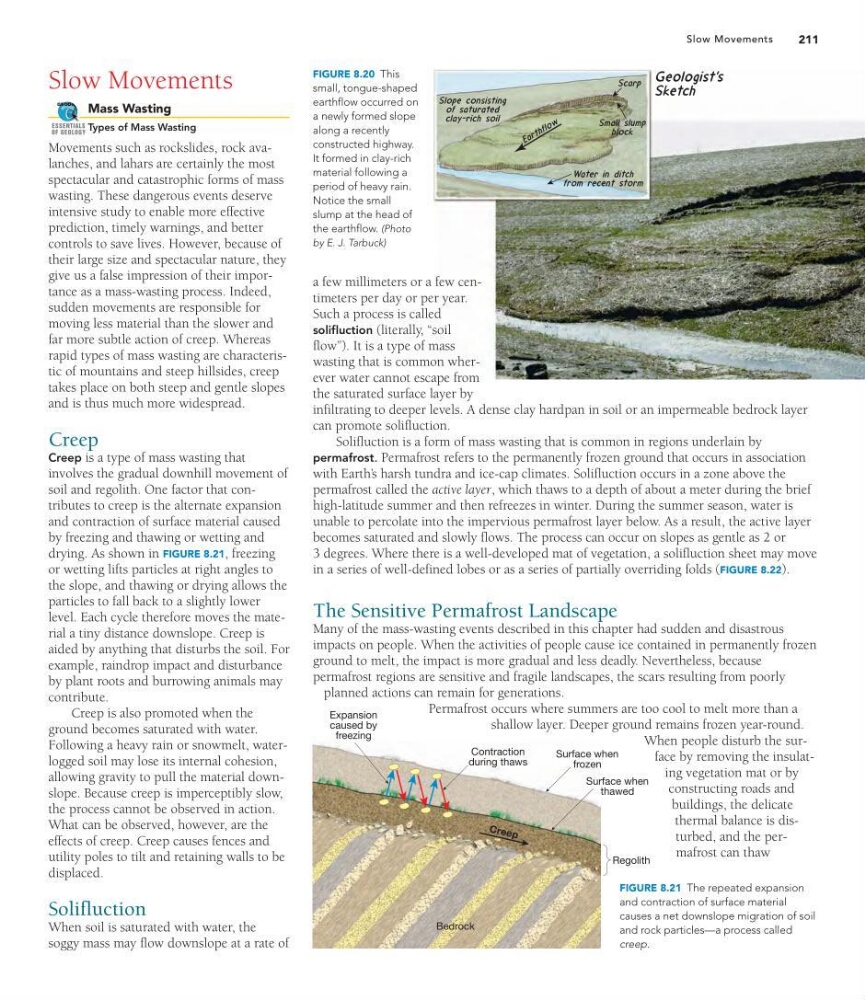
drying. As shown in FIGURE 8.21, freezing
or wetting lifts particles at right angles to
the slope, and thawing or drying allows the
particles to fall back to a slightly lower
level. Each cycle therefore moves the material a tiny distance downslope. Creep is
aided by anything that disturbs the soil. For
example, raindrop impact and disturbance
by plant roots and burrowing animals may
contribute.
Creep is also promoted when the
ground becomes saturated with water.
Following a heavy rain or snowmelt, waterlogged soil may lose its internal cohesion,
allowing gravity to pull the material downslope. Because creep is imperceptibly slow,
the process cannot be observed in action.
What can be observed, however, are the
effects of creep. Creep causes fences and
utility poles to tilt and retaining walls to be
displaced.
Solifluction
When soil is saturated with water, the
soggy mass may flow downslope at a rate of
GEODe
ESSENTIALS
OF GEOLOGY
a few millimeters or a few centimeters per day or per year.
Such a process is called
solifluction (literally, “soil
flow”). It is a type of mass
wasting that is common wherever water cannot escape from
the saturated surface layer by
infiltrating to deeper levels. A dense clay hardpan in soil or an impermeable bedrock layer
can promote solifluction.
Solifluction is a form of mass wasting that is common in regions underlain by
permafrost. Permafrost refers to the permanently frozen ground that occurs in association
with Earth’ s harsh tundra and ice-cap climates. Solifluction occurs in a zone above the
permafrost called the active layer, which thaws to a depth of about a meter during the brief
high-latitude summer and then refreezes in winter. During the summer season, water is
unable to percolate into the impervious permafrost layer below. As a result, the active layer
becomes saturated and slowly flows. The process can occur on slopes as gentle as 2 or
3 degrees. Where there is a well-developed mat of vegetation, a solifluction sheet may move
in a series of well-defined lobes or as a series of partially overriding folds (FIGURE 8.22).
The Sensitive Permafrost Landscape
Many of the mass-wasting events described in this chapter had sudden and disastrous
impacts on people. When the activities of people cause ice contained in permanently frozen
ground to melt, the impact is more gradual and less deadly. Nevertheless, because
permafrost regions are sensitive and fragile landscapes, the scars resulting from poorly
planned actions can remain for generations.
Permafrost occurs where summers are too cool to melt more than a
shallow layer. Deeper ground remains frozen year-round.
When people disturb the surface by removing the insulating vegetation mat or by
constructing roads and
buildings, the delicate
thermal balance is disturbed, and the permafrost can thaw
FIGURE 8.20 This
small, tongue-shaped
earthflow occurred on
a newly formed slope
along a recently
constructed highway.
It formed in clay-rich
material following a
period of heavy rain.
Notice the small
slump at the head of
the earthflow. (Photo
by E. J. Tarbuck)
FIGURE 8.21 The repeated expansion
and contraction of surface material
causes a net downslope migration of soil
and rock particles—a process called
creep.
Bedrock
C re e p
Expansion
caused by
freezing
Contraction
during thaws
Surface when
frozen
Surface when
thawed
211
Slow Movements
Slow Movements
Mass Wasting
Types of Mass Wasting
Movements such as rockslides, rock avalanches, and lahars are certainly the most
spectacular and catastrophic forms of mass
wasting. These dangerous events deserve
intensive study to enable more effective
prediction, timely warnings, and better
controls to save lives. However, because of
their large size and spectacular nature, they
give us a false impression of their importance as a mass-wasting process. Indeed,
sudden movements are responsible for
moving less material than the slower and
far more subtle action of creep. Whereas
rapid types of mass wasting are characteristic of mountains and steep hillsides, creep
takes place on both steep and gentle slopes
and is thus much more widespread.
Creep
Creep is a type of mass wasting that
involves the gradual downhill movement of
soil and regolith. One factor that contributes to creep is the alternate expansion
and contraction of surface material caused
by freezing and thawing or wetting and
drying. As shown in FIGURE 8.21, freezing
or wetting lifts particles at right angles to
the slope, and thawing or drying allows the
particles to fall back to a slightly lower
level. Each cycle therefore moves the material a tiny distance downslope. Creep is
aided by anything that disturbs the soil. For
example, raindrop impact and disturbance
by plant roots and burrowing animals may
contribute.
Creep is also promoted when the
ground becomes saturated with water.
Following a heavy rain or snowmelt, waterlogged soil may lose its internal cohesion,
allowing gravity to pull the material downslope. Because creep is imperceptibly slow,
the process cannot be observed in action.
What can be observed, however, are the
effects of creep. Creep causes fences and
utility poles to tilt and retaining walls to be
displaced.
Solifluction
When soil is saturated with water, the
soggy mass may flow downslope at a rate of
GEODe
ESSENTIALS
OF GEOLOGY
a few millimeters or a few centimeters per day or per year.
Such a process is called
solifluction (literally, “soil
flow”). It is a type of mass
wasting that is common wherever water cannot escape from
the saturated surface layer by
infiltrating to deeper levels. A dense clay hardpan in soil or an impermeable bedrock layer
can promote solifluction.
Solifluction is a form of mass wasting that is common in regions underlain by
permafrost. Permafrost refers to the permanently frozen ground that occurs in association
with Earth’ s harsh tundra and ice-cap climates. Solifluction occurs in a zone above the
permafrost called the active layer, which thaws to a depth of about a meter during the brief
high-latitude summer and then refreezes in winter. During the summer season, water is
unable to percolate into the impervious permafrost layer below. As a result, the active layer
becomes saturated and slowly flows. The process can occur on slopes as gentle as 2 or
3 degrees. Where there is a well-developed mat of vegetation, a solifluction sheet may move
in a series of well-defined lobes or as a series of partially overriding folds (FIGURE 8.22).
The Sensitive Permafrost Landscape
Many of the mass-wasting events described in this chapter had sudden and disastrous
impacts on people. When the activities of people cause ice contained in permanently frozen
ground to melt, the impact is more gradual and less deadly. Nevertheless, because
permafrost regions are sensitive and fragile landscapes, the scars resulting from poorly
planned actions can remain for generations.
Permafrost occurs where summers are too cool to melt more than a
shallow layer. Deeper ground remains frozen year-round.
When people disturb the surface by removing the insulating vegetation mat or by
constructing roads and
buildings, the delicate
thermal balance is disturbed, and the permafrost can thaw
FIGURE 8.20 This
small, tongue-shaped
earthflow occurred on
a newly formed slope
along a recently
constructed highway.
It formed in clay-rich
material following a
period of heavy rain.
Notice the small
slump at the head of
the earthflow. (Photo
by E. J. Tarbuck)
FIGURE 8.21 The repeated expansion
and contraction of surface material
causes a net downslope migration of soil
and rock particles—a process called
creep.