

mass wasting
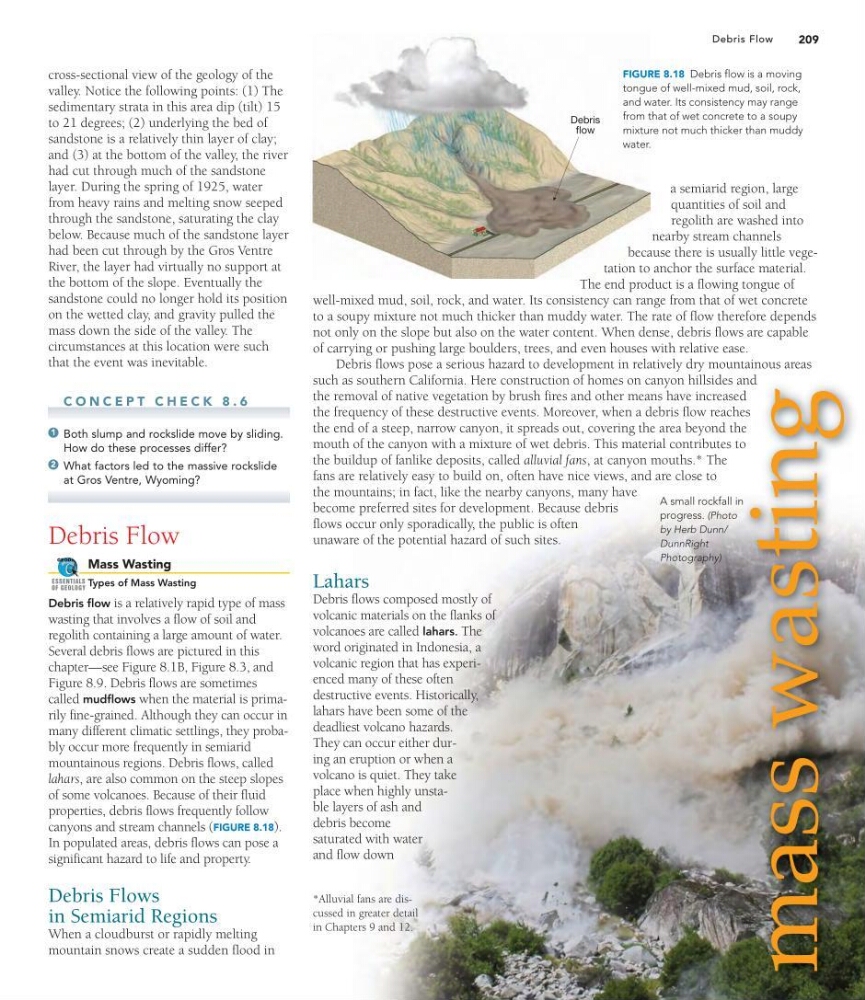
Debris
flow
*Alluvial fans are discussed in greater detail
in Chapters 9 and 12.
a semiarid region, large
quantities of soil and
regolith are washed into
nearby stream channels
because there is usually little vegetation to anchor the surface material.
The end product is a flowing tongue of
well-mixed mud, soil, rock, and water. Its consistency can range from that of wet concrete
to a soupy mixture not much thicker than muddy water. The rate of flow therefore depends
not only on the slope but also on the water content. When dense, debris flows are capable
of carrying or pushing large boulders, trees, and even houses with relative ease.
Debris flows pose a serious hazard to development in relatively dry mountainous areas
such as southern California. Here construction of homes on canyon hillsides and
the removal of native vegetation by brush fires and other means have increased
the frequency of these destructive events. Moreover, when a debris flow reaches
the end of a steep, narrow canyon, it spreads out, covering the area beyond the
mouth of the canyon with a mixture of wet debris. This material contributes to
the buildup of fanlike deposits, called alluvial fans, at canyon mouths.* The
fans are relatively easy to build on, often have nice views, and are close to
the mountains; in fact, like the nearby canyons, many have
become preferred sites for development. Because debris
flows occur only sporadically, the public is often
unaware of the potential hazard of such sites.
Lahars
Debris flows composed mostly of
volcanic materials on the flanks of
volcanoes are called lahars. The
word originated in Indonesia, a
volcanic region that has experienced many of these often
destructive events. Historically,
lahars have been some of the
deadliest volcano hazards.
They can occur either during an eruption or when a
volcano is quiet. They take
place when highly unstable layers of ash and
debris become
saturated with water
and flow down
209
Debris Flow
A small rockfall in
progress. (Photo
by Herb Dunn/
DunnRight
Photography)
cross-sectional view of the geology of the
valley. Notice the following points: (1) The
sedimentary strata in this area dip (tilt) 15
to 21 degrees; (2) underlying the bed of
sandstone is a relatively thin layer of clay;
and (3) at the bottom of the valley, the river
had cut through much of the sandstone
layer. During the spring of 1925, water
from heavy rains and melting snow seeped
through the sandstone, saturating the clay
below. Because much of the sandstone layer
had been cut through by the Gros Ventre
River, the layer had virtually no support at
the bottom of the slope. Eventually the
sandstone could no longer hold its position
on the wetted clay, and gravity pulled the
mass down the side of the valley. The
circumstances at this location were such
that the event was inevitable.
C O N C E P T C H E C K 8 . 6
Both slump and rockslide move by sliding.
How do these processes differ?
What factors led to the massive rockslide
at Gros Ventre, Wyoming?
Debris Flow
Mass Wasting
Types of Mass Wasting
Debris flow is a relatively rapid type of mass
wasting that involves a flow of soil and
regolith containing a large amount of water.
Several debris flows are pictured in this
chapter—see Figure 8.1B, Figure 8.3, and
Figure 8.9. Debris flows are sometimes
called mudflows when the material is primarily fine-grained. Although they can occur in
many different climatic settlings, they probably occur more frequently in semiarid
mountainous regions. Debris flows, called
lahars, are also common on the steep slopes
of some volcanoes. Because of their fluid
properties, debris flows frequently follow
canyons and stream channels (FIGURE 8.18).
In populated areas, debris flows can pose a
significant hazard to life and property.
Debris Flows
in Semiarid Regions
When a cloudburst or rapidly melting
mountain snows create a sudden flood in
GEODe
ESSENTIALS
OF GEOLOGY
2
1
FIGURE 8.18 Debris flow is a moving
tongue of well-mixed mud, soil, rock,
and water. Its consistency may range
from that of wet concrete to a soupy
mixture not much thicker than muddy
water.
Debris
flow
*Alluvial fans are discussed in greater detail
in Chapters 9 and 12.
a semiarid region, large
quantities of soil and
regolith are washed into
nearby stream channels
because there is usually little vegetation to anchor the surface material.
The end product is a flowing tongue of
well-mixed mud, soil, rock, and water. Its consistency can range from that of wet concrete
to a soupy mixture not much thicker than muddy water. The rate of flow therefore depends
not only on the slope but also on the water content. When dense, debris flows are capable
of carrying or pushing large boulders, trees, and even houses with relative ease.
Debris flows pose a serious hazard to development in relatively dry mountainous areas
such as southern California. Here construction of homes on canyon hillsides and
the removal of native vegetation by brush fires and other means have increased
the frequency of these destructive events. Moreover, when a debris flow reaches
the end of a steep, narrow canyon, it spreads out, covering the area beyond the
mouth of the canyon with a mixture of wet debris. This material contributes to
the buildup of fanlike deposits, called alluvial fans, at canyon mouths.* The
fans are relatively easy to build on, often have nice views, and are close to
the mountains; in fact, like the nearby canyons, many have
become preferred sites for development. Because debris
flows occur only sporadically, the public is often
unaware of the potential hazard of such sites.
Lahars
Debris flows composed mostly of
volcanic materials on the flanks of
volcanoes are called lahars. The
word originated in Indonesia, a
volcanic region that has experienced many of these often
destructive events. Historically,
lahars have been some of the
deadliest volcano hazards.
They can occur either during an eruption or when a
volcano is quiet. They take
place when highly unstable layers of ash and
debris become
saturated with water
and flow down
209
Debris Flow
A small rockfall in
progress. (Photo
by Herb Dunn/
DunnRight
Photography)
cross-sectional view of the geology of the
valley. Notice the following points: (1) The
sedimentary strata in this area dip (tilt) 15
to 21 degrees; (2) underlying the bed of
sandstone is a relatively thin layer of clay;
and (3) at the bottom of the valley, the river
had cut through much of the sandstone
layer. During the spring of 1925, water
from heavy rains and melting snow seeped
through the sandstone, saturating the clay
below. Because much of the sandstone layer
had been cut through by the Gros Ventre
River, the layer had virtually no support at
the bottom of the slope. Eventually the
sandstone could no longer hold its position
on the wetted clay, and gravity pulled the
mass down the side of the valley. The
circumstances at this location were such
that the event was inevitable.
C O N C E P T C H E C K 8 . 6
Both slump and rockslide move by sliding.
How do these processes differ?
What factors led to the massive rockslide
at Gros Ventre, Wyoming?
Debris Flow
Mass Wasting
Types of Mass Wasting
Debris flow is a relatively rapid type of mass
wasting that involves a flow of soil and
regolith containing a large amount of water.
Several debris flows are pictured in this
chapter—see Figure 8.1B, Figure 8.3, and
Figure 8.9. Debris flows are sometimes
called mudflows when the material is primarily fine-grained. Although they can occur in
many different climatic settlings, they probably occur more frequently in semiarid
mountainous regions. Debris flows, called
lahars, are also common on the steep slopes
of some volcanoes. Because of their fluid
properties, debris flows frequently follow
canyons and stream channels (FIGURE 8.18).
In populated areas, debris flows can pose a
significant hazard to life and property.
Debris Flows
in Semiarid Regions
When a cloudburst or rapidly melting
mountain snows create a sudden flood in
GEODe
ESSENTIALS
OF GEOLOGY
2
1
FIGURE 8.18 Debris flow is a moving
tongue of well-mixed mud, soil, rock,
and water. Its consistency may range
from that of wet concrete to a soupy
mixture not much thicker than muddy
water.