

CHAPTER 8 Mass Wasting: The Work of Gravity
206
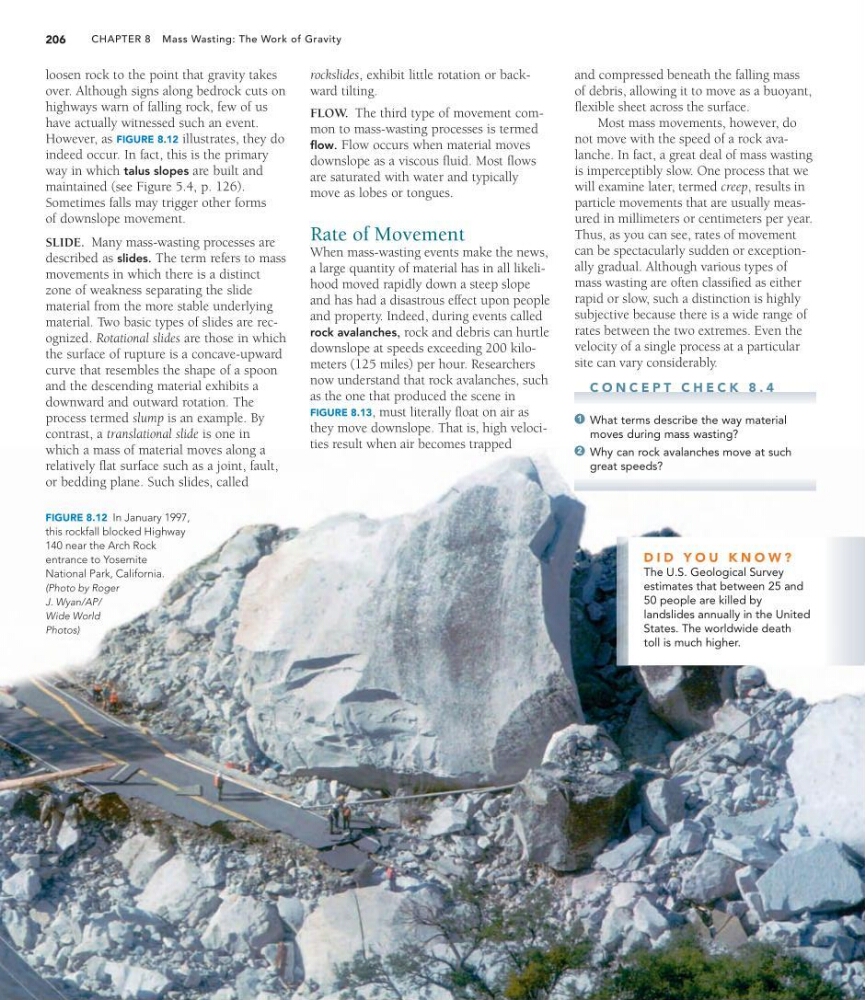
FIGURE 8.12 In January 1997,
this rockfall blocked Highway
140 near the Arch Rock
entrance to Yosemite
National Park, California.
(Photo by Roger
J. Wyan/AP/
Wide World
Photos)
loosen rock to the point that gravity takes
over. Although signs along bedrock cuts on
highways warn of falling rock, few of us
have actually witnessed such an event.
However, as FIGURE 8.12 illustrates, they do
indeed occur. In fact, this is the primary
way in which talus slopes are built and
maintained (see Figure 5.4, p. 126).
Sometimes falls may trigger other forms
of downslope movement.
SLIDE. Many mass-wasting processes are
described as slides. The term refers to mass
movements in which there is a distinct
zone of weakness separating the slide
material from the more stable underlying
material. Two basic types of slides are recognized. Rotational slides are those in which
the surface of rupture is a concave-upward
curve that resembles the shape of a spoon
and the descending material exhibits a
downward and outward rotation. The
process termed slump is an example. By
contrast, a translational slide is one in
which a mass of material moves along a
relatively flat surface such as a joint, fault,
or bedding plane. Such slides, called
rockslides, exhibit little rotation or backward tilting.
FLOW. The third type of movement common to mass-wasting processes is termed
flow. Flow occurs when material moves
downslope as a viscous fluid. Most flows
are saturated with water and typically
move as lobes or tongues.
Rate of Movement
When mass-wasting events make the news,
a large quantity of material has in all likelihood moved rapidly down a steep slope
and has had a disastrous effect upon people
and property. Indeed, during events called
rock avalanches, rock and debris can hurtle
downslope at speeds exceeding 200 kilometers (125 miles) per hour. Researchers
now understand that rock avalanches, such
as the one that produced the scene in
FIGURE 8.13, must literally float on air as
they move downslope. That is, high velocities result when air becomes trapped
and compressed beneath the falling mass
of debris, allowing it to move as a buoyant,
flexible sheet across the surface.
Most mass movements, however, do
not move with the speed of a rock avalanche. In fact, a great deal of mass wasting
is imperceptibly slow. One process that we
will examine later, termed creep, results in
particle movements that are usually measured in millimeters or centimeters per year.
Thus, as you can see, rates of movement
can be spectacularly sudden or exceptionally gradual. Although various types of
mass wasting are often classified as either
rapid or slow, such a distinction is highly
subjective because there is a wide range of
rates between the two extremes. Even the
velocity of a single process at a particular
site can vary considerably.
C O N C E P T C H E C K 8 . 4
What terms describe the way material
moves during mass wasting?
Why can rock avalanches move at such
great speeds?
2
1
D I D Y O U K N O W ?
The U.S. Geological Survey
estimates that between 25 and
50 people are killed by
landslides annually in the United
States. The worldwide death
toll is much higher.
206
FIGURE 8.12 In January 1997,
this rockfall blocked Highway
140 near the Arch Rock
entrance to Yosemite
National Park, California.
(Photo by Roger
J. Wyan/AP/
Wide World
Photos)
loosen rock to the point that gravity takes
over. Although signs along bedrock cuts on
highways warn of falling rock, few of us
have actually witnessed such an event.
However, as FIGURE 8.12 illustrates, they do
indeed occur. In fact, this is the primary
way in which talus slopes are built and
maintained (see Figure 5.4, p. 126).
Sometimes falls may trigger other forms
of downslope movement.
SLIDE. Many mass-wasting processes are
described as slides. The term refers to mass
movements in which there is a distinct
zone of weakness separating the slide
material from the more stable underlying
material. Two basic types of slides are recognized. Rotational slides are those in which
the surface of rupture is a concave-upward
curve that resembles the shape of a spoon
and the descending material exhibits a
downward and outward rotation. The
process termed slump is an example. By
contrast, a translational slide is one in
which a mass of material moves along a
relatively flat surface such as a joint, fault,
or bedding plane. Such slides, called
rockslides, exhibit little rotation or backward tilting.
FLOW. The third type of movement common to mass-wasting processes is termed
flow. Flow occurs when material moves
downslope as a viscous fluid. Most flows
are saturated with water and typically
move as lobes or tongues.
Rate of Movement
When mass-wasting events make the news,
a large quantity of material has in all likelihood moved rapidly down a steep slope
and has had a disastrous effect upon people
and property. Indeed, during events called
rock avalanches, rock and debris can hurtle
downslope at speeds exceeding 200 kilometers (125 miles) per hour. Researchers
now understand that rock avalanches, such
as the one that produced the scene in
FIGURE 8.13, must literally float on air as
they move downslope. That is, high velocities result when air becomes trapped
and compressed beneath the falling mass
of debris, allowing it to move as a buoyant,
flexible sheet across the surface.
Most mass movements, however, do
not move with the speed of a rock avalanche. In fact, a great deal of mass wasting
is imperceptibly slow. One process that we
will examine later, termed creep, results in
particle movements that are usually measured in millimeters or centimeters per year.
Thus, as you can see, rates of movement
can be spectacularly sudden or exceptionally gradual. Although various types of
mass wasting are often classified as either
rapid or slow, such a distinction is highly
subjective because there is a wide range of
rates between the two extremes. Even the
velocity of a single process at a particular
site can vary considerably.
C O N C E P T C H E C K 8 . 4
What terms describe the way material
moves during mass wasting?
Why can rock avalanches move at such
great speeds?
2
1
D I D Y O U K N O W ?
The U.S. Geological Survey
estimates that between 25 and
50 people are killed by
landslides annually in the United
States. The worldwide death
toll is much higher.