

CHAPTER 8 Mass Wasting: The Work of Gravity
202
unstable slopes that become prime sites for
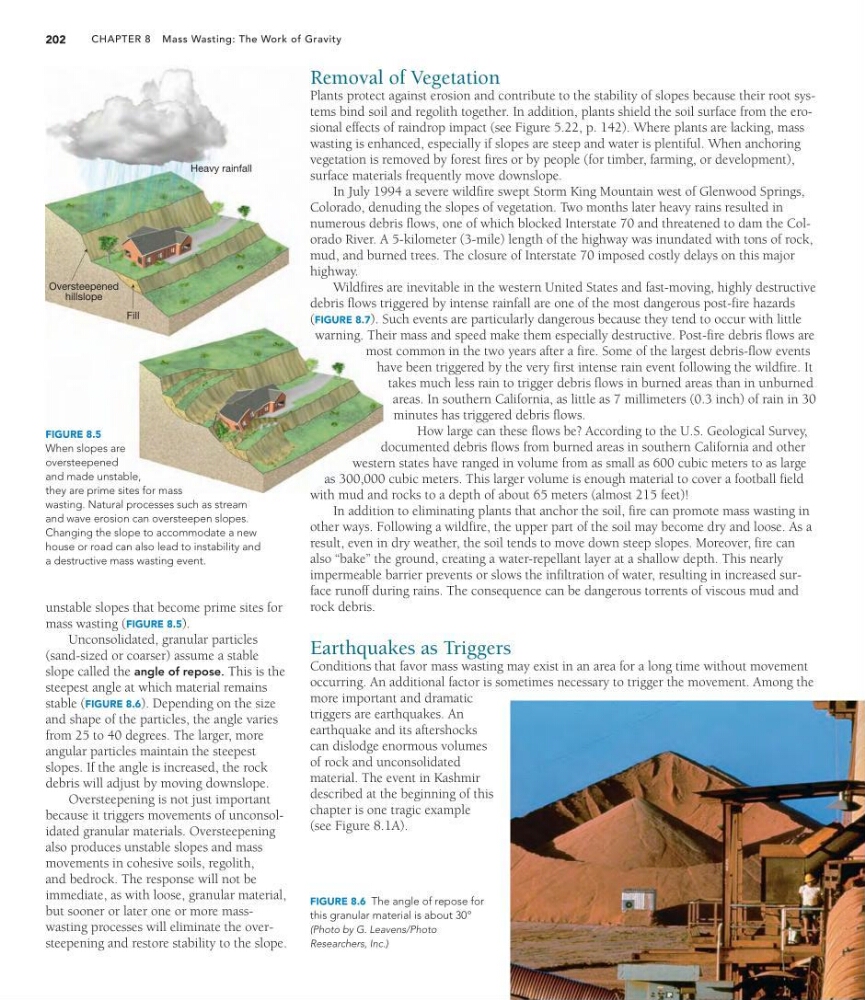
mass wasting (FIGURE 8.5).
Unconsolidated, granular particles
(sand-sized or coarser) assume a stable
slope called the angle of repose. This is the
steepest angle at which material remains
stable (FIGURE 8.6). Depending on the size
and shape of the particles, the angle varies
from 25 to 40 degrees. The larger, more
angular particles maintain the steepest
slopes. If the angle is increased, the rock
debris will adjust by moving downslope.
Oversteepening is not just important
because it triggers movements of unconsolidated granular materials. Oversteepening
also produces unstable slopes and mass
movements in cohesive soils, regolith,
and bedrock. The response will not be
immediate, as with loose, granular material,
but sooner or later one or more masswasting processes will eliminate the oversteepening and restore stability to the slope.
Heavy rainfall
Oversteepened
hillslope
Fill
FIGURE 8.6 The angle of repose for
this granular material is about 30°
(Photo by G. Leavens/Photo
Researchers, Inc.)
Removal of Vegetation
Plants protect against erosion and contribute to the stability of slopes because their root systems bind soil and regolith together. In addition, plants shield the soil surface from the erosional effects of raindrop impact (see Figure 5.22, p. 142). Where plants are lacking, mass
wasting is enhanced, especially if slopes are steep and water is plentiful. When anchoring
vegetation is removed by forest fires or by people (for timber, farming, or development),
surface materials frequently move downslope.
In July 1994 a severe wildfire swept Storm King Mountain west of Glenwood Springs,
Colorado, denuding the slopes of vegetation. Two months later heavy rains resulted in
numerous debris flows, one of which blocked Interstate 70 and threatened to dam the Colorado River. A 5-kilometer (3-mile) length of the highway was inundated with tons of rock,
mud, and burned trees. The closure of Interstate 70 imposed costly delays on this major
highway.
Wildfires are inevitable in the western United States and fast-moving, highly destructive
debris flows triggered by intense rainfall are one of the most dangerous post-fire hazards
(FIGURE 8.7). Such events are particularly dangerous because they tend to occur with little
warning. Their mass and speed make them especially destructive. Post-fire debris flows are
most common in the two years after a fire. Some of the largest debris-flow events
have been triggered by the very first intense rain event following the wildfire. It
takes much less rain to trigger debris flows in burned areas than in unburned
areas. In southern California, as little as 7 millimeters (0.3 inch) of rain in 30
minutes has triggered debris flows.
How large can these flows be? According to the U.S. Geological Survey,
documented debris flows from burned areas in southern California and other
western states have ranged in volume from as small as 600 cubic meters to as large
as 300,000 cubic meters. This larger volume is enough material to cover a football field
with mud and rocks to a depth of about 65 meters (almost 215 feet)!
In addition to eliminating plants that anchor the soil, fire can promote mass wasting in
other ways. Following a wildfire, the upper part of the soil may become dry and loose. As a
result, even in dry weather, the soil tends to move down steep slopes. Moreover, fire can
also “bake” the ground, creating a water-repellant layer at a shallow depth. This nearly
impermeable barrier prevents or slows the infiltration of water, resulting in increased surface runoff during rains. The consequence can be dangerous torrents of viscous mud and
rock debris.
Earthquakes as Triggers
Conditions that favor mass wasting may exist in an area for a long time without movement
occurring. An additional factor is sometimes necessary to trigger the movement. Among the
more important and dramatic
triggers are earthquakes. An
earthquake and its aftershocks
can dislodge enormous volumes
of rock and unconsolidated
material. The event in Kashmir
described at the beginning of this
chapter is one tragic example
(see Figure 8.1A).
FIGURE 8.5
When slopes are
oversteepened
and made unstable,
they are prime sites for mass
wasting. Natural processes such as stream
and wave erosion can oversteepen slopes.
Changing the slope to accommodate a new
house or road can also lead to instability and
a destructive mass wasting event.
202
unstable slopes that become prime sites for
mass wasting (FIGURE 8.5).
Unconsolidated, granular particles
(sand-sized or coarser) assume a stable
slope called the angle of repose. This is the
steepest angle at which material remains
stable (FIGURE 8.6). Depending on the size
and shape of the particles, the angle varies
from 25 to 40 degrees. The larger, more
angular particles maintain the steepest
slopes. If the angle is increased, the rock
debris will adjust by moving downslope.
Oversteepening is not just important
because it triggers movements of unconsolidated granular materials. Oversteepening
also produces unstable slopes and mass
movements in cohesive soils, regolith,
and bedrock. The response will not be
immediate, as with loose, granular material,
but sooner or later one or more masswasting processes will eliminate the oversteepening and restore stability to the slope.
Heavy rainfall
Oversteepened
hillslope
Fill
FIGURE 8.6 The angle of repose for
this granular material is about 30°
(Photo by G. Leavens/Photo
Researchers, Inc.)
Removal of Vegetation
Plants protect against erosion and contribute to the stability of slopes because their root systems bind soil and regolith together. In addition, plants shield the soil surface from the erosional effects of raindrop impact (see Figure 5.22, p. 142). Where plants are lacking, mass
wasting is enhanced, especially if slopes are steep and water is plentiful. When anchoring
vegetation is removed by forest fires or by people (for timber, farming, or development),
surface materials frequently move downslope.
In July 1994 a severe wildfire swept Storm King Mountain west of Glenwood Springs,
Colorado, denuding the slopes of vegetation. Two months later heavy rains resulted in
numerous debris flows, one of which blocked Interstate 70 and threatened to dam the Colorado River. A 5-kilometer (3-mile) length of the highway was inundated with tons of rock,
mud, and burned trees. The closure of Interstate 70 imposed costly delays on this major
highway.
Wildfires are inevitable in the western United States and fast-moving, highly destructive
debris flows triggered by intense rainfall are one of the most dangerous post-fire hazards
(FIGURE 8.7). Such events are particularly dangerous because they tend to occur with little
warning. Their mass and speed make them especially destructive. Post-fire debris flows are
most common in the two years after a fire. Some of the largest debris-flow events
have been triggered by the very first intense rain event following the wildfire. It
takes much less rain to trigger debris flows in burned areas than in unburned
areas. In southern California, as little as 7 millimeters (0.3 inch) of rain in 30
minutes has triggered debris flows.
How large can these flows be? According to the U.S. Geological Survey,
documented debris flows from burned areas in southern California and other
western states have ranged in volume from as small as 600 cubic meters to as large
as 300,000 cubic meters. This larger volume is enough material to cover a football field
with mud and rocks to a depth of about 65 meters (almost 215 feet)!
In addition to eliminating plants that anchor the soil, fire can promote mass wasting in
other ways. Following a wildfire, the upper part of the soil may become dry and loose. As a
result, even in dry weather, the soil tends to move down steep slopes. Moreover, fire can
also “bake” the ground, creating a water-repellant layer at a shallow depth. This nearly
impermeable barrier prevents or slows the infiltration of water, resulting in increased surface runoff during rains. The consequence can be dangerous torrents of viscous mud and
rock debris.
Earthquakes as Triggers
Conditions that favor mass wasting may exist in an area for a long time without movement
occurring. An additional factor is sometimes necessary to trigger the movement. Among the
more important and dramatic
triggers are earthquakes. An
earthquake and its aftershocks
can dislodge enormous volumes
of rock and unconsolidated
material. The event in Kashmir
described at the beginning of this
chapter is one tragic example
(see Figure 8.1A).
FIGURE 8.5
When slopes are
oversteepened
and made unstable,
they are prime sites for mass
wasting. Natural processes such as stream
and wave erosion can oversteepen slopes.
Changing the slope to accommodate a new
house or road can also lead to instability and
a destructive mass wasting event.