

Slate
Phyllite
Schist
Gneiss
CHAPTER 7 Metamorphism and Metamorphic Rocks
192
Increasing Metamorphism
Low Grade (200°)
Intermediate Grade
High Grade (800°)
Mineral
Composition
Rock Type
Chlorite
Muscovite (mica)
Biotite (mica)
Garnet
Staurolite
Sillimanite
Quartz
Feldspar
No
alteration
Slate
Phyllite
Schist
Melting
Gneiss
FIGURE 7.21 The
typical transition in
mineral content that
results from the
progressive
metamorphism
of shale.
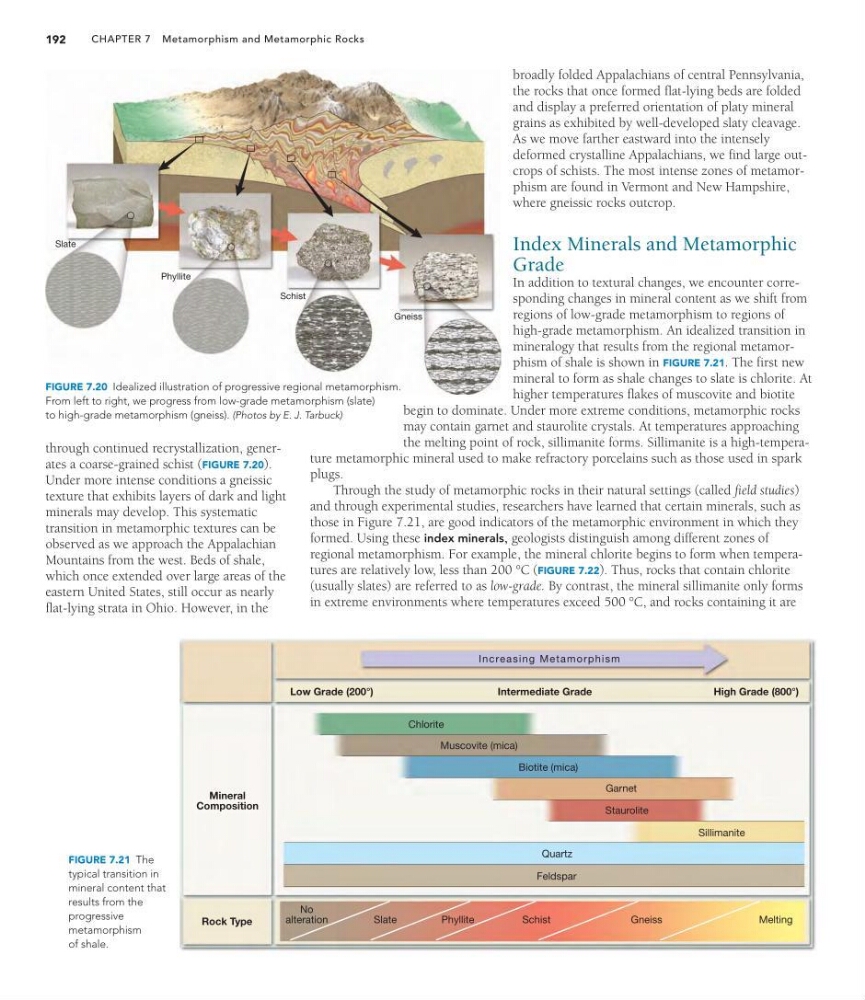
through continued recrystallization, generates a coarse-grained schist (FIGURE 7.20).
Under more intense conditions a gneissic
texture that exhibits layers of dark and light
minerals may develop. This systematic
transition in metamorphic textures can be
observed as we approach the Appalachian
Mountains from the west. Beds of shale,
which once extended over large areas of the
eastern United States, still occur as nearly
flat-lying strata in Ohio. However, in the
broadly folded Appalachians of central Pennsylvania,
the rocks that once formed flat-lying beds are folded
and display a preferred orientation of platy mineral
grains as exhibited by well-developed slaty cleavage.
As we move farther eastward into the intensely
deformed crystalline Appalachians, we find large outcrops of schists. The most intense zones of metamorphism are found in Vermont and New Hampshire,
where gneissic rocks outcrop.
Index Minerals and Metamorphic
Grade
In addition to textural changes, we encounter corresponding changes in mineral content as we shift from
regions of low-grade metamorphism to regions of
high-grade metamorphism. An idealized transition in
mineralogy that results from the regional metamorphism of shale is shown in FIGURE 7.21. The first new
mineral to form as shale changes to slate is chlorite. At
higher temperatures flakes of muscovite and biotite
begin to dominate. Under more extreme conditions, metamorphic rocks
may contain garnet and staurolite crystals. At temperatures approaching
the melting point of rock, sillimanite forms. Sillimanite is a high-temperature metamorphic mineral used to make refractory porcelains such as those used in spark
plugs.
Through the study of metamorphic rocks in their natural settings (called field studies)
and through experimental studies, researchers have learned that certain minerals, such as
those in Figure 7.21, are good indicators of the metamorphic environment in which they
formed. Using these index minerals, geologists distinguish among different zones of
regional metamorphism. For example, the mineral chlorite begins to form when temperatures are relatively low, less than 200 °C (FIGURE 7.22). Thus, rocks that contain chlorite
(usually slates) are referred to as low-grade. By contrast, the mineral sillimanite only forms
in extreme environments where temperatures exceed 500 °C, and rocks containing it are
FIGURE 7.20 Idealized illustration of progressive regional metamorphism.
From left to right, we progress from low-grade metamorphism (slate)
to high-grade metamorphism (gneiss). (Photos by E. J. Tarbuck)
Phyllite
Schist
Gneiss
CHAPTER 7 Metamorphism and Metamorphic Rocks
192
Increasing Metamorphism
Low Grade (200°)
Intermediate Grade
High Grade (800°)
Mineral
Composition
Rock Type
Chlorite
Muscovite (mica)
Biotite (mica)
Garnet
Staurolite
Sillimanite
Quartz
Feldspar
No
alteration
Slate
Phyllite
Schist
Melting
Gneiss
FIGURE 7.21 The
typical transition in
mineral content that
results from the
progressive
metamorphism
of shale.
through continued recrystallization, generates a coarse-grained schist (FIGURE 7.20).
Under more intense conditions a gneissic
texture that exhibits layers of dark and light
minerals may develop. This systematic
transition in metamorphic textures can be
observed as we approach the Appalachian
Mountains from the west. Beds of shale,
which once extended over large areas of the
eastern United States, still occur as nearly
flat-lying strata in Ohio. However, in the
broadly folded Appalachians of central Pennsylvania,
the rocks that once formed flat-lying beds are folded
and display a preferred orientation of platy mineral
grains as exhibited by well-developed slaty cleavage.
As we move farther eastward into the intensely
deformed crystalline Appalachians, we find large outcrops of schists. The most intense zones of metamorphism are found in Vermont and New Hampshire,
where gneissic rocks outcrop.
Index Minerals and Metamorphic
Grade
In addition to textural changes, we encounter corresponding changes in mineral content as we shift from
regions of low-grade metamorphism to regions of
high-grade metamorphism. An idealized transition in
mineralogy that results from the regional metamorphism of shale is shown in FIGURE 7.21. The first new
mineral to form as shale changes to slate is chlorite. At
higher temperatures flakes of muscovite and biotite
begin to dominate. Under more extreme conditions, metamorphic rocks
may contain garnet and staurolite crystals. At temperatures approaching
the melting point of rock, sillimanite forms. Sillimanite is a high-temperature metamorphic mineral used to make refractory porcelains such as those used in spark
plugs.
Through the study of metamorphic rocks in their natural settings (called field studies)
and through experimental studies, researchers have learned that certain minerals, such as
those in Figure 7.21, are good indicators of the metamorphic environment in which they
formed. Using these index minerals, geologists distinguish among different zones of
regional metamorphism. For example, the mineral chlorite begins to form when temperatures are relatively low, less than 200 °C (FIGURE 7.22). Thus, rocks that contain chlorite
(usually slates) are referred to as low-grade. By contrast, the mineral sillimanite only forms
in extreme environments where temperatures exceed 500 °C, and rocks containing it are
FIGURE 7.20 Idealized illustration of progressive regional metamorphism.
From left to right, we progress from low-grade metamorphism (slate)
to high-grade metamorphism (gneiss). (Photos by E. J. Tarbuck)