

191
Metamorphic Zones
D I D Y O U K N O W ?
Although most of central North
America has a rather subdued
topography, the underlying bedrock is
similar to rocks found in the cores of
metamorphosed mountain belts. This
strongly supports the view that these
rocks once formed the roots of ancient
mountain chains that may have risen as
high as the present-day Himalayas.
Zone of fault breccia and gouge
Zone of mylonite
Offset
drainage
Active
fault
zone
L in e a r v a ll e y
Brittle
fracture
Ductile
flow
A. Fault breccia, California
B. Mylonite
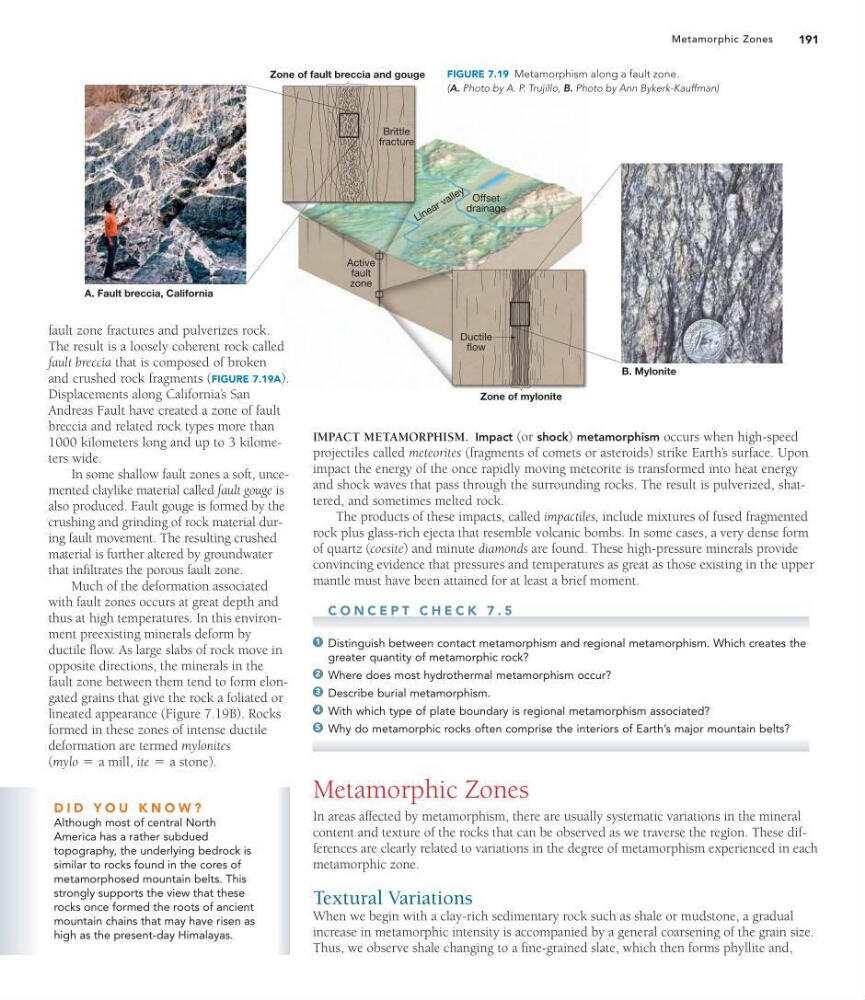
fault zone fractures and pulverizes rock.
The result is a loosely coherent rock called
fault breccia that is composed of broken
and crushed rock fragments (FIGURE 7.19A).
Displacements along California’ s San
Andreas Fault have created a zone of fault
breccia and related rock types more than
1000 kilometers long and up to 3 kilometers wide.
In some shallow fault zones a soft, uncemented claylike material called fault gouge is
also produced. Fault gouge is formed by the
crushing and grinding of rock material during fault movement. The resulting crushed
material is further altered by groundwater
that infiltrates the porous fault zone.
Much of the deformation associated
with fault zones occurs at great depth and
thus at high temperatures. In this environment preexisting minerals deform by
ductile flow. As large slabs of rock move in
opposite directions, the minerals in the
fault zone between them tend to form elongated grains that give the rock a foliated or
lineated appearance (Figure 7.19B). Rocks
formed in these zones of intense ductile
deformation are termed mylonites
(
,
) .
ite = a stone
mylo = a mill
IMPACT METAMORPHISM. Impact (or shock) metamorphism occurs when high-speed
projectiles called meteorites (fragments of comets or asteroids) strike Earth’ s surface. Upon
impact the energy of the once rapidly moving meteorite is transformed into heat energy
and shock waves that pass through the surrounding rocks. The result is pulverized, shattered, and sometimes melted rock.
The products of these impacts, called impactiles, include mixtures of fused fragmented
rock plus glass-rich ejecta that resemble volcanic bombs. In some cases, a very dense form
of quartz (coesite) and minute diamonds are found. These high-pressure minerals provide
convincing evidence that pressures and temperatures as great as those existing in the upper
mantle must have been attained for at least a brief moment.
C O N C E P T C H E C K 7 . 5
Distinguish between contact metamorphism and regional metamorphism. Which creates the
greater quantity of metamorphic rock?
Where does most hydrothermal metamorphism occur?
Describe burial metamorphism.
With which type of plate boundary is regional metamorphism associated?
Why do metamorphic rocks often comprise the interiors of Earth’s major mountain belts?
Metamorphic Zones
In areas affected by metamorphism, there are usually systematic variations in the mineral
content and texture of the rocks that can be observed as we traverse the region. These differences are clearly related to variations in the degree of metamorphism experienced in each
metamorphic zone.
Textural Variations
When we begin with a clay-rich sedimentary rock such as shale or mudstone, a gradual
increase in metamorphic intensity is accompanied by a general coarsening of the grain size.
Thus, we observe shale changing to a fine-grained slate, which then forms phyllite and,
5
4
3
2
1
FIGURE 7.19 Metamorphism along a fault zone.
(A. Photo by A. P. Trujillo, B. Photo by Ann Bykerk-Kauffman)
Metamorphic Zones
D I D Y O U K N O W ?
Although most of central North
America has a rather subdued
topography, the underlying bedrock is
similar to rocks found in the cores of
metamorphosed mountain belts. This
strongly supports the view that these
rocks once formed the roots of ancient
mountain chains that may have risen as
high as the present-day Himalayas.
Zone of fault breccia and gouge
Zone of mylonite
Offset
drainage
Active
fault
zone
L in e a r v a ll e y
Brittle
fracture
Ductile
flow
A. Fault breccia, California
B. Mylonite
fault zone fractures and pulverizes rock.
The result is a loosely coherent rock called
fault breccia that is composed of broken
and crushed rock fragments (FIGURE 7.19A).
Displacements along California’ s San
Andreas Fault have created a zone of fault
breccia and related rock types more than
1000 kilometers long and up to 3 kilometers wide.
In some shallow fault zones a soft, uncemented claylike material called fault gouge is
also produced. Fault gouge is formed by the
crushing and grinding of rock material during fault movement. The resulting crushed
material is further altered by groundwater
that infiltrates the porous fault zone.
Much of the deformation associated
with fault zones occurs at great depth and
thus at high temperatures. In this environment preexisting minerals deform by
ductile flow. As large slabs of rock move in
opposite directions, the minerals in the
fault zone between them tend to form elongated grains that give the rock a foliated or
lineated appearance (Figure 7.19B). Rocks
formed in these zones of intense ductile
deformation are termed mylonites
(
,
) .
ite = a stone
mylo = a mill
IMPACT METAMORPHISM. Impact (or shock) metamorphism occurs when high-speed
projectiles called meteorites (fragments of comets or asteroids) strike Earth’ s surface. Upon
impact the energy of the once rapidly moving meteorite is transformed into heat energy
and shock waves that pass through the surrounding rocks. The result is pulverized, shattered, and sometimes melted rock.
The products of these impacts, called impactiles, include mixtures of fused fragmented
rock plus glass-rich ejecta that resemble volcanic bombs. In some cases, a very dense form
of quartz (coesite) and minute diamonds are found. These high-pressure minerals provide
convincing evidence that pressures and temperatures as great as those existing in the upper
mantle must have been attained for at least a brief moment.
C O N C E P T C H E C K 7 . 5
Distinguish between contact metamorphism and regional metamorphism. Which creates the
greater quantity of metamorphic rock?
Where does most hydrothermal metamorphism occur?
Describe burial metamorphism.
With which type of plate boundary is regional metamorphism associated?
Why do metamorphic rocks often comprise the interiors of Earth’s major mountain belts?
Metamorphic Zones
In areas affected by metamorphism, there are usually systematic variations in the mineral
content and texture of the rocks that can be observed as we traverse the region. These differences are clearly related to variations in the degree of metamorphism experienced in each
metamorphic zone.
Textural Variations
When we begin with a clay-rich sedimentary rock such as shale or mudstone, a gradual
increase in metamorphic intensity is accompanied by a general coarsening of the grain size.
Thus, we observe shale changing to a fine-grained slate, which then forms phyllite and,
5
4
3
2
1
FIGURE 7.19 Metamorphism along a fault zone.
(A. Photo by A. P. Trujillo, B. Photo by Ann Bykerk-Kauffman)