

189
Metamorphic Environments
including volcanic ash and basalt. In some cases,
large grains of metamorphic minerals, such as garnet
and staurolite, may form, giving the hornfels a
porphyroblastic texture (see Figure 7.10).
Hydrothermal Metamorphism
When hot, ion-rich fluids circulate through fissures
and cracks in rock, a chemical alteration called
hydrothermal metamorphism occurs (FIGURE 7.16).
This type of metamorphism is often closely associated
with the emplacement of magma. As large magma bodies cool and solidify, silica-rich fluids (mainly water)
are driven into the host rocks. When the host rock is
highly fractured, mineral matter contained in these
hydrothermal solutions may precipitate to form a
variety of minerals, some of which are economically
important. If the host rocks are permeable and highly
reactive, such as the carbonate rock limestone, silicaterich hydrothermal solutions react to produce a variety
of calcium-rich silicate minerals. Recall that a metamorphic process that alters the overall chemical
composition of a rock unit is called metasomatism.
As our understanding of
plate tectonics grew, it
became clear that the
most widespread
occurrence of
Mid-ocean ridge
Black
smoker
Hot
mineral-rich
water rises to
the seafloor
Cold seawater
percolates into
the hot newly
formed crust
Black smoker
spewing hot,
mineral-rich
seawater
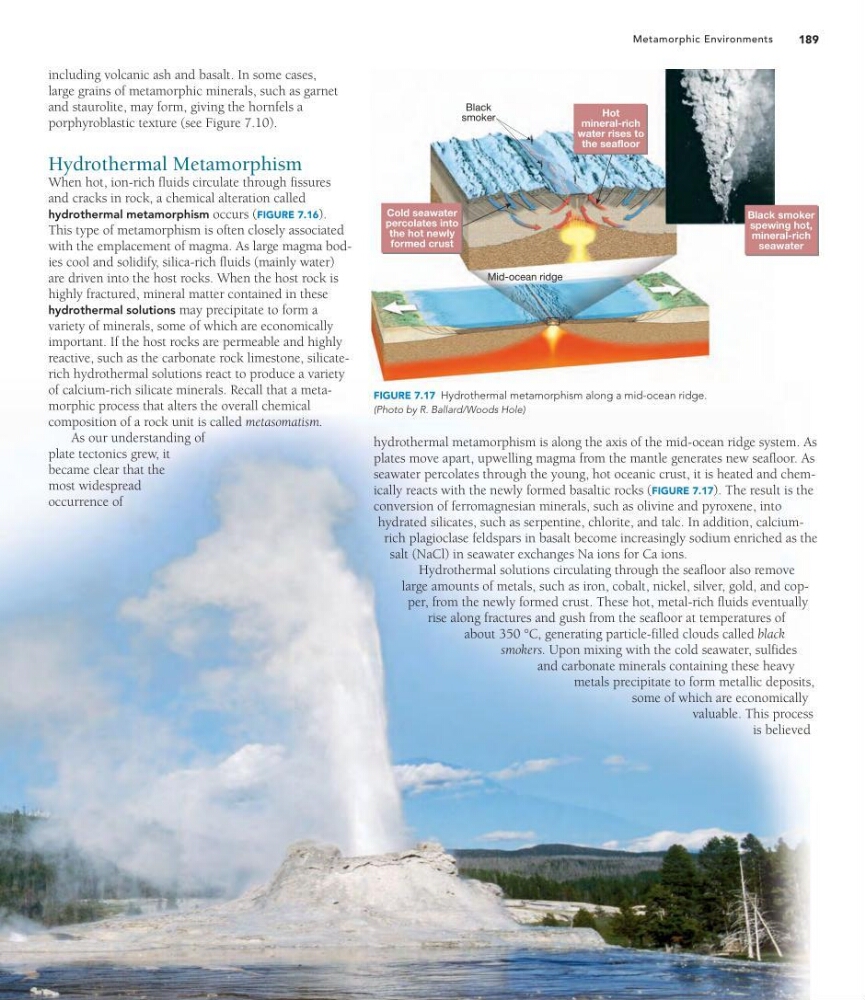
hydrothermal metamorphism is along the axis of the mid-ocean ridge system. As
plates move apart, upwelling magma from the mantle generates new seafloor. As
seawater percolates through the young, hot oceanic crust, it is heated and chemically reacts with the newly formed basaltic rocks (FIGURE 7.17). The result is the
conversion of ferromagnesian minerals, such as olivine and pyroxene, into
hydrated silicates, such as serpentine, chlorite, and talc. In addition, calciumrich plagioclase feldspars in basalt become increasingly sodium enriched as the
salt (NaCl) in seawater exchanges Na ions for Ca ions.
Hydrothermal solutions circulating through the seafloor also remove
large amounts of metals, such as iron, cobalt, nickel, silver, gold, and copper, from the newly formed crust. These hot, metal-rich fluids eventually
rise along fractures and gush from the seafloor at temperatures of
about 350 °C, generating particle-filled clouds called black
smokers. Upon mixing with the cold seawater, sulfides
and carbonate minerals containing these heavy
metals precipitate to form metallic deposits,
some of which are economically
valuable. This process
is believed
FIGURE 7.17 Hydrothermal metamorphism along a mid-ocean ridge.
(Photo by R. Ballard/Woods Hole)
Metamorphic Environments
including volcanic ash and basalt. In some cases,
large grains of metamorphic minerals, such as garnet
and staurolite, may form, giving the hornfels a
porphyroblastic texture (see Figure 7.10).
Hydrothermal Metamorphism
When hot, ion-rich fluids circulate through fissures
and cracks in rock, a chemical alteration called
hydrothermal metamorphism occurs (FIGURE 7.16).
This type of metamorphism is often closely associated
with the emplacement of magma. As large magma bodies cool and solidify, silica-rich fluids (mainly water)
are driven into the host rocks. When the host rock is
highly fractured, mineral matter contained in these
hydrothermal solutions may precipitate to form a
variety of minerals, some of which are economically
important. If the host rocks are permeable and highly
reactive, such as the carbonate rock limestone, silicaterich hydrothermal solutions react to produce a variety
of calcium-rich silicate minerals. Recall that a metamorphic process that alters the overall chemical
composition of a rock unit is called metasomatism.
As our understanding of
plate tectonics grew, it
became clear that the
most widespread
occurrence of
Mid-ocean ridge
Black
smoker
Hot
mineral-rich
water rises to
the seafloor
Cold seawater
percolates into
the hot newly
formed crust
Black smoker
spewing hot,
mineral-rich
seawater
hydrothermal metamorphism is along the axis of the mid-ocean ridge system. As
plates move apart, upwelling magma from the mantle generates new seafloor. As
seawater percolates through the young, hot oceanic crust, it is heated and chemically reacts with the newly formed basaltic rocks (FIGURE 7.17). The result is the
conversion of ferromagnesian minerals, such as olivine and pyroxene, into
hydrated silicates, such as serpentine, chlorite, and talc. In addition, calciumrich plagioclase feldspars in basalt become increasingly sodium enriched as the
salt (NaCl) in seawater exchanges Na ions for Ca ions.
Hydrothermal solutions circulating through the seafloor also remove
large amounts of metals, such as iron, cobalt, nickel, silver, gold, and copper, from the newly formed crust. These hot, metal-rich fluids eventually
rise along fractures and gush from the seafloor at temperatures of
about 350 °C, generating particle-filled clouds called black
smokers. Upon mixing with the cold seawater, sulfides
and carbonate minerals containing these heavy
metals precipitate to form metallic deposits,
some of which are economically
valuable. This process
is believed
FIGURE 7.17 Hydrothermal metamorphism along a mid-ocean ridge.
(Photo by R. Ballard/Woods Hole)