

CHAPTER 7 Metamorphism and Metamorphic Rocks
188
Magma
chamber
Metamorphic
aureole
Roof pendant
(metamorphic aureole)
A. Implacement of
igneous body and
metamorphism
B. Crystallization of pluton
Host
rock
Host
rock
C. Uplift and erosion expose pluton and metamorphic cap rock
Igneous
pluton
Igneous
pluton
Metamorphic
aureole
Roof pendant
(metamorphic aureole)
D I D Y O U K N O W ?
Because marble can be carved readily,
it has been used for centuries for
buildings and memorials. Examples of
important structures whose exteriors
are clad in marble include the
Parthenon in Greece, the Taj Mahal in
India, and the Washington Monument
in the United States.
Metamorphic
Environments
There are many environments in which
metamorphism occurs. Most are in the
vicinity of plate margins, and several are
associated with igneous activity. We will
consider the following types of metamorphism: (1) contact or thermal metamorphism;
(2) hydrothermal metamorphism; (3) burial
and subduction zone metamorphism;
(4) regional metamorphism; (5) metamorphism along faults; (6) impact metamorphism
and with the exception of impact metamorphism, there is considerable overlap among
the types.
Contact or Thermal
Metamorphism
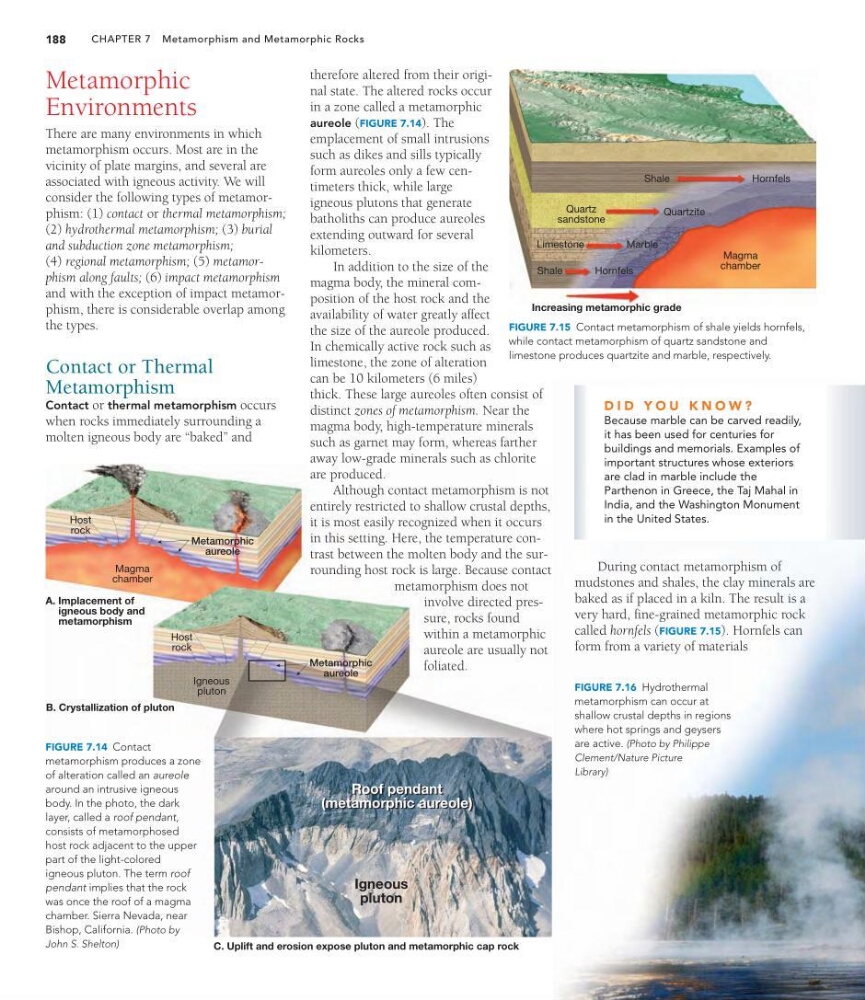
Contact or thermal metamorphism occurs
when rocks immediately surrounding a
molten igneous body are “baked” and
therefore altered from their original state. The altered rocks occur
in a zone called a metamorphic
aureole (FIGURE 7.14). The
emplacement of small intrusions
such as dikes and sills typically
form aureoles only a few centimeters thick, while large
igneous plutons that generate
batholiths can produce aureoles
extending outward for several
kilometers.
In addition to the size of the
magma body, the mineral composition of the host rock and the
availability of water greatly affect
the size of the aureole produced.
In chemically active rock such as
limestone, the zone of alteration
can be 10 kilometers (6 miles)
thick. These large aureoles often consist of
distinct zones of metamorphism. Near the
magma body, high-temperature minerals
such as garnet may form, whereas farther
away low-grade minerals such as chlorite
are produced.
Although contact metamorphism is not
entirely restricted to shallow crustal depths,
it is most easily recognized when it occurs
in this setting. Here, the temperature contrast between the molten body and the surrounding host rock is large. Because contact
metamorphism does not
involve directed pressure, rocks found
within a metamorphic
aureole are usually not
foliated.
FIGURE 7.14 Contact
metamorphism produces a zone
of alteration called an aureole
around an intrusive igneous
body. In the photo, the dark
layer, called a roof pendant,
consists of metamorphosed
host rock adjacent to the upper
part of the light-colored
igneous pluton. The term roof
pendant implies that the rock
was once the roof of a magma
chamber. Sierra Nevada, near
Bishop, California. (Photo by
John S. Shelton)
Shale
Quartz
sandstone
Limestone
Shale
Hornfels
Quartzite
Marble
Hornfels
Magma
chamber
Increasing metamorphic grade
FIGURE 7.15 Contact metamorphism of shale yields hornfels,
while contact metamorphism of quartz sandstone and
limestone produces quartzite and marble, respectively.
FIGURE 7.16 Hydrothermal
metamorphism can occur at
shallow crustal depths in regions
where hot springs and geysers
are active. (Photo by Philippe
Clement/Nature Picture
Library)
During contact metamorphism of
mudstones and shales, the clay minerals are
baked as if placed in a kiln. The result is a
very hard, fine-grained metamorphic rock
called hornfels (FIGURE 7.15). Hornfels can
form from a variety of materials
188
Magma
chamber
Metamorphic
aureole
Roof pendant
(metamorphic aureole)
A. Implacement of
igneous body and
metamorphism
B. Crystallization of pluton
Host
rock
Host
rock
C. Uplift and erosion expose pluton and metamorphic cap rock
Igneous
pluton
Igneous
pluton
Metamorphic
aureole
Roof pendant
(metamorphic aureole)
D I D Y O U K N O W ?
Because marble can be carved readily,
it has been used for centuries for
buildings and memorials. Examples of
important structures whose exteriors
are clad in marble include the
Parthenon in Greece, the Taj Mahal in
India, and the Washington Monument
in the United States.
Metamorphic
Environments
There are many environments in which
metamorphism occurs. Most are in the
vicinity of plate margins, and several are
associated with igneous activity. We will
consider the following types of metamorphism: (1) contact or thermal metamorphism;
(2) hydrothermal metamorphism; (3) burial
and subduction zone metamorphism;
(4) regional metamorphism; (5) metamorphism along faults; (6) impact metamorphism
and with the exception of impact metamorphism, there is considerable overlap among
the types.
Contact or Thermal
Metamorphism
Contact or thermal metamorphism occurs
when rocks immediately surrounding a
molten igneous body are “baked” and
therefore altered from their original state. The altered rocks occur
in a zone called a metamorphic
aureole (FIGURE 7.14). The
emplacement of small intrusions
such as dikes and sills typically
form aureoles only a few centimeters thick, while large
igneous plutons that generate
batholiths can produce aureoles
extending outward for several
kilometers.
In addition to the size of the
magma body, the mineral composition of the host rock and the
availability of water greatly affect
the size of the aureole produced.
In chemically active rock such as
limestone, the zone of alteration
can be 10 kilometers (6 miles)
thick. These large aureoles often consist of
distinct zones of metamorphism. Near the
magma body, high-temperature minerals
such as garnet may form, whereas farther
away low-grade minerals such as chlorite
are produced.
Although contact metamorphism is not
entirely restricted to shallow crustal depths,
it is most easily recognized when it occurs
in this setting. Here, the temperature contrast between the molten body and the surrounding host rock is large. Because contact
metamorphism does not
involve directed pressure, rocks found
within a metamorphic
aureole are usually not
foliated.
FIGURE 7.14 Contact
metamorphism produces a zone
of alteration called an aureole
around an intrusive igneous
body. In the photo, the dark
layer, called a roof pendant,
consists of metamorphosed
host rock adjacent to the upper
part of the light-colored
igneous pluton. The term roof
pendant implies that the rock
was once the roof of a magma
chamber. Sierra Nevada, near
Bishop, California. (Photo by
John S. Shelton)
Shale
Quartz
sandstone
Limestone
Shale
Hornfels
Quartzite
Marble
Hornfels
Magma
chamber
Increasing metamorphic grade
FIGURE 7.15 Contact metamorphism of shale yields hornfels,
while contact metamorphism of quartz sandstone and
limestone produces quartzite and marble, respectively.
FIGURE 7.16 Hydrothermal
metamorphism can occur at
shallow crustal depths in regions
where hot springs and geysers
are active. (Photo by Philippe
Clement/Nature Picture
Library)
During contact metamorphism of
mudstones and shales, the clay minerals are
baked as if placed in a kiln. The result is a
very hard, fine-grained metamorphic rock
called hornfels (FIGURE 7.15). Hornfels can
form from a variety of materials