

187
Common Metamorphic Rocks
These banded gneisses often exhibit evidence of
deformation, including folds and sometimes faults
(see Figure 7.1).
Most gneisses have a felsic composition and are
often derived from granite or its fine-grained equivalent, rhyolite. However, many form from the highgrade metamorphism of shale. In this instance,
gneiss represents the last rock in the sequence of
shale, slate, phyllite, schist, and gneiss. Like schists,
gneisses may also include large crystals of accessory
minerals such as garnet and staurolite. Gneisses
made up primarily of dark minerals such as those
that compose basalt also occur. For example, an
amphibole-rich rock that exhibits a gneissic texture
is called amphibolite.
Nonfoliated Rocks
MARBLE. Marble is a coarse, crystalline metamorphic rock whose parent was limestone or dolostone
(Figure 7.12). Pure marble is white and composed essentially of the mineral calcite.
Because of its relative softness (hardness of 3), marble is easy to cut and shape. White
marble is particularly prized as a stone from which to create monuments and statues, such
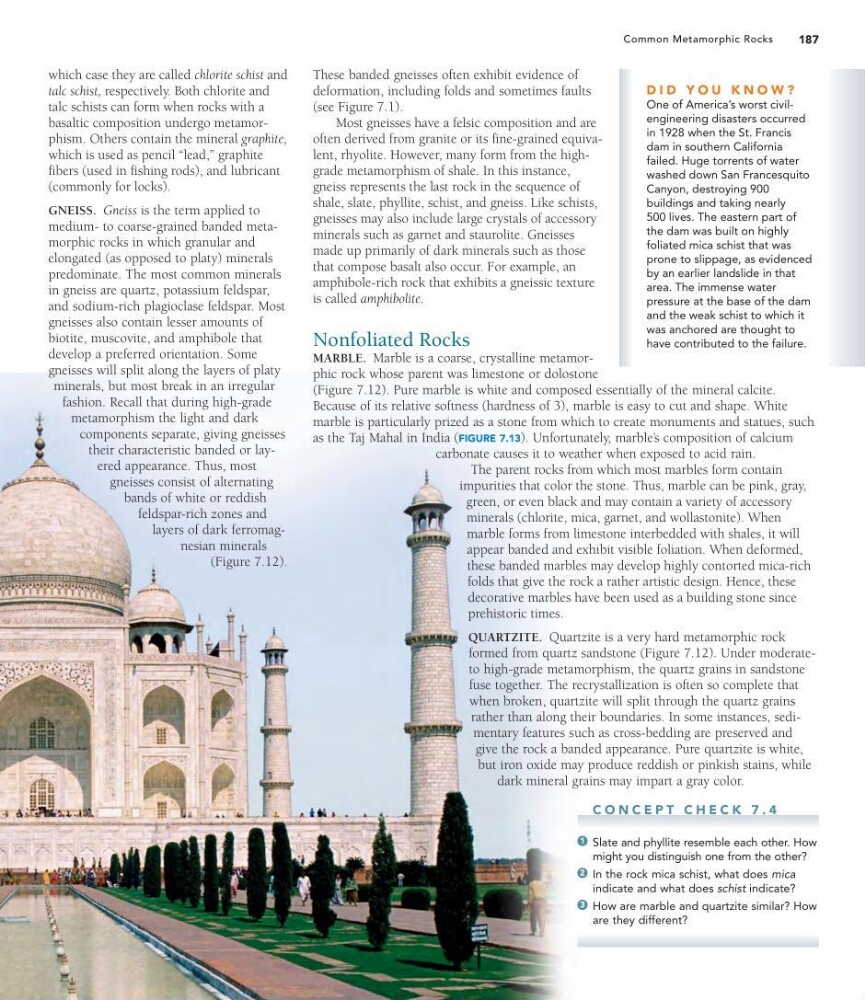
as the Taj Mahal in India (FIGURE 7.13). Unfortunately, marble’ s composition of calcium
carbonate causes it to weather when exposed to acid rain.
The parent rocks from which most marbles form contain
impurities that color the stone. Thus, marble can be pink, gray,
green, or even black and may contain a variety of accessory
minerals (chlorite, mica, garnet, and wollastonite). When
marble forms from limestone interbedded with shales, it will
appear banded and exhibit visible foliation. When deformed,
these banded marbles may develop highly contorted mica-rich
folds that give the rock a rather artistic design. Hence, these
decorative marbles have been used as a building stone since
prehistoric times.
QUARTZITE. Quartzite is a very hard metamorphic rock
formed from quartz sandstone (Figure 7.12). Under moderateto high-grade metamorphism, the quartz grains in sandstone
fuse together. The recrystallization is often so complete that
when broken, quartzite will split through the quartz grains
rather than along their boundaries. In some instances, sedimentary features such as cross-bedding are preserved and
give the rock a banded appearance. Pure quartzite is white,
but iron oxide may produce reddish or pinkish stains, while
dark mineral grains may impart a gray color.
D I D Y O U K N O W ?
One of America’s worst civilengineering disasters occurred
in 1928 when the St. Francis
dam in southern California
failed. Huge torrents of water
washed down San Francesquito
Canyon, destroying 900
buildings and taking nearly
500 lives. The eastern part of
the dam was built on highly
foliated mica schist that was
prone to slippage, as evidenced
by an earlier landslide in that
area. The immense water
pressure at the base of the dam
and the weak schist to which it
was anchored are thought to
have contributed to the failure.
which case they are called chlorite schist and
talc schist, respectively. Both chlorite and
talc schists can form when rocks with a
basaltic composition undergo metamorphism. Others contain the mineral graphite,
which is used as pencil “lead,” graphite
fibers (used in fishing rods), and lubricant
(commonly for locks).
GNEISS. Gneiss is the term applied to
medium- to coarse-grained banded metamorphic rocks in which granular and
elongated (as opposed to platy) minerals
predominate. The most common minerals
in gneiss are quartz, potassium feldspar,
and sodium-rich plagioclase feldspar. Most
gneisses also contain lesser amounts of
biotite, muscovite, and amphibole that
develop a preferred orientation. Some
gneisses will split along the layers of platy
minerals, but most break in an irregular
fashion. Recall that during high-grade
metamorphism the light and dark
components separate, giving gneisses
their characteristic banded or layered appearance. Thus, most
gneisses consist of alternating
bands of white or reddish
feldspar-rich zones and
layers of dark ferromagnesian minerals
(Figure 7.12).
C O N C E P T C H E C K 7 . 4
Slate and phyllite resemble each other. How
might you distinguish one from the other?
In the rock mica schist, what does mica
indicate and what does schist indicate?
How are marble and quartzite similar? How
are they different?
3
2
1
Common Metamorphic Rocks
These banded gneisses often exhibit evidence of
deformation, including folds and sometimes faults
(see Figure 7.1).
Most gneisses have a felsic composition and are
often derived from granite or its fine-grained equivalent, rhyolite. However, many form from the highgrade metamorphism of shale. In this instance,
gneiss represents the last rock in the sequence of
shale, slate, phyllite, schist, and gneiss. Like schists,
gneisses may also include large crystals of accessory
minerals such as garnet and staurolite. Gneisses
made up primarily of dark minerals such as those
that compose basalt also occur. For example, an
amphibole-rich rock that exhibits a gneissic texture
is called amphibolite.
Nonfoliated Rocks
MARBLE. Marble is a coarse, crystalline metamorphic rock whose parent was limestone or dolostone
(Figure 7.12). Pure marble is white and composed essentially of the mineral calcite.
Because of its relative softness (hardness of 3), marble is easy to cut and shape. White
marble is particularly prized as a stone from which to create monuments and statues, such
as the Taj Mahal in India (FIGURE 7.13). Unfortunately, marble’ s composition of calcium
carbonate causes it to weather when exposed to acid rain.
The parent rocks from which most marbles form contain
impurities that color the stone. Thus, marble can be pink, gray,
green, or even black and may contain a variety of accessory
minerals (chlorite, mica, garnet, and wollastonite). When
marble forms from limestone interbedded with shales, it will
appear banded and exhibit visible foliation. When deformed,
these banded marbles may develop highly contorted mica-rich
folds that give the rock a rather artistic design. Hence, these
decorative marbles have been used as a building stone since
prehistoric times.
QUARTZITE. Quartzite is a very hard metamorphic rock
formed from quartz sandstone (Figure 7.12). Under moderateto high-grade metamorphism, the quartz grains in sandstone
fuse together. The recrystallization is often so complete that
when broken, quartzite will split through the quartz grains
rather than along their boundaries. In some instances, sedimentary features such as cross-bedding are preserved and
give the rock a banded appearance. Pure quartzite is white,
but iron oxide may produce reddish or pinkish stains, while
dark mineral grains may impart a gray color.
D I D Y O U K N O W ?
One of America’s worst civilengineering disasters occurred
in 1928 when the St. Francis
dam in southern California
failed. Huge torrents of water
washed down San Francesquito
Canyon, destroying 900
buildings and taking nearly
500 lives. The eastern part of
the dam was built on highly
foliated mica schist that was
prone to slippage, as evidenced
by an earlier landslide in that
area. The immense water
pressure at the base of the dam
and the weak schist to which it
was anchored are thought to
have contributed to the failure.
which case they are called chlorite schist and
talc schist, respectively. Both chlorite and
talc schists can form when rocks with a
basaltic composition undergo metamorphism. Others contain the mineral graphite,
which is used as pencil “lead,” graphite
fibers (used in fishing rods), and lubricant
(commonly for locks).
GNEISS. Gneiss is the term applied to
medium- to coarse-grained banded metamorphic rocks in which granular and
elongated (as opposed to platy) minerals
predominate. The most common minerals
in gneiss are quartz, potassium feldspar,
and sodium-rich plagioclase feldspar. Most
gneisses also contain lesser amounts of
biotite, muscovite, and amphibole that
develop a preferred orientation. Some
gneisses will split along the layers of platy
minerals, but most break in an irregular
fashion. Recall that during high-grade
metamorphism the light and dark
components separate, giving gneisses
their characteristic banded or layered appearance. Thus, most
gneisses consist of alternating
bands of white or reddish
feldspar-rich zones and
layers of dark ferromagnesian minerals
(Figure 7.12).
C O N C E P T C H E C K 7 . 4
Slate and phyllite resemble each other. How
might you distinguish one from the other?
In the rock mica schist, what does mica
indicate and what does schist indicate?
How are marble and quartzite similar? How
are they different?
3
2
1