

Foliated Rocks
SLATE. Slate is a very fine-grained
(less than 0.5 millimeter) foliated rock
composed of minute mica flakes
that are too small to be visible
(FIGURE 7.12). Thus, slate generally
appears dull and closely resembles
shale. A noteworthy characteristic of
slate is its excellent rock cleavage, or
tendency to break into flat slabs (see
Figure 7.8).
Slate is most often generated by
the low-grade metamorphism of shale,
mudstone, or siltstone. Less frequently
it is produced when volcanic ash is
metamorphosed. Slate’ s color depends
on its mineral constituents. Black
(carbonaceous) slate contains organic
material; red slate gets its color from
iron oxide; and green slate usually
contains chlorite.
PHYLLITE. Phyllite represents a
gradation in the degree of metamorphism between slate and schist. Its
constituent platy minerals are
larger than those in slate but not
yet large enough to be readily
identifiable with the unaided
eye. Although phyllite appears
similar to slate, it can be easily
distinguished from slate by its
glossy sheen and its sometimes
wavy surface (Figure 7.12).
Phyllite usually exhibits rock
cleavage and is composed
mainly of very fine crystals of
either muscovite or chlorite,
or both.
SCHIST. Schists are mediumto coarse-grained metamorphic rocks in which platy
minerals predominate. These flat components commonly include the micas (muscovite and biotite), which display a planar
alignment that gives the rock its foliated
texture. In addition, schists contain smaller
amounts of other minerals, often quartz
and feldspar. Schists composed mostly of
dark minerals (amphiboles) are known.
Like slate, the parent rock of many schists
is shale, which has undergone medium- to
high-grade metamorphism during major
mountain-building episodes.
The term schist describes the texture of
a rock and as such it is used to describe
rocks having a wide variety of chemical
compositions. To indicate the composition,
mineral names are used. For example,
schists composed primarily of muscovite
and biotite are called mica schist
(Figure 7.12). Depending upon the degree
of metamorphism and composition of the
parent rock, mica schists often contain
accessory minerals, some of which are
unique to metamorphic rocks. Some
common accessory minerals that occur as
porphyroblasts include garnet, staurolite,
and sillimanite, in which case the rock is
called garnet-mica schist, staurolite-mica
schist, and so forth (see Figure 7.10).
In addition, schists may be
composed largely of the minerals chlorite or talc, in
Foliated metamorphic rocks
Slate
Phyllite
Schist
Gneiss
Nonfoliated metamorphic rocks
Foliated metamorphic rocks
Nonfoliated metamorphic rocks
Marble
Quartzite
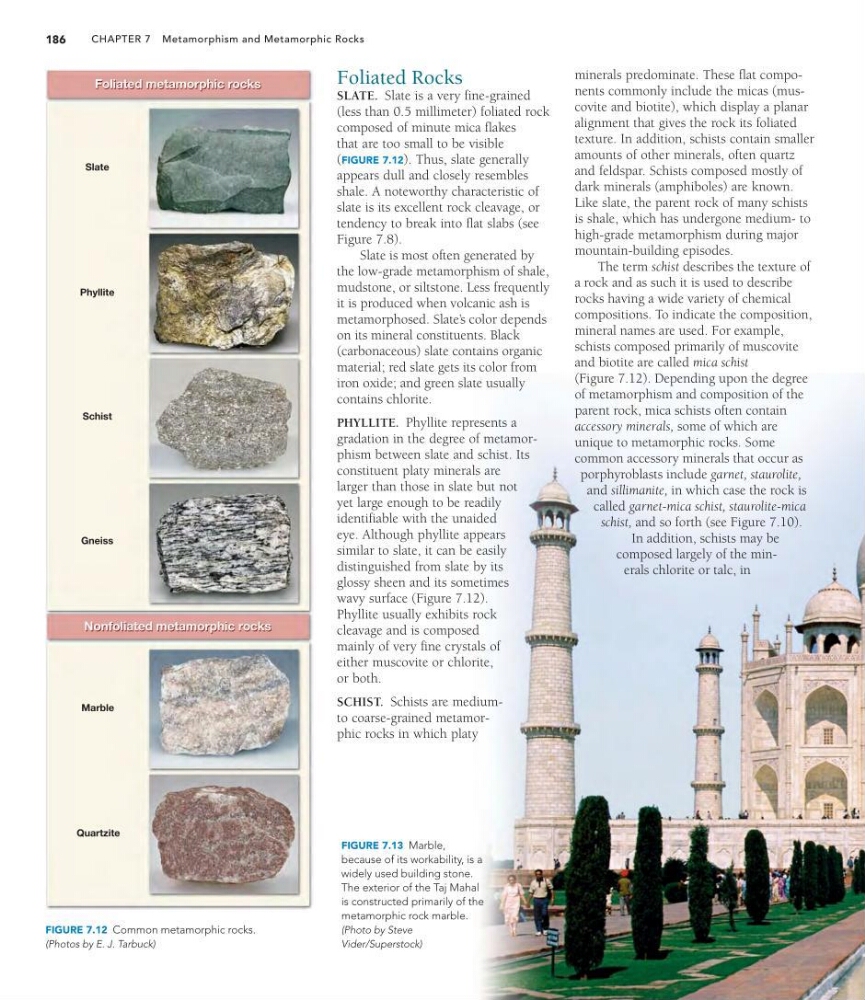
FIGURE 7.13 Marble,
because of its workability, is a
widely used building stone.
The exterior of the Taj Mahal
is constructed primarily of the
metamorphic rock marble.
(Photo by Steve
Vider/Superstock)
FIGURE 7.12 Common metamorphic rocks.
(Photos by E. J. Tarbuck)
CHAPTER 7 Metamorphism and Metamorphic Rocks
186
SLATE. Slate is a very fine-grained
(less than 0.5 millimeter) foliated rock
composed of minute mica flakes
that are too small to be visible
(FIGURE 7.12). Thus, slate generally
appears dull and closely resembles
shale. A noteworthy characteristic of
slate is its excellent rock cleavage, or
tendency to break into flat slabs (see
Figure 7.8).
Slate is most often generated by
the low-grade metamorphism of shale,
mudstone, or siltstone. Less frequently
it is produced when volcanic ash is
metamorphosed. Slate’ s color depends
on its mineral constituents. Black
(carbonaceous) slate contains organic
material; red slate gets its color from
iron oxide; and green slate usually
contains chlorite.
PHYLLITE. Phyllite represents a
gradation in the degree of metamorphism between slate and schist. Its
constituent platy minerals are
larger than those in slate but not
yet large enough to be readily
identifiable with the unaided
eye. Although phyllite appears
similar to slate, it can be easily
distinguished from slate by its
glossy sheen and its sometimes
wavy surface (Figure 7.12).
Phyllite usually exhibits rock
cleavage and is composed
mainly of very fine crystals of
either muscovite or chlorite,
or both.
SCHIST. Schists are mediumto coarse-grained metamorphic rocks in which platy
minerals predominate. These flat components commonly include the micas (muscovite and biotite), which display a planar
alignment that gives the rock its foliated
texture. In addition, schists contain smaller
amounts of other minerals, often quartz
and feldspar. Schists composed mostly of
dark minerals (amphiboles) are known.
Like slate, the parent rock of many schists
is shale, which has undergone medium- to
high-grade metamorphism during major
mountain-building episodes.
The term schist describes the texture of
a rock and as such it is used to describe
rocks having a wide variety of chemical
compositions. To indicate the composition,
mineral names are used. For example,
schists composed primarily of muscovite
and biotite are called mica schist
(Figure 7.12). Depending upon the degree
of metamorphism and composition of the
parent rock, mica schists often contain
accessory minerals, some of which are
unique to metamorphic rocks. Some
common accessory minerals that occur as
porphyroblasts include garnet, staurolite,
and sillimanite, in which case the rock is
called garnet-mica schist, staurolite-mica
schist, and so forth (see Figure 7.10).
In addition, schists may be
composed largely of the minerals chlorite or talc, in
Foliated metamorphic rocks
Slate
Phyllite
Schist
Gneiss
Nonfoliated metamorphic rocks
Foliated metamorphic rocks
Nonfoliated metamorphic rocks
Marble
Quartzite
FIGURE 7.13 Marble,
because of its workability, is a
widely used building stone.
The exterior of the Taj Mahal
is constructed primarily of the
metamorphic rock marble.
(Photo by Steve
Vider/Superstock)
FIGURE 7.12 Common metamorphic rocks.
(Photos by E. J. Tarbuck)
CHAPTER 7 Metamorphism and Metamorphic Rocks
186