

CHAPTER 7 Metamorphism and Metamorphic Rocks
184
across them. Other metamorphic rocks,
such as schists and gneisses, may also split
along planar surfaces and exhibit rock
cleavage.
SCHISTOSITY. Under higher temperaturepressure regimes, the minute mica and
chlorite crystals in slate begin to grow.
When these platy minerals are large
enough to be discernible with the unaided
eye and exhibit a planar or layered structure, the rock is said to exhibit a type of
foliation called schistosity. Rocks having
this texture are referred to as schists. In
addition to platy minerals, schists often
contain deformed quartz and feldspar
crystals that appear flat or lens-shaped
and are hidden among the mica grains.
GNEISSIC TEXTURE. During high-grade
metamorphism, ion migration can result in
the segregation of minerals as shown in
FIGURE 7.9. Notice that the dark biotite
crystals and light silicate minerals (quartz
and feldspar) have separated, giving the
rock a banded appearance called gneissic
texture. A metamorphic rock with this
texture is called gneiss (pronounced “nice”).
Although foliated, gneisses will not usually
split as easily as slates and some schists.
Other Metamorphic
Textures
Not all metamorphic rocks exhibit a
foliated texture. Those that do not are
referred to as nonfoliated. Nonfoliated
metamorphic rocks typically develop in
environments where deformation is minimal and the parent rocks are composed of
minerals that exhibit equidimensional
crystals, such as quartz or calcite. For
example, when a fine-grained limestone
(made of calcite) is metamorphosed by the
intrusion of a hot magma body, the small
calcite grains recrystallize to form larger
interlocking crystals. The resulting rock,
marble, exhibits large, equidimensional
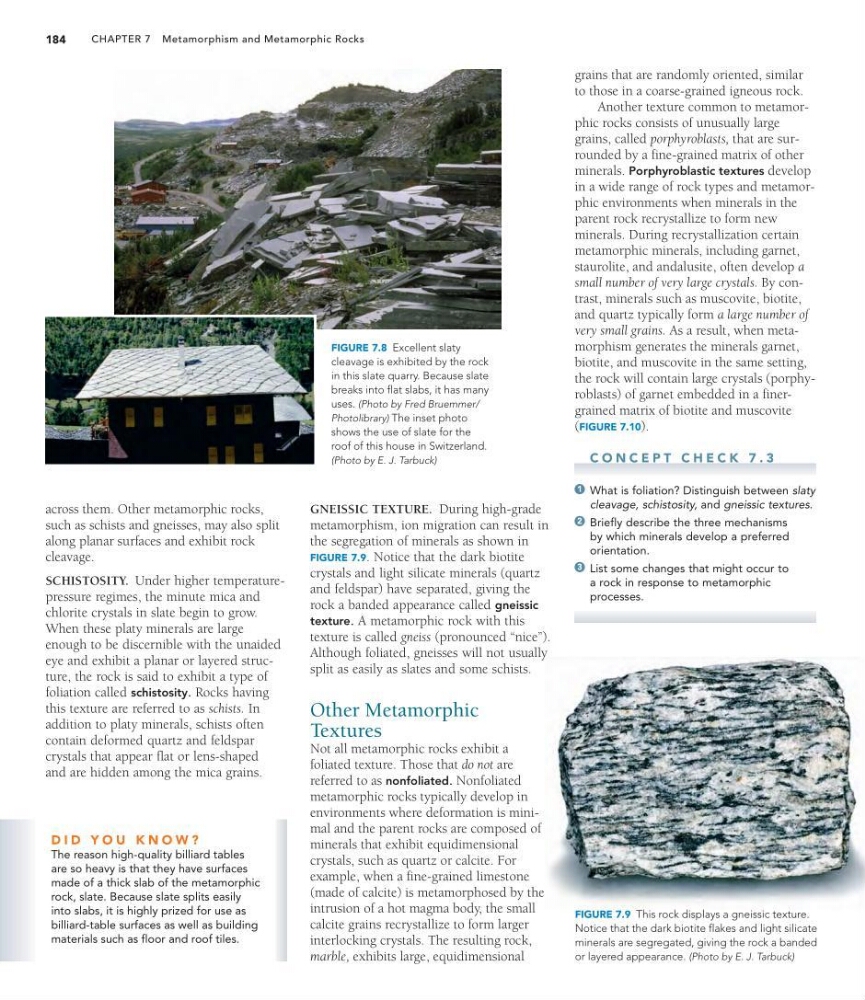
FIGURE 7.8 Excellent slaty
cleavage is exhibited by the rock
in this slate quarry. Because slate
breaks into flat slabs, it has many
uses. (Photo by Fred Bruemmer/
Photolibrary) The inset photo
shows the use of slate for the
roof of this house in Switzerland.
(Photo by E. J. Tarbuck)
D I D Y O U K N O W ?
The reason high-quality billiard tables
are so heavy is that they have surfaces
made of a thick slab of the metamorphic
rock, slate. Because slate splits easily
into slabs, it is highly prized for use as
billiard-table surfaces as well as building
materials such as floor and roof tiles.
grains that are randomly oriented, similar
to those in a coarse-grained igneous rock.
Another texture common to metamorphic rocks consists of unusually large
grains, called porphyroblasts, that are surrounded by a fine-grained matrix of other
minerals. Porphyroblastic textures develop
in a wide range of rock types and metamorphic environments when minerals in the
parent rock recrystallize to form new
minerals. During recrystallization certain
metamorphic minerals, including garnet,
staurolite, and andalusite, often develop a
small number of very large crystals. By contrast, minerals such as muscovite, biotite,
and quartz typically form a large number of
very small grains. As a result, when metamorphism generates the minerals garnet,
biotite, and muscovite in the same setting,
the rock will contain large crystals (porphyroblasts) of garnet embedded in a finergrained matrix of biotite and muscovite
(FIGURE 7.10).
C O N C E P T C H E C K 7 . 3
What is foliation? Distinguish between slaty
cleavage, schistosity, and gneissic textures.
Briefly describe the three mechanisms
by which minerals develop a preferred
orientation.
List some changes that might occur to
a rock in response to metamorphic
processes.
3
2
1
FIGURE 7.9 This rock displays a gneissic texture.
Notice that the dark biotite flakes and light silicate
minerals are segregated, giving the rock a banded
or layered appearance. (Photo by E. J. Tarbuck)
184
across them. Other metamorphic rocks,
such as schists and gneisses, may also split
along planar surfaces and exhibit rock
cleavage.
SCHISTOSITY. Under higher temperaturepressure regimes, the minute mica and
chlorite crystals in slate begin to grow.
When these platy minerals are large
enough to be discernible with the unaided
eye and exhibit a planar or layered structure, the rock is said to exhibit a type of
foliation called schistosity. Rocks having
this texture are referred to as schists. In
addition to platy minerals, schists often
contain deformed quartz and feldspar
crystals that appear flat or lens-shaped
and are hidden among the mica grains.
GNEISSIC TEXTURE. During high-grade
metamorphism, ion migration can result in
the segregation of minerals as shown in
FIGURE 7.9. Notice that the dark biotite
crystals and light silicate minerals (quartz
and feldspar) have separated, giving the
rock a banded appearance called gneissic
texture. A metamorphic rock with this
texture is called gneiss (pronounced “nice”).
Although foliated, gneisses will not usually
split as easily as slates and some schists.
Other Metamorphic
Textures
Not all metamorphic rocks exhibit a
foliated texture. Those that do not are
referred to as nonfoliated. Nonfoliated
metamorphic rocks typically develop in
environments where deformation is minimal and the parent rocks are composed of
minerals that exhibit equidimensional
crystals, such as quartz or calcite. For
example, when a fine-grained limestone
(made of calcite) is metamorphosed by the
intrusion of a hot magma body, the small
calcite grains recrystallize to form larger
interlocking crystals. The resulting rock,
marble, exhibits large, equidimensional
FIGURE 7.8 Excellent slaty
cleavage is exhibited by the rock
in this slate quarry. Because slate
breaks into flat slabs, it has many
uses. (Photo by Fred Bruemmer/
Photolibrary) The inset photo
shows the use of slate for the
roof of this house in Switzerland.
(Photo by E. J. Tarbuck)
D I D Y O U K N O W ?
The reason high-quality billiard tables
are so heavy is that they have surfaces
made of a thick slab of the metamorphic
rock, slate. Because slate splits easily
into slabs, it is highly prized for use as
billiard-table surfaces as well as building
materials such as floor and roof tiles.
grains that are randomly oriented, similar
to those in a coarse-grained igneous rock.
Another texture common to metamorphic rocks consists of unusually large
grains, called porphyroblasts, that are surrounded by a fine-grained matrix of other
minerals. Porphyroblastic textures develop
in a wide range of rock types and metamorphic environments when minerals in the
parent rock recrystallize to form new
minerals. During recrystallization certain
metamorphic minerals, including garnet,
staurolite, and andalusite, often develop a
small number of very large crystals. By contrast, minerals such as muscovite, biotite,
and quartz typically form a large number of
very small grains. As a result, when metamorphism generates the minerals garnet,
biotite, and muscovite in the same setting,
the rock will contain large crystals (porphyroblasts) of garnet embedded in a finergrained matrix of biotite and muscovite
(FIGURE 7.10).
C O N C E P T C H E C K 7 . 3
What is foliation? Distinguish between slaty
cleavage, schistosity, and gneissic textures.
Briefly describe the three mechanisms
by which minerals develop a preferred
orientation.
List some changes that might occur to
a rock in response to metamorphic
processes.
3
2
1
FIGURE 7.9 This rock displays a gneissic texture.
Notice that the dark biotite flakes and light silicate
minerals are segregated, giving the rock a banded
or layered appearance. (Photo by E. J. Tarbuck)