

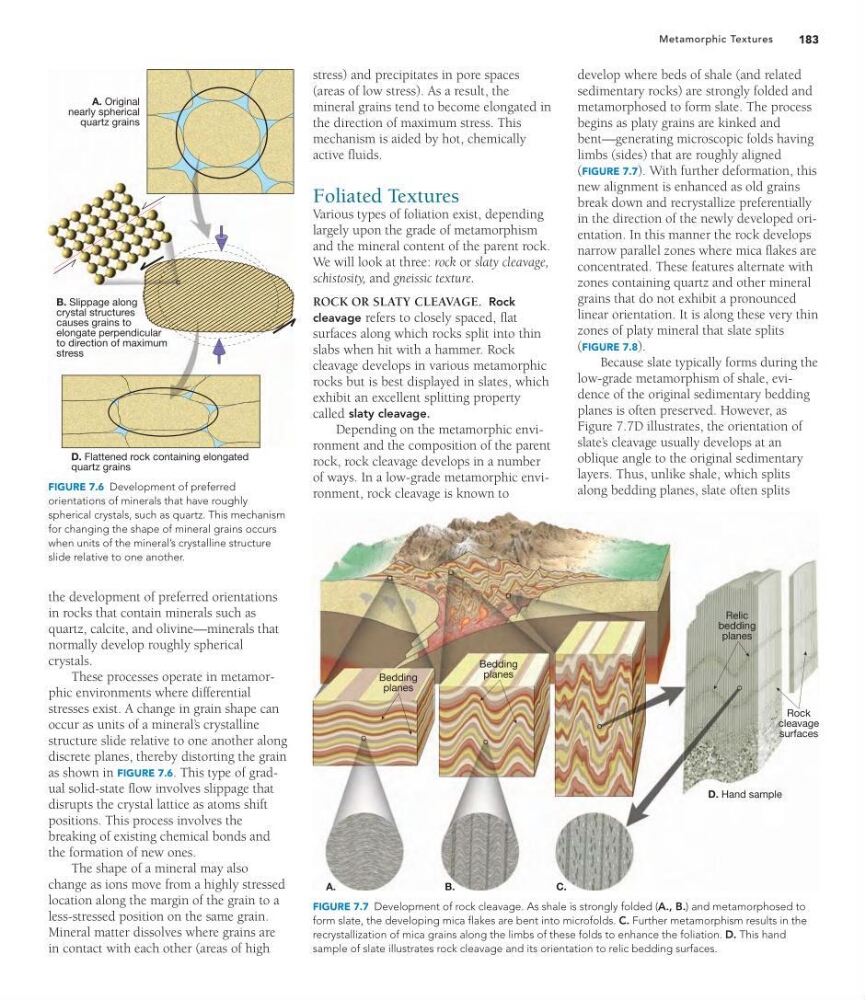
A. Original
nearly spherical
quartz grains
B. Slippage along
crystal structures
causes grains to
elongate perpendicular
to direction of maximum
stress
D. Flattened rock containing elongated
quartz grains
183
Metamorphic Textures
the development of preferred orientations
in rocks that contain minerals such as
quartz, calcite, and olivine—minerals that
normally develop roughly spherical
crystals.
These processes operate in metamorphic environments where differential
stresses exist. A change in grain shape can
occur as units of a mineral’ s crystalline
structure slide relative to one another along
discrete planes, thereby distorting the grain
as shown in FIGURE 7.6. This type of gradual solid-state flow involves slippage that
disrupts the crystal lattice as atoms shift
positions. This process involves the
breaking of existing chemical bonds and
the formation of new ones.
The shape of a mineral may also
change as ions move from a highly stressed
location along the margin of the grain to a
less-stressed position on the same grain.
Mineral matter dissolves where grains are
in contact with each other (areas of high
develop where beds of shale (and related
sedimentary rocks) are strongly folded and
metamorphosed to form slate. The process
begins as platy grains are kinked and
bent—generating microscopic folds having
limbs (sides) that are roughly aligned
(FIGURE 7.7). With further deformation, this
new alignment is enhanced as old grains
break down and recrystallize preferentially
in the direction of the newly developed orientation. In this manner the rock develops
narrow parallel zones where mica flakes are
concentrated. These features alternate with
zones containing quartz and other mineral
grains that do not exhibit a pronounced
linear orientation. It is along these very thin
zones of platy mineral that slate splits
(FIGURE 7.8).
Because slate typically forms during the
low-grade metamorphism of shale, evidence of the original sedimentary bedding
planes is often preserved. However, as
Figure 7.7D illustrates, the orientation of
slate’ s cleavage usually develops at an
oblique angle to the original sedimentary
layers. Thus, unlike shale, which splits
along bedding planes, slate often splits
FIGURE 7.6 Development of preferred
orientations of minerals that have roughly
spherical crystals, such as quartz. This mechanism
for changing the shape of mineral grains occurs
when units of the mineral’s crystalline structure
slide relative to one another.
stress) and precipitates in pore spaces
(areas of low stress). As a result, the
mineral grains tend to become elongated in
the direction of maximum stress. This
mechanism is aided by hot, chemically
active fluids.
Foliated Textures
Various types of foliation exist, depending
largely upon the grade of metamorphism
and the mineral content of the parent rock.
We will look at three: rock or slaty cleavage,
schistosity, and gneissic texture.
ROCK OR SLATY CLEAVAGE. Rock
cleavage refers to closely spaced, flat
surfaces along which rocks split into thin
slabs when hit with a hammer. Rock
cleavage develops in various metamorphic
rocks but is best displayed in slates, which
exhibit an excellent splitting property
called slaty cleavage.
Depending on the metamorphic environment and the composition of the parent
rock, rock cleavage develops in a number
of ways. In a low-grade metamorphic environment, rock cleavage is known to
Bedding
planes
Relic
bedding
planes
Rock
cleavage
surfaces
A.
B.
C.
D. Hand sample
Bedding
planes
FIGURE 7.7 Development of rock cleavage. As shale is strongly folded (A., B.) and metamorphosed to
form slate, the developing mica flakes are bent into microfolds. C. Further metamorphism results in the
recrystallization of mica grains along the limbs of these folds to enhance the foliation. D. This hand
sample of slate illustrates rock cleavage and its orientation to relic bedding surfaces.
nearly spherical
quartz grains
B. Slippage along
crystal structures
causes grains to
elongate perpendicular
to direction of maximum
stress
D. Flattened rock containing elongated
quartz grains
183
Metamorphic Textures
the development of preferred orientations
in rocks that contain minerals such as
quartz, calcite, and olivine—minerals that
normally develop roughly spherical
crystals.
These processes operate in metamorphic environments where differential
stresses exist. A change in grain shape can
occur as units of a mineral’ s crystalline
structure slide relative to one another along
discrete planes, thereby distorting the grain
as shown in FIGURE 7.6. This type of gradual solid-state flow involves slippage that
disrupts the crystal lattice as atoms shift
positions. This process involves the
breaking of existing chemical bonds and
the formation of new ones.
The shape of a mineral may also
change as ions move from a highly stressed
location along the margin of the grain to a
less-stressed position on the same grain.
Mineral matter dissolves where grains are
in contact with each other (areas of high
develop where beds of shale (and related
sedimentary rocks) are strongly folded and
metamorphosed to form slate. The process
begins as platy grains are kinked and
bent—generating microscopic folds having
limbs (sides) that are roughly aligned
(FIGURE 7.7). With further deformation, this
new alignment is enhanced as old grains
break down and recrystallize preferentially
in the direction of the newly developed orientation. In this manner the rock develops
narrow parallel zones where mica flakes are
concentrated. These features alternate with
zones containing quartz and other mineral
grains that do not exhibit a pronounced
linear orientation. It is along these very thin
zones of platy mineral that slate splits
(FIGURE 7.8).
Because slate typically forms during the
low-grade metamorphism of shale, evidence of the original sedimentary bedding
planes is often preserved. However, as
Figure 7.7D illustrates, the orientation of
slate’ s cleavage usually develops at an
oblique angle to the original sedimentary
layers. Thus, unlike shale, which splits
along bedding planes, slate often splits
FIGURE 7.6 Development of preferred
orientations of minerals that have roughly
spherical crystals, such as quartz. This mechanism
for changing the shape of mineral grains occurs
when units of the mineral’s crystalline structure
slide relative to one another.
stress) and precipitates in pore spaces
(areas of low stress). As a result, the
mineral grains tend to become elongated in
the direction of maximum stress. This
mechanism is aided by hot, chemically
active fluids.
Foliated Textures
Various types of foliation exist, depending
largely upon the grade of metamorphism
and the mineral content of the parent rock.
We will look at three: rock or slaty cleavage,
schistosity, and gneissic texture.
ROCK OR SLATY CLEAVAGE. Rock
cleavage refers to closely spaced, flat
surfaces along which rocks split into thin
slabs when hit with a hammer. Rock
cleavage develops in various metamorphic
rocks but is best displayed in slates, which
exhibit an excellent splitting property
called slaty cleavage.
Depending on the metamorphic environment and the composition of the parent
rock, rock cleavage develops in a number
of ways. In a low-grade metamorphic environment, rock cleavage is known to
Bedding
planes
Relic
bedding
planes
Rock
cleavage
surfaces
A.
B.
C.
D. Hand sample
Bedding
planes
FIGURE 7.7 Development of rock cleavage. As shale is strongly folded (A., B.) and metamorphosed to
form slate, the developing mica flakes are bent into microfolds. C. Further metamorphism results in the
recrystallization of mica grains along the limbs of these folds to enhance the foliation. D. This hand
sample of slate illustrates rock cleavage and its orientation to relic bedding surfaces.