

CHAPTER 7 Metamorphism and Metamorphic Rocks
182
D I D Y O U K N O W ?
The temperature of Earth’s crust
increases with depth, an idea that can
be expressed as the deeper one goes,
the hotter it gets. This causes
considerable problems for
underground mining efforts. In the
Western Deep Levels mine in South
Africa, which is 2.5 miles deep, the
temperature of the rock is hot enough
to scorch human skin. Here, the miners
work in groups of two: one to mine the
rock, and the other to operate the fan
that keeps them cool.
split into tabular slabs. These diverse types
of foliation can form in many different
ways, including:
1. Rotation of platy and/or elongated
mineral grains into a parallel or nearly
parallel orientation.
2. Recrystallization that produces new
minerals with grains that exhibit a
preferred orientation.
3. Mechanisms that change spherically
shaped grains into elongated shapes
that are aligned in a preferred
orientation.
The rotation of existing mineral grains
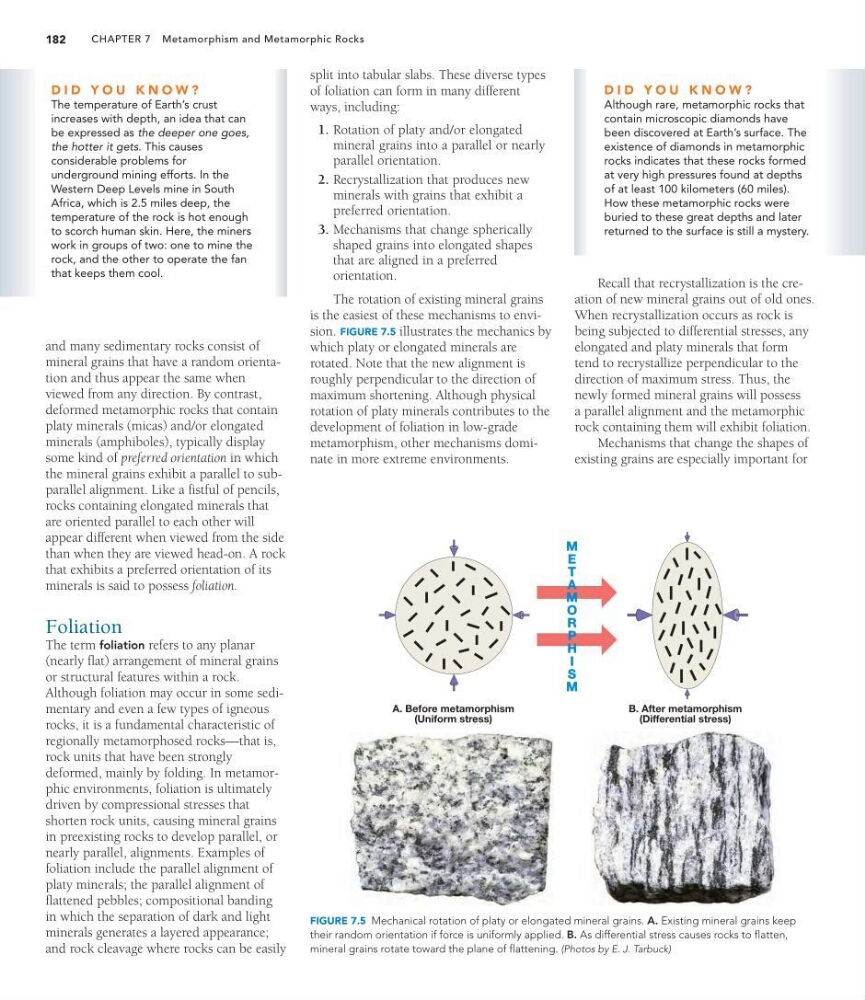
is the easiest of these mechanisms to envision. FIGURE 7.5 illustrates the mechanics by
which platy or elongated minerals are
rotated. Note that the new alignment is
roughly perpendicular to the direction of
maximum shortening. Although physical
rotation of platy minerals contributes to the
development of foliation in low-grade
metamorphism, other mechanisms dominate in more extreme environments.
D I D Y O U K N O W ?
Although rare, metamorphic rocks that
contain microscopic diamonds have
been discovered at Earth’s surface. The
existence of diamonds in metamorphic
rocks indicates that these rocks formed
at very high pressures found at depths
of at least 100 kilometers (60 miles).
How these metamorphic rocks were
buried to these great depths and later
returned to the surface is still a mystery.
A. Before metamorphism
(Uniform stress)
B. After metamorphism
(Differential stress)
M
E
T
A
M
O
R
P
H
I
S
M
M
E
T
A
M
O
R
P
H
I
S
M
FIGURE 7.5 Mechanical rotation of platy or elongated mineral grains. A. Existing mineral grains keep
their random orientation if force is uniformly applied. B. As differential stress causes rocks to flatten,
mineral grains rotate toward the plane of flattening. (Photos by E. J. Tarbuck)
and many sedimentary rocks consist of
mineral grains that have a random orientation and thus appear the same when
viewed from any direction. By contrast,
deformed metamorphic rocks that contain
platy minerals (micas) and/or elongated
minerals (amphiboles), typically display
some kind of preferred orientation in which
the mineral grains exhibit a parallel to subparallel alignment. Like a fistful of pencils,
rocks containing elongated minerals that
are oriented parallel to each other will
appear different when viewed from the side
than when they are viewed head-on. A rock
that exhibits a preferred orientation of its
minerals is said to possess foliation.
Foliation
The term foliation refers to any planar
(nearly flat) arrangement of mineral grains
or structural features within a rock.
Although foliation may occur in some sedimentary and even a few types of igneous
rocks, it is a fundamental characteristic of
regionally metamorphosed rocks—that is,
rock units that have been strongly
deformed, mainly by folding. In metamorphic environments, foliation is ultimately
driven by compressional stresses that
shorten rock units, causing mineral grains
in preexisting rocks to develop parallel, or
nearly parallel, alignments. Examples of
foliation include the parallel alignment of
platy minerals; the parallel alignment of
flattened pebbles; compositional banding
in which the separation of dark and light
minerals generates a layered appearance;
and rock cleavage where rocks can be easily
Recall that recrystallization is the creation of new mineral grains out of old ones.
When recrystallization occurs as rock is
being subjected to differential stresses, any
elongated and platy minerals that form
tend to recrystallize perpendicular to the
direction of maximum stress. Thus, the
newly formed mineral grains will possess
a parallel alignment and the metamorphic
rock containing them will exhibit foliation.
Mechanisms that change the shapes of
existing grains are especially important for
182
D I D Y O U K N O W ?
The temperature of Earth’s crust
increases with depth, an idea that can
be expressed as the deeper one goes,
the hotter it gets. This causes
considerable problems for
underground mining efforts. In the
Western Deep Levels mine in South
Africa, which is 2.5 miles deep, the
temperature of the rock is hot enough
to scorch human skin. Here, the miners
work in groups of two: one to mine the
rock, and the other to operate the fan
that keeps them cool.
split into tabular slabs. These diverse types
of foliation can form in many different
ways, including:
1. Rotation of platy and/or elongated
mineral grains into a parallel or nearly
parallel orientation.
2. Recrystallization that produces new
minerals with grains that exhibit a
preferred orientation.
3. Mechanisms that change spherically
shaped grains into elongated shapes
that are aligned in a preferred
orientation.
The rotation of existing mineral grains
is the easiest of these mechanisms to envision. FIGURE 7.5 illustrates the mechanics by
which platy or elongated minerals are
rotated. Note that the new alignment is
roughly perpendicular to the direction of
maximum shortening. Although physical
rotation of platy minerals contributes to the
development of foliation in low-grade
metamorphism, other mechanisms dominate in more extreme environments.
D I D Y O U K N O W ?
Although rare, metamorphic rocks that
contain microscopic diamonds have
been discovered at Earth’s surface. The
existence of diamonds in metamorphic
rocks indicates that these rocks formed
at very high pressures found at depths
of at least 100 kilometers (60 miles).
How these metamorphic rocks were
buried to these great depths and later
returned to the surface is still a mystery.
A. Before metamorphism
(Uniform stress)
B. After metamorphism
(Differential stress)
M
E
T
A
M
O
R
P
H
I
S
M
M
E
T
A
M
O
R
P
H
I
S
M
FIGURE 7.5 Mechanical rotation of platy or elongated mineral grains. A. Existing mineral grains keep
their random orientation if force is uniformly applied. B. As differential stress causes rocks to flatten,
mineral grains rotate toward the plane of flattening. (Photos by E. J. Tarbuck)
and many sedimentary rocks consist of
mineral grains that have a random orientation and thus appear the same when
viewed from any direction. By contrast,
deformed metamorphic rocks that contain
platy minerals (micas) and/or elongated
minerals (amphiboles), typically display
some kind of preferred orientation in which
the mineral grains exhibit a parallel to subparallel alignment. Like a fistful of pencils,
rocks containing elongated minerals that
are oriented parallel to each other will
appear different when viewed from the side
than when they are viewed head-on. A rock
that exhibits a preferred orientation of its
minerals is said to possess foliation.
Foliation
The term foliation refers to any planar
(nearly flat) arrangement of mineral grains
or structural features within a rock.
Although foliation may occur in some sedimentary and even a few types of igneous
rocks, it is a fundamental characteristic of
regionally metamorphosed rocks—that is,
rock units that have been strongly
deformed, mainly by folding. In metamorphic environments, foliation is ultimately
driven by compressional stresses that
shorten rock units, causing mineral grains
in preexisting rocks to develop parallel, or
nearly parallel, alignments. Examples of
foliation include the parallel alignment of
platy minerals; the parallel alignment of
flattened pebbles; compositional banding
in which the separation of dark and light
minerals generates a layered appearance;
and rock cleavage where rocks can be easily
Recall that recrystallization is the creation of new mineral grains out of old ones.
When recrystallization occurs as rock is
being subjected to differential stresses, any
elongated and platy minerals that form
tend to recrystallize perpendicular to the
direction of maximum stress. Thus, the
newly formed mineral grains will possess
a parallel alignment and the metamorphic
rock containing them will exhibit foliation.
Mechanisms that change the shapes of
existing grains are especially important for