

heat
181
Metamorphic Textures
In surface environments where temperatures are comparatively low, rocks are brittle
and tend to fracture when subjected to
differential stress. Continued deformation
grinds and pulverizes the mineral grains
into small fragments. By contrast, in hightemperature environments rocks are ductile.
When rocks exhibit ductile behavior, their
mineral grains tend to flatten and elongate when
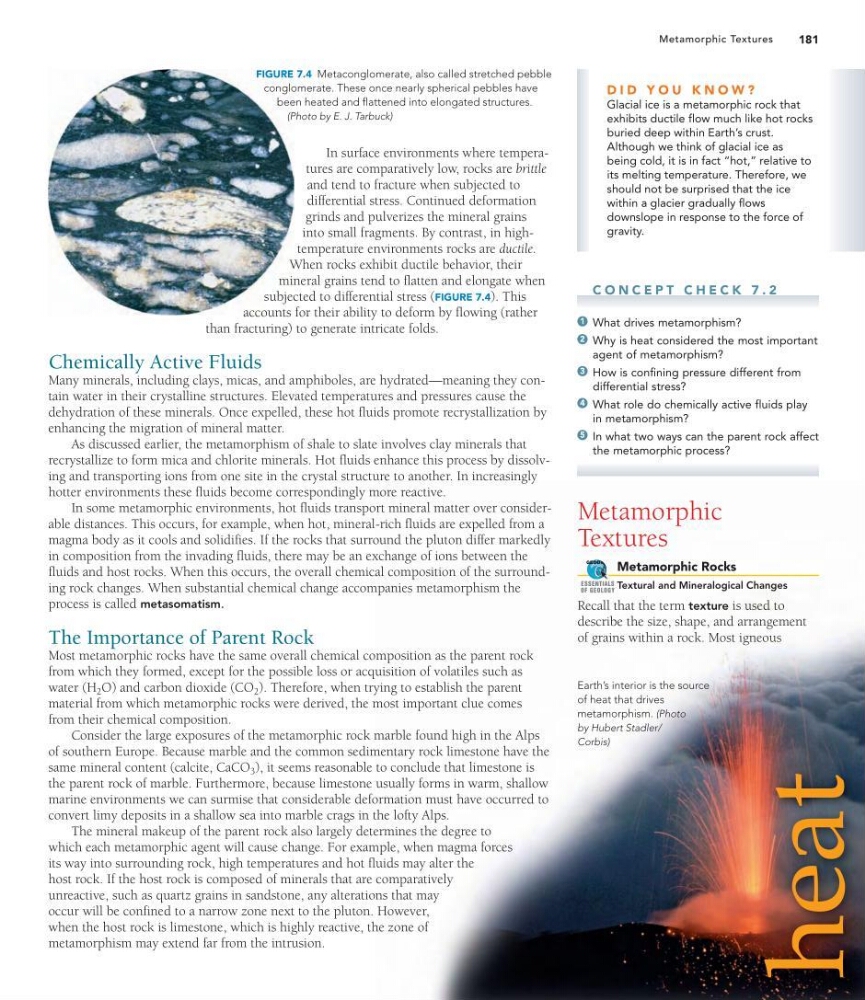
subjected to differential stress (FIGURE 7.4). This
accounts for their ability to deform by flowing (rather
than fracturing) to generate intricate folds.
Chemically Active Fluids
Many minerals, including clays, micas, and amphiboles, are hydrated—meaning they contain water in their crystalline structures. Elevated temperatures and pressures cause the
dehydration of these minerals. Once expelled, these hot fluids promote recrystallization by
enhancing the migration of mineral matter.
As discussed earlier, the metamorphism of shale to slate involves clay minerals that
recrystallize to form mica and chlorite minerals. Hot fluids enhance this process by dissolving and transporting ions from one site in the crystal structure to another. In increasingly
hotter environments these fluids become correspondingly more reactive.
In some metamorphic environments, hot fluids transport mineral matter over considerable distances. This occurs, for example, when hot, mineral-rich fluids are expelled from a
magma body as it cools and solidifies. If the rocks that surround the pluton differ markedly
in composition from the invading fluids, there may be an exchange of ions between the
fluids and host rocks. When this occurs, the overall chemical composition of the surrounding rock changes. When substantial chemical change accompanies metamorphism the
process is called metasomatism.
The Importance of Parent Rock
Most metamorphic rocks have the same overall chemical composition as the parent rock
from which they formed, except for the possible loss or acquisition of volatiles such as
water (H 2 O) and carbon dioxide (CO 2 ). Therefore, when trying to establish the parent
material from which metamorphic rocks were derived, the most important clue comes
from their chemical composition.
Consider the large exposures of the metamorphic rock marble found high in the Alps
of southern Europe. Because marble and the common sedimentary rock limestone have the
same mineral content (calcite, CaCO 3 ), it seems reasonable to conclude that limestone is
the parent rock of marble. Furthermore, because limestone usually forms in warm, shallow
marine environments we can surmise that considerable deformation must have occurred to
convert limy deposits in a shallow sea into marble crags in the lofty Alps.
The mineral makeup of the parent rock also largely determines the degree to
which each metamorphic agent will cause change. For example, when magma forces
its way into surrounding rock, high temperatures and hot fluids may alter the
host rock. If the host rock is composed of minerals that are comparatively
unreactive, such as quartz grains in sandstone, any alterations that may
occur will be confined to a narrow zone next to the pluton. However,
when the host rock is limestone, which is highly reactive, the zone of
metamorphism may extend far from the intrusion.
FIGURE 7.4 Metaconglomerate, also called stretched pebble
conglomerate. These once nearly spherical pebbles have
been heated and flattened into elongated structures.
(Photo by E. J. Tarbuck)
C O N C E P T C H E C K 7 . 2
What drives metamorphism?
Why is heat considered the most important
agent of metamorphism?
How is confining pressure different from
differential stress?
What role do chemically active fluids play
in metamorphism?
In what two ways can the parent rock affect
the metamorphic process?
Metamorphic
Textures
Metamorphic Rocks
Textural and Mineralogical Changes
Recall that the term texture is used to
describe the size, shape, and arrangement
of grains within a rock. Most igneous
GEODe
ESSENTIALS
OF GEOLOGY
5
4
3
2
1
Earth’s interior is the source
of heat that drives
metamorphism. (Photo
by Hubert Stadler/
Corbis)
D I D Y O U K N O W ?
Glacial ice is a metamorphic rock that
exhibits ductile flow much like hot rocks
buried deep within Earth’s crust.
Although we think of glacial ice as
being cold, it is in fact “hot,” relative to
its melting temperature. Therefore, we
should not be surprised that the ice
within a glacier gradually flows
downslope in response to the force of
gravity.
181
Metamorphic Textures
In surface environments where temperatures are comparatively low, rocks are brittle
and tend to fracture when subjected to
differential stress. Continued deformation
grinds and pulverizes the mineral grains
into small fragments. By contrast, in hightemperature environments rocks are ductile.
When rocks exhibit ductile behavior, their
mineral grains tend to flatten and elongate when
subjected to differential stress (FIGURE 7.4). This
accounts for their ability to deform by flowing (rather
than fracturing) to generate intricate folds.
Chemically Active Fluids
Many minerals, including clays, micas, and amphiboles, are hydrated—meaning they contain water in their crystalline structures. Elevated temperatures and pressures cause the
dehydration of these minerals. Once expelled, these hot fluids promote recrystallization by
enhancing the migration of mineral matter.
As discussed earlier, the metamorphism of shale to slate involves clay minerals that
recrystallize to form mica and chlorite minerals. Hot fluids enhance this process by dissolving and transporting ions from one site in the crystal structure to another. In increasingly
hotter environments these fluids become correspondingly more reactive.
In some metamorphic environments, hot fluids transport mineral matter over considerable distances. This occurs, for example, when hot, mineral-rich fluids are expelled from a
magma body as it cools and solidifies. If the rocks that surround the pluton differ markedly
in composition from the invading fluids, there may be an exchange of ions between the
fluids and host rocks. When this occurs, the overall chemical composition of the surrounding rock changes. When substantial chemical change accompanies metamorphism the
process is called metasomatism.
The Importance of Parent Rock
Most metamorphic rocks have the same overall chemical composition as the parent rock
from which they formed, except for the possible loss or acquisition of volatiles such as
water (H 2 O) and carbon dioxide (CO 2 ). Therefore, when trying to establish the parent
material from which metamorphic rocks were derived, the most important clue comes
from their chemical composition.
Consider the large exposures of the metamorphic rock marble found high in the Alps
of southern Europe. Because marble and the common sedimentary rock limestone have the
same mineral content (calcite, CaCO 3 ), it seems reasonable to conclude that limestone is
the parent rock of marble. Furthermore, because limestone usually forms in warm, shallow
marine environments we can surmise that considerable deformation must have occurred to
convert limy deposits in a shallow sea into marble crags in the lofty Alps.
The mineral makeup of the parent rock also largely determines the degree to
which each metamorphic agent will cause change. For example, when magma forces
its way into surrounding rock, high temperatures and hot fluids may alter the
host rock. If the host rock is composed of minerals that are comparatively
unreactive, such as quartz grains in sandstone, any alterations that may
occur will be confined to a narrow zone next to the pluton. However,
when the host rock is limestone, which is highly reactive, the zone of
metamorphism may extend far from the intrusion.
FIGURE 7.4 Metaconglomerate, also called stretched pebble
conglomerate. These once nearly spherical pebbles have
been heated and flattened into elongated structures.
(Photo by E. J. Tarbuck)
C O N C E P T C H E C K 7 . 2
What drives metamorphism?
Why is heat considered the most important
agent of metamorphism?
How is confining pressure different from
differential stress?
What role do chemically active fluids play
in metamorphism?
In what two ways can the parent rock affect
the metamorphic process?
Metamorphic
Textures
Metamorphic Rocks
Textural and Mineralogical Changes
Recall that the term texture is used to
describe the size, shape, and arrangement
of grains within a rock. Most igneous
GEODe
ESSENTIALS
OF GEOLOGY
5
4
3
2
1
Earth’s interior is the source
of heat that drives
metamorphism. (Photo
by Hubert Stadler/
Corbis)
D I D Y O U K N O W ?
Glacial ice is a metamorphic rock that
exhibits ductile flow much like hot rocks
buried deep within Earth’s crust.
Although we think of glacial ice as
being cold, it is in fact “hot,” relative to
its melting temperature. Therefore, we
should not be surprised that the ice
within a glacier gradually flows
downslope in response to the force of
gravity.