

CHAPTER 7 Metamorphism and Metamorphic Rocks
180
D I D Y O U K N O W ?
Some low-grade metamorphic rocks
actually contain fossils. When fossils are
present in metamorphic rocks, they
provide useful clues for determining
the original rock type and its
depositional environment. In addition,
fossils whose shapes have been
distorted during metamorphism
provide insight into the extent to which
the rock has been deformed.
A. Confining pressure
Increasing
confining
pressure
B. Differential stress
Undeformed
strata
Deformed
strata
Undeformed
strata
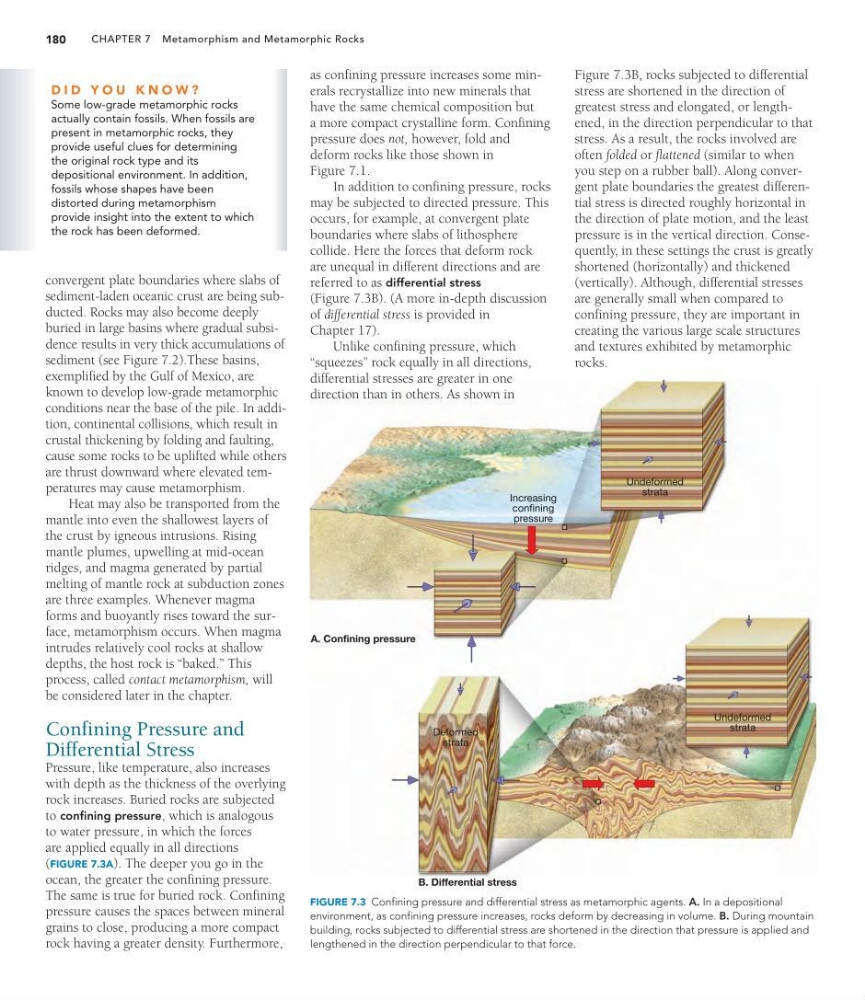
FIGURE 7.3 Confining pressure and differential stress as metamorphic agents. A. In a depositional
environment, as confining pressure increases, rocks deform by decreasing in volume. B. During mountain
building, rocks subjected to differential stress are shortened in the direction that pressure is applied and
lengthened in the direction perpendicular to that force.
as confining pressure increases some minerals recrystallize into new minerals that
have the same chemical composition but
a more compact crystalline form. Confining
pressure does not, however, fold and
deform rocks like those shown in
Figure 7.1.
In addition to confining pressure, rocks
may be subjected to directed pressure. This
occurs, for example, at convergent plate
boundaries where slabs of lithosphere
collide. Here the forces that deform rock
are unequal in different directions and are
referred to as differential stress
(Figure 7.3B). (A more in-depth discussion
of differential stress is provided in
Chapter 17).
Unlike confining pressure, which
“squeezes” rock equally in all directions,
differential stresses are greater in one
direction than in others. As shown in
convergent plate boundaries where slabs of
sediment-laden oceanic crust are being subducted. Rocks may also become deeply
buried in large basins where gradual subsidence results in very thick accumulations of
sediment (see Figure 7.2).These basins,
exemplified by the Gulf of Mexico, are
known to develop low-grade metamorphic
conditions near the base of the pile. In addition, continental collisions, which result in
crustal thickening by folding and faulting,
cause some rocks to be uplifted while others
are thrust downward where elevated temperatures may cause metamorphism.
Heat may also be transported from the
mantle into even the shallowest layers of
the crust by igneous intrusions. Rising
mantle plumes, upwelling at mid-ocean
ridges, and magma generated by partial
melting of mantle rock at subduction zones
are three examples. Whenever magma
forms and buoyantly rises toward the surface, metamorphism occurs. When magma
intrudes relatively cool rocks at shallow
depths, the host rock is “baked.” This
process, called contact metamorphism, will
be considered later in the chapter.
Confining Pressure and
Differential Stress
Pressure, like temperature, also increases
with depth as the thickness of the overlying
rock increases. Buried rocks are subjected
to confining pressure, which is analogous
to water pressure, in which the forces
are applied equally in all directions
(FIGURE 7.3A). The deeper you go in the
ocean, the greater the confining pressure.
The same is true for buried rock. Confining
pressure causes the spaces between mineral
grains to close, producing a more compact
rock having a greater density. Furthermore,
Figure 7.3B, rocks subjected to differential
stress are shortened in the direction of
greatest stress and elongated, or lengthened, in the direction perpendicular to that
stress. As a result, the rocks involved are
often folded or flattened (similar to when
you step on a rubber ball). Along convergent plate boundaries the greatest differential stress is directed roughly horizontal in
the direction of plate motion, and the least
pressure is in the vertical direction. Consequently, in these settings the crust is greatly
shortened (horizontally) and thickened
(vertically). Although, differential stresses
are generally small when compared to
confining pressure, they are important in
creating the various large scale structures
and textures exhibited by metamorphic
rocks.
180
D I D Y O U K N O W ?
Some low-grade metamorphic rocks
actually contain fossils. When fossils are
present in metamorphic rocks, they
provide useful clues for determining
the original rock type and its
depositional environment. In addition,
fossils whose shapes have been
distorted during metamorphism
provide insight into the extent to which
the rock has been deformed.
A. Confining pressure
Increasing
confining
pressure
B. Differential stress
Undeformed
strata
Deformed
strata
Undeformed
strata
FIGURE 7.3 Confining pressure and differential stress as metamorphic agents. A. In a depositional
environment, as confining pressure increases, rocks deform by decreasing in volume. B. During mountain
building, rocks subjected to differential stress are shortened in the direction that pressure is applied and
lengthened in the direction perpendicular to that force.
as confining pressure increases some minerals recrystallize into new minerals that
have the same chemical composition but
a more compact crystalline form. Confining
pressure does not, however, fold and
deform rocks like those shown in
Figure 7.1.
In addition to confining pressure, rocks
may be subjected to directed pressure. This
occurs, for example, at convergent plate
boundaries where slabs of lithosphere
collide. Here the forces that deform rock
are unequal in different directions and are
referred to as differential stress
(Figure 7.3B). (A more in-depth discussion
of differential stress is provided in
Chapter 17).
Unlike confining pressure, which
“squeezes” rock equally in all directions,
differential stresses are greater in one
direction than in others. As shown in
convergent plate boundaries where slabs of
sediment-laden oceanic crust are being subducted. Rocks may also become deeply
buried in large basins where gradual subsidence results in very thick accumulations of
sediment (see Figure 7.2).These basins,
exemplified by the Gulf of Mexico, are
known to develop low-grade metamorphic
conditions near the base of the pile. In addition, continental collisions, which result in
crustal thickening by folding and faulting,
cause some rocks to be uplifted while others
are thrust downward where elevated temperatures may cause metamorphism.
Heat may also be transported from the
mantle into even the shallowest layers of
the crust by igneous intrusions. Rising
mantle plumes, upwelling at mid-ocean
ridges, and magma generated by partial
melting of mantle rock at subduction zones
are three examples. Whenever magma
forms and buoyantly rises toward the surface, metamorphism occurs. When magma
intrudes relatively cool rocks at shallow
depths, the host rock is “baked.” This
process, called contact metamorphism, will
be considered later in the chapter.
Confining Pressure and
Differential Stress
Pressure, like temperature, also increases
with depth as the thickness of the overlying
rock increases. Buried rocks are subjected
to confining pressure, which is analogous
to water pressure, in which the forces
are applied equally in all directions
(FIGURE 7.3A). The deeper you go in the
ocean, the greater the confining pressure.
The same is true for buried rock. Confining
pressure causes the spaces between mineral
grains to close, producing a more compact
rock having a greater density. Furthermore,
Figure 7.3B, rocks subjected to differential
stress are shortened in the direction of
greatest stress and elongated, or lengthened, in the direction perpendicular to that
stress. As a result, the rocks involved are
often folded or flattened (similar to when
you step on a rubber ball). Along convergent plate boundaries the greatest differential stress is directed roughly horizontal in
the direction of plate motion, and the least
pressure is in the vertical direction. Consequently, in these settings the crust is greatly
shortened (horizontally) and thickened
(vertically). Although, differential stresses
are generally small when compared to
confining pressure, they are important in
creating the various large scale structures
and textures exhibited by metamorphic
rocks.