

CHAPTER 7 Metamorphism and Metamorphic Rocks
178
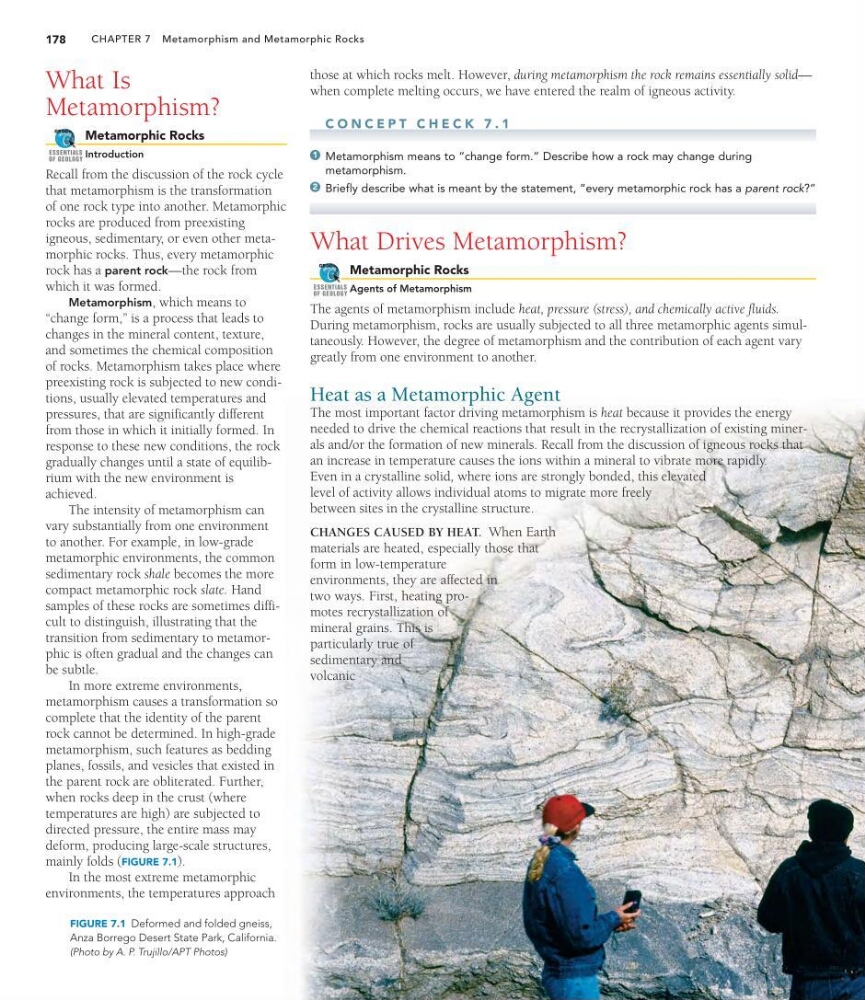
FIGURE 7.1 Deformed and folded gneiss,
Anza Borrego Desert State Park, California.
(Photo by A. P. Trujillo/APT Photos)
What Is
Metamorphism?
Metamorphic Rocks
Introduction
Recall from the discussion of the rock cycle
that metamorphism is the transformation
of one rock type into another. Metamorphic
rocks are produced from preexisting
igneous, sedimentary, or even other metamorphic rocks. Thus, every metamorphic
rock has a parent rock—the rock from
which it was formed.
Metamorphism, which means to
“change form,” is a process that leads to
changes in the mineral content, texture,
and sometimes the chemical composition
of rocks. Metamorphism takes place where
preexisting rock is subjected to new conditions, usually elevated temperatures and
pressures, that are significantly different
from those in which it initially formed. In
response to these new conditions, the rock
gradually changes until a state of equilibrium with the new environment is
achieved.
The intensity of metamorphism can
vary substantially from one environment
to another. For example, in low-grade
metamorphic environments, the common
sedimentary rock shale becomes the more
compact metamorphic rock slate. Hand
samples of these rocks are sometimes difficult to distinguish, illustrating that the
transition from sedimentary to metamorphic is often gradual and the changes can
be subtle.
In more extreme environments,
metamorphism causes a transformation so
complete that the identity of the parent
rock cannot be determined. In high-grade
metamorphism, such features as bedding
planes, fossils, and vesicles that existed in
the parent rock are obliterated. Further,
when rocks deep in the crust (where
temperatures are high) are subjected to
directed pressure, the entire mass may
deform, producing large-scale structures,
mainly folds (FIGURE 7.1).
In the most extreme metamorphic
environments, the temperatures approach
GEODe
ESSENTIALS
OF GEOLOGY
those at which rocks melt. However, during metamorphism the rock remains essentially solid—
when complete melting occurs, we have entered the realm of igneous activity.
C O N C E P T C H E C K 7 . 1
Metamorphism means to “change form.” Describe how a rock may change during
metamorphism.
Briefly describe what is meant by the statement, “every metamorphic rock has a parent rock?”
What Drives Metamorphism?
Metamorphic Rocks
Agents of Metamorphism
The agents of metamorphism include heat, pressure (stress), and chemically active fluids.
During metamorphism, rocks are usually subjected to all three metamorphic agents simultaneously. However, the degree of metamorphism and the contribution of each agent vary
greatly from one environment to another.
Heat as a Metamorphic Agent
The most important factor driving metamorphism is heat because it provides the energy
needed to drive the chemical reactions that result in the recrystallization of existing minerals and/or the formation of new minerals. Recall from the discussion of igneous rocks that
an increase in temperature causes the ions within a mineral to vibrate more rapidly.
Even in a crystalline solid, where ions are strongly bonded, this elevated
level of activity allows individual atoms to migrate more freely
between sites in the crystalline structure.
CHANGES CAUSED BY HEAT. When Earth
materials are heated, especially those that
form in low-temperature
environments, they are affected in
two ways. First, heating promotes recrystallization of
mineral grains. This is
particularly true of
sedimentary and
volcanic
GEODe
ESSENTIALS
OF GEOLOGY
2
1
178
FIGURE 7.1 Deformed and folded gneiss,
Anza Borrego Desert State Park, California.
(Photo by A. P. Trujillo/APT Photos)
What Is
Metamorphism?
Metamorphic Rocks
Introduction
Recall from the discussion of the rock cycle
that metamorphism is the transformation
of one rock type into another. Metamorphic
rocks are produced from preexisting
igneous, sedimentary, or even other metamorphic rocks. Thus, every metamorphic
rock has a parent rock—the rock from
which it was formed.
Metamorphism, which means to
“change form,” is a process that leads to
changes in the mineral content, texture,
and sometimes the chemical composition
of rocks. Metamorphism takes place where
preexisting rock is subjected to new conditions, usually elevated temperatures and
pressures, that are significantly different
from those in which it initially formed. In
response to these new conditions, the rock
gradually changes until a state of equilibrium with the new environment is
achieved.
The intensity of metamorphism can
vary substantially from one environment
to another. For example, in low-grade
metamorphic environments, the common
sedimentary rock shale becomes the more
compact metamorphic rock slate. Hand
samples of these rocks are sometimes difficult to distinguish, illustrating that the
transition from sedimentary to metamorphic is often gradual and the changes can
be subtle.
In more extreme environments,
metamorphism causes a transformation so
complete that the identity of the parent
rock cannot be determined. In high-grade
metamorphism, such features as bedding
planes, fossils, and vesicles that existed in
the parent rock are obliterated. Further,
when rocks deep in the crust (where
temperatures are high) are subjected to
directed pressure, the entire mass may
deform, producing large-scale structures,
mainly folds (FIGURE 7.1).
In the most extreme metamorphic
environments, the temperatures approach
GEODe
ESSENTIALS
OF GEOLOGY
those at which rocks melt. However, during metamorphism the rock remains essentially solid—
when complete melting occurs, we have entered the realm of igneous activity.
C O N C E P T C H E C K 7 . 1
Metamorphism means to “change form.” Describe how a rock may change during
metamorphism.
Briefly describe what is meant by the statement, “every metamorphic rock has a parent rock?”
What Drives Metamorphism?
Metamorphic Rocks
Agents of Metamorphism
The agents of metamorphism include heat, pressure (stress), and chemically active fluids.
During metamorphism, rocks are usually subjected to all three metamorphic agents simultaneously. However, the degree of metamorphism and the contribution of each agent vary
greatly from one environment to another.
Heat as a Metamorphic Agent
The most important factor driving metamorphism is heat because it provides the energy
needed to drive the chemical reactions that result in the recrystallization of existing minerals and/or the formation of new minerals. Recall from the discussion of igneous rocks that
an increase in temperature causes the ions within a mineral to vibrate more rapidly.
Even in a crystalline solid, where ions are strongly bonded, this elevated
level of activity allows individual atoms to migrate more freely
between sites in the crystalline structure.
CHANGES CAUSED BY HEAT. When Earth
materials are heated, especially those that
form in low-temperature
environments, they are affected in
two ways. First, heating promotes recrystallization of
mineral grains. This is
particularly true of
sedimentary and
volcanic
GEODe
ESSENTIALS
OF GEOLOGY
2
1