

T
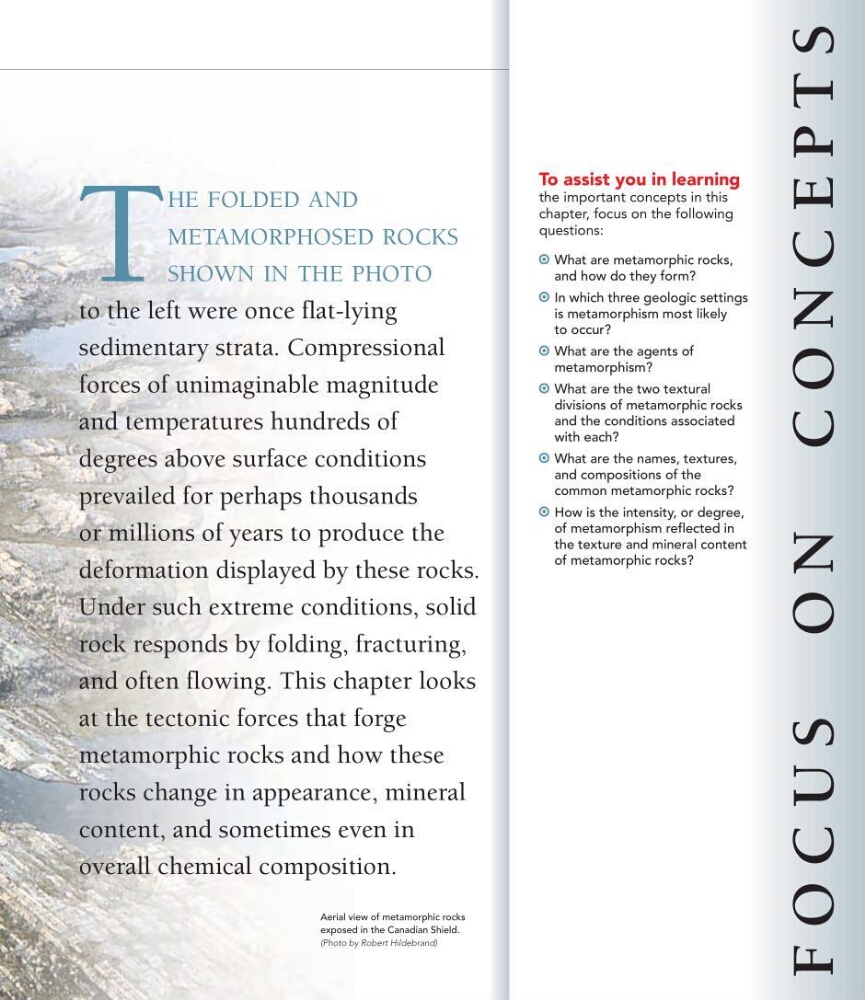
HE FOLDED AND
METAMORPHOSED ROCKS
SHOWN IN THE PHOTO
to the left were once flat-lying
sedimentary strata. Compressional
forces of unimaginable magnitude
and temperatures hundreds of
degrees above surface conditions
prevailed for perhaps thousands
or millions of years to produce the
deformation displayed by these rocks.
Under such extreme conditions, solid
rock responds by folding, fracturing,
and often flowing. This chapter looks
at the tectonic forces that forge
metamorphic rocks and how these
rocks change in appearance, mineral
content, and sometimes even in
overall chemical composition.
F O C U S O N C O N C E P T S
To assist you in learning
the important concepts in this
chapter, focus on the following
questions:
What are metamorphic rocks,
and how do they form?
In which three geologic settings
is metamorphism most likely
to occur?
What are the agents of
metamorphism?
What are the two textural
divisions of metamorphic rocks
and the conditions associated
with each?
What are the names, textures,
and compositions of the
common metamorphic rocks?
How is the intensity, or degree,
of metamorphism reflected in
the texture and mineral content
of metamorphic rocks?
Aerial view of metamorphic rocks
exposed in the Canadian Shield.
(Photo by Robert Hildebrand)
HE FOLDED AND
METAMORPHOSED ROCKS
SHOWN IN THE PHOTO
to the left were once flat-lying
sedimentary strata. Compressional
forces of unimaginable magnitude
and temperatures hundreds of
degrees above surface conditions
prevailed for perhaps thousands
or millions of years to produce the
deformation displayed by these rocks.
Under such extreme conditions, solid
rock responds by folding, fracturing,
and often flowing. This chapter looks
at the tectonic forces that forge
metamorphic rocks and how these
rocks change in appearance, mineral
content, and sometimes even in
overall chemical composition.
F O C U S O N C O N C E P T S
To assist you in learning
the important concepts in this
chapter, focus on the following
questions:
What are metamorphic rocks,
and how do they form?
In which three geologic settings
is metamorphism most likely
to occur?
What are the agents of
metamorphism?
What are the two textural
divisions of metamorphic rocks
and the conditions associated
with each?
What are the names, textures,
and compositions of the
common metamorphic rocks?
How is the intensity, or degree,
of metamorphism reflected in
the texture and mineral content
of metamorphic rocks?
Aerial view of metamorphic rocks
exposed in the Canadian Shield.
(Photo by Robert Hildebrand)