

Burning
of fossil
fuels
Photosynthesis
by vegetation
Weathering
of carbonate
rock
Weathering
of
granite
Volcanic
activity
Burning and
decay of
biomass
Respiration
by land
organisms
Photosynthesis
and respiration
of marine
organisms
Deposition
of carbonate
sediments
Burial of
biomass
CO2
dissolves
in seawater
Lithosphere
Sediment and
sedimentary rock
CO2 entering the
atmosphere
CO 2 leaving the
atmosphere
Oil and Natural Gas
Petroleum and natural gas obviously are
not rocks, but we class them as mineral
resources because they come from sedimentary rocks. They are found in similar environments and typically occur together. Both
consist of various hydrocarbon compounds
(compounds consisting of hydrogen and
carbon) mixed together. They may also
contain small quantities of other elements,
such as sulfur, nitrogen, and oxygen. Like
coal, petroleum and natural gas are biological products derived from the remains of
organisms. However, the environments in
which they form are very different, as are
the organisms. Coal is formed mostly from
plant material that accumulated in a
swampy environment above sea level.
Oil and gas are derived from the remains
of both plants and animals having a
marine origin.
Petroleum formation is complex and
not completely understood. Nevertheless,
we know that it begins with the accumulation of sediment in ocean areas that are rich
in plant and animal remains. These accumulations must occur where biological
activity is high, such as nearshore areas.
However, most marine environments are
oxygen rich, which leads to the decay of
organic remains before they can be buried
by other sediments. Therefore, accumulations of oil and gas are not as widespread as
the marine environments that support abundant biological activity. This limiting factor
notwithstanding, large quantities of organic matter are buried and protected from oxidation
in many offshore sedimentary basins. With increasing burial over millions of years, chemical reactions gradually transform some of the original organic matter into the liquid and
gaseous hydrocarbons we call petroleum and natural gas.
Unlike the solid organic matter from which they formed, the newly created petroleum
and natural gas are mobile. These fluids are gradually squeezed from the compacting, mudrich layers where they originate into adjacent permeable beds such as sandstone, where
openings between sediment grains are larger. Because all of this occurs underwater, the rock
layers containing the oil and gas are already saturated with water. But oil and gas are less
dense than water, so they migrate upward through the water-filled pore spaces of the
enclosing rocks. Unless something acts to halt this upward migration, the fluids will
eventually reach the surface. There the volatile components will evaporate.
Sometimes the upward migration is halted. A geologic environment that allows for
economically significant amounts of oil and gas to accumulate underground is termed an oil
trap. Several geologic structures can act as oil traps. All have two basic conditions in common: a porous, permeable reservoir rock that will yield petroleum and natural gas in sufficient quantities to make drilling worthwhile; and a cap rock, such as shale, that is virtually
impermeable to oil and gas. The cap rock keeps the upwardly mobile oil and gas from
escaping at the surface.
C O N C E P T C H E C K 6 . 1 1
Coal has the advantage of being plentiful. What are some of coal’s disadvantages?
What is an oil trap? List two conditions common to all traps.
The Carbon Cycle and Sedimentary Rocks
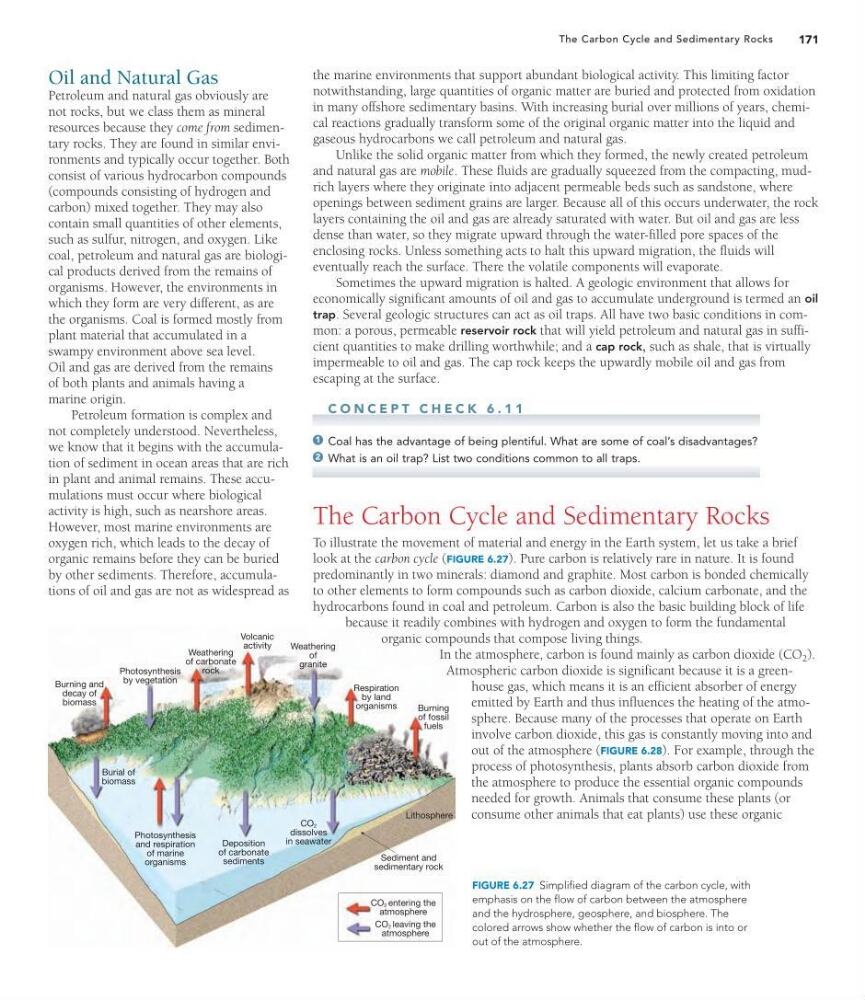
To illustrate the movement of material and energy in the Earth system, let us take a brief
look at the carbon cycle (FIGURE 6.27). Pure carbon is relatively rare in nature. It is found
predominantly in two minerals: diamond and graphite. Most carbon is bonded chemically
to other elements to form compounds such as carbon dioxide, calcium carbonate, and the
hydrocarbons found in coal and petroleum. Carbon is also the basic building block of life
because it readily combines with hydrogen and oxygen to form the fundamental
organic compounds that compose living things.
In the atmosphere, carbon is found mainly as carbon dioxide (CO 2 ).
Atmospheric carbon dioxide is significant because it is a greenhouse gas, which means it is an efficient absorber of energy
emitted by Earth and thus influences the heating of the atmosphere. Because many of the processes that operate on Earth
involve carbon dioxide, this gas is constantly moving into and
out of the atmosphere (FIGURE 6.28). For example, through the
process of photosynthesis, plants absorb carbon dioxide from
the atmosphere to produce the essential organic compounds
needed for growth. Animals that consume these plants (or
consume other animals that eat plants) use these organic
2
1
171
The Carbon Cycle and Sedimentary Rocks
FIGURE 6.27 Simplified diagram of the carbon cycle, with
emphasis on the flow of carbon between the atmosphere
and the hydrosphere, geosphere, and biosphere. The
colored arrows show whether the flow of carbon is into or
out of the atmosphere.
of fossil
fuels
Photosynthesis
by vegetation
Weathering
of carbonate
rock
Weathering
of
granite
Volcanic
activity
Burning and
decay of
biomass
Respiration
by land
organisms
Photosynthesis
and respiration
of marine
organisms
Deposition
of carbonate
sediments
Burial of
biomass
CO2
dissolves
in seawater
Lithosphere
Sediment and
sedimentary rock
CO2 entering the
atmosphere
CO 2 leaving the
atmosphere
Oil and Natural Gas
Petroleum and natural gas obviously are
not rocks, but we class them as mineral
resources because they come from sedimentary rocks. They are found in similar environments and typically occur together. Both
consist of various hydrocarbon compounds
(compounds consisting of hydrogen and
carbon) mixed together. They may also
contain small quantities of other elements,
such as sulfur, nitrogen, and oxygen. Like
coal, petroleum and natural gas are biological products derived from the remains of
organisms. However, the environments in
which they form are very different, as are
the organisms. Coal is formed mostly from
plant material that accumulated in a
swampy environment above sea level.
Oil and gas are derived from the remains
of both plants and animals having a
marine origin.
Petroleum formation is complex and
not completely understood. Nevertheless,
we know that it begins with the accumulation of sediment in ocean areas that are rich
in plant and animal remains. These accumulations must occur where biological
activity is high, such as nearshore areas.
However, most marine environments are
oxygen rich, which leads to the decay of
organic remains before they can be buried
by other sediments. Therefore, accumulations of oil and gas are not as widespread as
the marine environments that support abundant biological activity. This limiting factor
notwithstanding, large quantities of organic matter are buried and protected from oxidation
in many offshore sedimentary basins. With increasing burial over millions of years, chemical reactions gradually transform some of the original organic matter into the liquid and
gaseous hydrocarbons we call petroleum and natural gas.
Unlike the solid organic matter from which they formed, the newly created petroleum
and natural gas are mobile. These fluids are gradually squeezed from the compacting, mudrich layers where they originate into adjacent permeable beds such as sandstone, where
openings between sediment grains are larger. Because all of this occurs underwater, the rock
layers containing the oil and gas are already saturated with water. But oil and gas are less
dense than water, so they migrate upward through the water-filled pore spaces of the
enclosing rocks. Unless something acts to halt this upward migration, the fluids will
eventually reach the surface. There the volatile components will evaporate.
Sometimes the upward migration is halted. A geologic environment that allows for
economically significant amounts of oil and gas to accumulate underground is termed an oil
trap. Several geologic structures can act as oil traps. All have two basic conditions in common: a porous, permeable reservoir rock that will yield petroleum and natural gas in sufficient quantities to make drilling worthwhile; and a cap rock, such as shale, that is virtually
impermeable to oil and gas. The cap rock keeps the upwardly mobile oil and gas from
escaping at the surface.
C O N C E P T C H E C K 6 . 1 1
Coal has the advantage of being plentiful. What are some of coal’s disadvantages?
What is an oil trap? List two conditions common to all traps.
The Carbon Cycle and Sedimentary Rocks
To illustrate the movement of material and energy in the Earth system, let us take a brief
look at the carbon cycle (FIGURE 6.27). Pure carbon is relatively rare in nature. It is found
predominantly in two minerals: diamond and graphite. Most carbon is bonded chemically
to other elements to form compounds such as carbon dioxide, calcium carbonate, and the
hydrocarbons found in coal and petroleum. Carbon is also the basic building block of life
because it readily combines with hydrogen and oxygen to form the fundamental
organic compounds that compose living things.
In the atmosphere, carbon is found mainly as carbon dioxide (CO 2 ).
Atmospheric carbon dioxide is significant because it is a greenhouse gas, which means it is an efficient absorber of energy
emitted by Earth and thus influences the heating of the atmosphere. Because many of the processes that operate on Earth
involve carbon dioxide, this gas is constantly moving into and
out of the atmosphere (FIGURE 6.28). For example, through the
process of photosynthesis, plants absorb carbon dioxide from
the atmosphere to produce the essential organic compounds
needed for growth. Animals that consume these plants (or
consume other animals that eat plants) use these organic
2
1
171
The Carbon Cycle and Sedimentary Rocks
FIGURE 6.27 Simplified diagram of the carbon cycle, with
emphasis on the flow of carbon between the atmosphere
and the hydrosphere, geosphere, and biosphere. The
colored arrows show whether the flow of carbon is into or
out of the atmosphere.