

will eventually have to come from coal
and/or from alternative energy sources such
as nuclear, solar, wind, tidal, and hydroelectric power. Two fossil-fuel alternatives—oil sands and oil shale—are
sometimes mentioned as promising new
sources of liquid fuels. In the following
sections, we will briefly examine the
fuels that have traditionally supplied our
energy needs.
Coal
Along with oil and natural gas, coal is
commonly called a fossil fuel. Such a
designation is appropriate, because each
CHAPTER 6 Sedimentary Rocks
170
time we burn coal we are using
energy from the Sun that was
stored by plants many millions
of years ago. We are indeed
burning a “fossil.”
Coal has been an important
fuel for centuries. In the 19
th and
early 20
th centuries, cheap and
plentiful coal powered the
Industrial Revolution. By 1900,
coal was providing 90 percent of
the energy used in the United
States. Although still important,
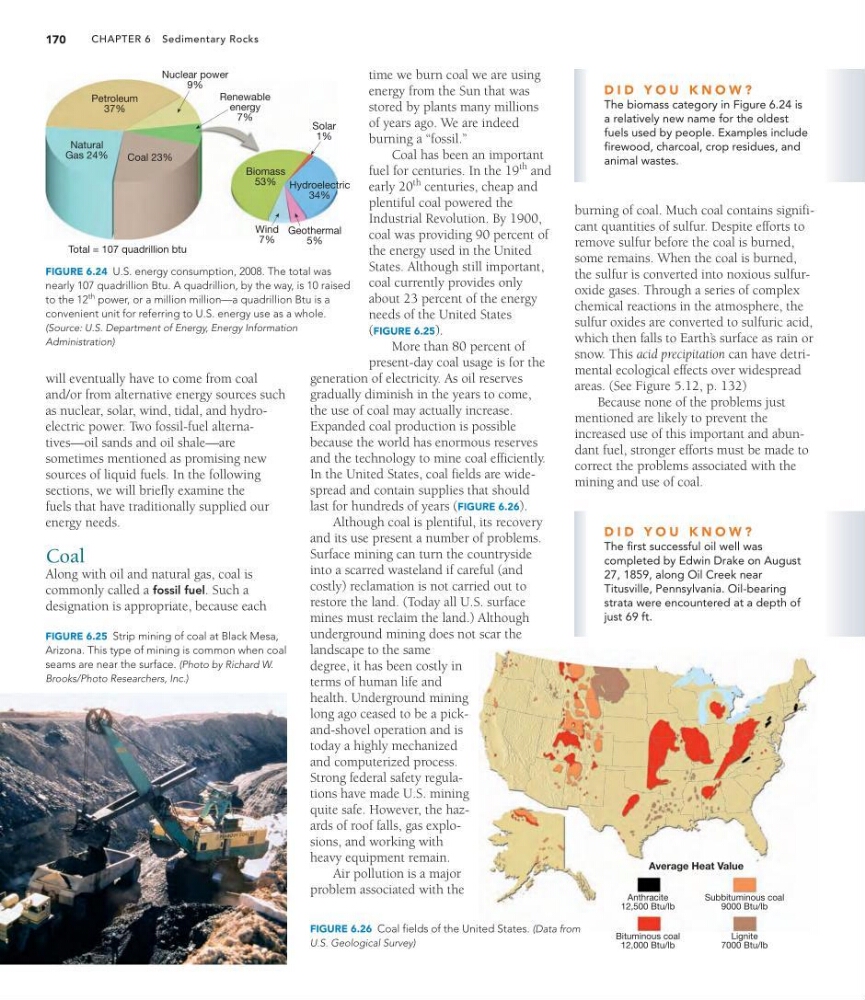
coal currently provides only
about 23 percent of the energy
needs of the United States
(FIGURE 6.25).
More than 80 percent of
present-day coal usage is for the
generation of electricity. As oil reserves
gradually diminish in the years to come,
the use of coal may actually increase.
Expanded coal production is possible
because the world has enormous reserves
and the technology to mine coal efficiently.
In the United States, coal fields are widespread and contain supplies that should
last for hundreds of years (FIGURE 6.26).
Although coal is plentiful, its recovery
and its use present a number of problems.
Surface mining can turn the countryside
into a scarred wasteland if careful (and
costly) reclamation is not carried out to
restore the land. (Today all U.S. surface
mines must reclaim the land.) Although
underground mining does not scar the
landscape to the same
degree, it has been costly in
terms of human life and
health. Underground mining
long ago ceased to be a pickand-shovel operation and is
today a highly mechanized
and computerized process.
Strong federal safety regulations have made U.S. mining
quite safe. However, the hazards of roof falls, gas explosions, and working with
heavy equipment remain.
Air pollution is a major
problem associated with the
D I D Y O U K N O W ?
The first successful oil well was
completed by Edwin Drake on August
27, 1859, along Oil Creek near
Titusville, Pennsylvania. Oil-bearing
strata were encountered at a depth of
just 69 ft.
FIGURE 6.25 Strip mining of coal at Black Mesa,
Arizona. This type of mining is common when coal
seams are near the surface. (Photo by Richard W.
Brooks/Photo Researchers, Inc.)
Petroleum
37%
Coal 23%
Natural
Gas 24%
Hydroelectric
34%
Nuclear power
9%
Renewable
energy
7%
Solar
1%
Biomass
53%
Wind
7%
Geothermal
5%
Total = 107 quadrillion btu
FIGURE 6.24 U.S. energy consumption, 2008. The total was
nearly 107 quadrillion Btu. A quadrillion, by the way, is 10 raised
to the 12
th power, or a million million—a quadrillion Btu is a
convenient unit for referring to U.S. energy use as a whole.
(Source: U.S. Department of Energy, Energy Information
Administration)
D I D Y O U K N O W ?
The biomass category in Figure 6.24 is
a relatively new name for the oldest
fuels used by people. Examples include
firewood, charcoal, crop residues, and
animal wastes.
Average Heat Value
Anthracite
12,500 Btu/lb
Bituminous coal
12,000 Btu/lb
Subbituminous coal
9000 Btu/lb
Lignite
7000 Btu/lb
FIGURE 6.26 Coal fields of the United States. (Data from
U.S. Geological Survey)
burning of coal. Much coal contains significant quantities of sulfur. Despite efforts to
remove sulfur before the coal is burned,
some remains. When the coal is burned,
the sulfur is converted into noxious sulfuroxide gases. Through a series of complex
chemical reactions in the atmosphere, the
sulfur oxides are converted to sulfuric acid,
which then falls to Earth’ s surface as rain or
snow. This acid precipitation can have detrimental ecological effects over widespread
areas. (See Figure 5.12, p. 132)
Because none of the problems just
mentioned are likely to prevent the
increased use of this important and abundant fuel, stronger efforts must be made to
correct the problems associated with the
mining and use of coal.
and/or from alternative energy sources such
as nuclear, solar, wind, tidal, and hydroelectric power. Two fossil-fuel alternatives—oil sands and oil shale—are
sometimes mentioned as promising new
sources of liquid fuels. In the following
sections, we will briefly examine the
fuels that have traditionally supplied our
energy needs.
Coal
Along with oil and natural gas, coal is
commonly called a fossil fuel. Such a
designation is appropriate, because each
CHAPTER 6 Sedimentary Rocks
170
time we burn coal we are using
energy from the Sun that was
stored by plants many millions
of years ago. We are indeed
burning a “fossil.”
Coal has been an important
fuel for centuries. In the 19
th and
early 20
th centuries, cheap and
plentiful coal powered the
Industrial Revolution. By 1900,
coal was providing 90 percent of
the energy used in the United
States. Although still important,
coal currently provides only
about 23 percent of the energy
needs of the United States
(FIGURE 6.25).
More than 80 percent of
present-day coal usage is for the
generation of electricity. As oil reserves
gradually diminish in the years to come,
the use of coal may actually increase.
Expanded coal production is possible
because the world has enormous reserves
and the technology to mine coal efficiently.
In the United States, coal fields are widespread and contain supplies that should
last for hundreds of years (FIGURE 6.26).
Although coal is plentiful, its recovery
and its use present a number of problems.
Surface mining can turn the countryside
into a scarred wasteland if careful (and
costly) reclamation is not carried out to
restore the land. (Today all U.S. surface
mines must reclaim the land.) Although
underground mining does not scar the
landscape to the same
degree, it has been costly in
terms of human life and
health. Underground mining
long ago ceased to be a pickand-shovel operation and is
today a highly mechanized
and computerized process.
Strong federal safety regulations have made U.S. mining
quite safe. However, the hazards of roof falls, gas explosions, and working with
heavy equipment remain.
Air pollution is a major
problem associated with the
D I D Y O U K N O W ?
The first successful oil well was
completed by Edwin Drake on August
27, 1859, along Oil Creek near
Titusville, Pennsylvania. Oil-bearing
strata were encountered at a depth of
just 69 ft.
FIGURE 6.25 Strip mining of coal at Black Mesa,
Arizona. This type of mining is common when coal
seams are near the surface. (Photo by Richard W.
Brooks/Photo Researchers, Inc.)
Petroleum
37%
Coal 23%
Natural
Gas 24%
Hydroelectric
34%
Nuclear power
9%
Renewable
energy
7%
Solar
1%
Biomass
53%
Wind
7%
Geothermal
5%
Total = 107 quadrillion btu
FIGURE 6.24 U.S. energy consumption, 2008. The total was
nearly 107 quadrillion Btu. A quadrillion, by the way, is 10 raised
to the 12
th power, or a million million—a quadrillion Btu is a
convenient unit for referring to U.S. energy use as a whole.
(Source: U.S. Department of Energy, Energy Information
Administration)
D I D Y O U K N O W ?
The biomass category in Figure 6.24 is
a relatively new name for the oldest
fuels used by people. Examples include
firewood, charcoal, crop residues, and
animal wastes.
Average Heat Value
Anthracite
12,500 Btu/lb
Bituminous coal
12,000 Btu/lb
Subbituminous coal
9000 Btu/lb
Lignite
7000 Btu/lb
FIGURE 6.26 Coal fields of the United States. (Data from
U.S. Geological Survey)
burning of coal. Much coal contains significant quantities of sulfur. Despite efforts to
remove sulfur before the coal is burned,
some remains. When the coal is burned,
the sulfur is converted into noxious sulfuroxide gases. Through a series of complex
chemical reactions in the atmosphere, the
sulfur oxides are converted to sulfuric acid,
which then falls to Earth’ s surface as rain or
snow. This acid precipitation can have detrimental ecological effects over widespread
areas. (See Figure 5.12, p. 132)
Because none of the problems just
mentioned are likely to prevent the
increased use of this important and abundant fuel, stronger efforts must be made to
correct the problems associated with the
mining and use of coal.