

169
Energy Resources from Sedimentary Rocks
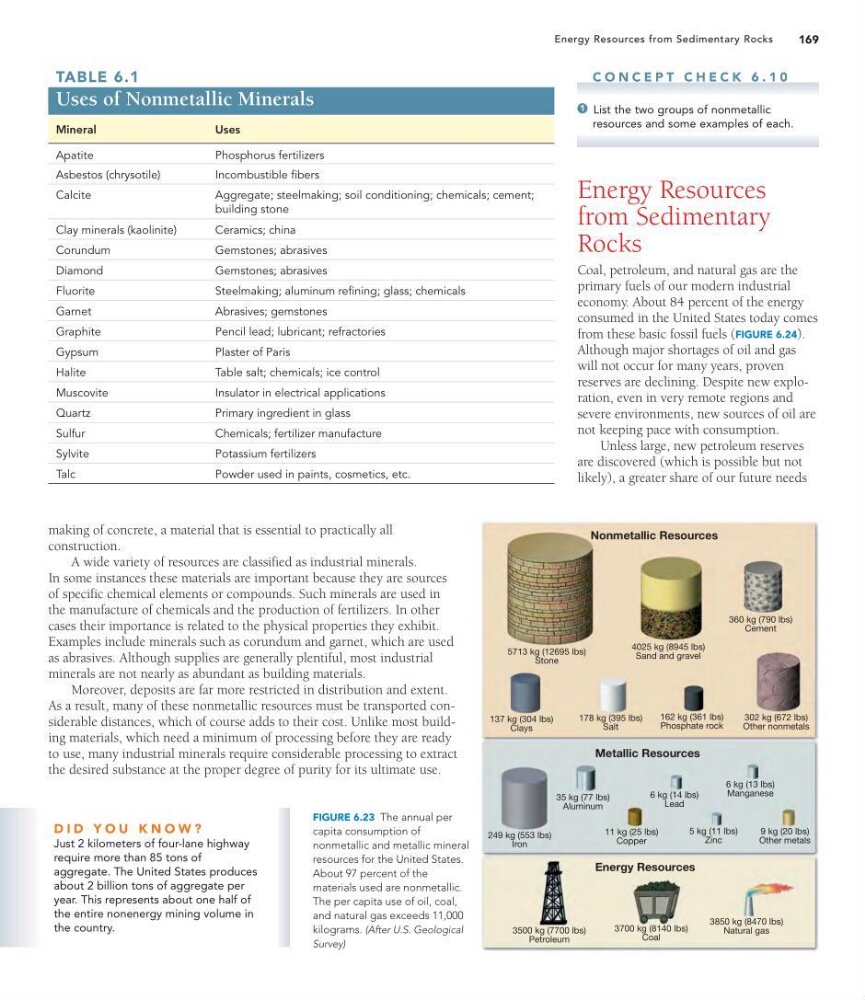
FIGURE 6.23 The annual per
capita consumption of
nonmetallic and metallic mineral
resources for the United States.
About 97 percent of the
materials used are nonmetallic.
The per capita use of oil, coal,
and natural gas exceeds 11,000
kilograms. (After U.S. Geological
Survey)
making of concrete, a material that is essential to practically all
construction.
A wide variety of resources are classified as industrial minerals.
In some instances these materials are important because they are sources
of specific chemical elements or compounds. Such minerals are used in
the manufacture of chemicals and the production of fertilizers. In other
cases their importance is related to the physical properties they exhibit.
Examples include minerals such as corundum and garnet, which are used
as abrasives. Although supplies are generally plentiful, most industrial
minerals are not nearly as abundant as building materials.
Moreover, deposits are far more restricted in distribution and extent.
As a result, many of these nonmetallic resources must be transported considerable distances, which of course adds to their cost. Unlike most building materials, which need a minimum of processing before they are ready
to use, many industrial minerals require considerable processing to extract
the desired substance at the proper degree of purity for its ultimate use.
TABLE 6.1
Uses of Nonmetallic Minerals
Mineral
Uses
Apatite
Phosphorus fertilizers
Asbestos (chrysotile)
Incombustible fibers
Calcite
Aggregate; steelmaking; soil conditioning; chemicals; cement;
building stone
Clay minerals (kaolinite)
Ceramics; china
Corundum
Gemstones; abrasives
Diamond
Gemstones; abrasives
Fluorite
Steelmaking; aluminum refining; glass; chemicals
Garnet
Abrasives; gemstones
Graphite
Pencil lead; lubricant; refractories
Gypsum
Plaster of Paris
Halite
Table salt; chemicals; ice control
Muscovite
Insulator in electrical applications
Quartz
Primary ingredient in glass
Sulfur
Chemicals; fertilizer manufacture
Sylvite
Potassium fertilizers
Talc
Powder used in paints, cosmetics, etc.
D I D Y O U K N O W ?
Just 2 kilometers of four-lane highway
require more than 85 tons of
aggregate. The United States produces
about 2 billion tons of aggregate per
year. This represents about one half of
the entire nonenergy mining volume in
the country.
C O N C E P T C H E C K 6 . 1 0
List the two groups of nonmetallic
resources and some examples of each.
Energy Resources
from Sedimentary
Rocks
Coal, petroleum, and natural gas are the
primary fuels of our modern industrial
economy. About 84 percent of the energy
consumed in the United States today comes
from these basic fossil fuels (FIGURE 6.24).
Although major shortages of oil and gas
will not occur for many years, proven
reserves are declining. Despite new exploration, even in very remote regions and
severe environments, new sources of oil are
not keeping pace with consumption.
Unless large, new petroleum reserves
are discovered (which is possible but not
likely), a greater share of our future needs
1
Nonmetallic Resources
Metallic Resources
3500 kg (7700 lbs)
Petroleum
3700 kg (8140 lbs)
Coal
3850 kg (8470 lbs)
Natural gas
Energy Resources
5713 kg (12695 lbs)
Stone
4025 kg (8945 lbs)
Sand and gravel
360 kg (790 lbs)
Cement
137 kg (304 lbs)
Clays
178 kg (395 lbs)
Salt
162 kg (361 lbs)
Phosphate rock
302 kg (672 lbs)
Other nonmetals
249 kg (553 lbs)
Iron
35 kg (77 lbs)
Aluminum
11 kg (25 lbs)
Copper
6 kg (14 lbs)
Lead
5 kg (11 lbs)
Zinc
6 kg (13 lbs)
Manganese
9 kg (20 lbs)
Other metals
Energy Resources from Sedimentary Rocks
FIGURE 6.23 The annual per
capita consumption of
nonmetallic and metallic mineral
resources for the United States.
About 97 percent of the
materials used are nonmetallic.
The per capita use of oil, coal,
and natural gas exceeds 11,000
kilograms. (After U.S. Geological
Survey)
making of concrete, a material that is essential to practically all
construction.
A wide variety of resources are classified as industrial minerals.
In some instances these materials are important because they are sources
of specific chemical elements or compounds. Such minerals are used in
the manufacture of chemicals and the production of fertilizers. In other
cases their importance is related to the physical properties they exhibit.
Examples include minerals such as corundum and garnet, which are used
as abrasives. Although supplies are generally plentiful, most industrial
minerals are not nearly as abundant as building materials.
Moreover, deposits are far more restricted in distribution and extent.
As a result, many of these nonmetallic resources must be transported considerable distances, which of course adds to their cost. Unlike most building materials, which need a minimum of processing before they are ready
to use, many industrial minerals require considerable processing to extract
the desired substance at the proper degree of purity for its ultimate use.
TABLE 6.1
Uses of Nonmetallic Minerals
Mineral
Uses
Apatite
Phosphorus fertilizers
Asbestos (chrysotile)
Incombustible fibers
Calcite
Aggregate; steelmaking; soil conditioning; chemicals; cement;
building stone
Clay minerals (kaolinite)
Ceramics; china
Corundum
Gemstones; abrasives
Diamond
Gemstones; abrasives
Fluorite
Steelmaking; aluminum refining; glass; chemicals
Garnet
Abrasives; gemstones
Graphite
Pencil lead; lubricant; refractories
Gypsum
Plaster of Paris
Halite
Table salt; chemicals; ice control
Muscovite
Insulator in electrical applications
Quartz
Primary ingredient in glass
Sulfur
Chemicals; fertilizer manufacture
Sylvite
Potassium fertilizers
Talc
Powder used in paints, cosmetics, etc.
D I D Y O U K N O W ?
Just 2 kilometers of four-lane highway
require more than 85 tons of
aggregate. The United States produces
about 2 billion tons of aggregate per
year. This represents about one half of
the entire nonenergy mining volume in
the country.
C O N C E P T C H E C K 6 . 1 0
List the two groups of nonmetallic
resources and some examples of each.
Energy Resources
from Sedimentary
Rocks
Coal, petroleum, and natural gas are the
primary fuels of our modern industrial
economy. About 84 percent of the energy
consumed in the United States today comes
from these basic fossil fuels (FIGURE 6.24).
Although major shortages of oil and gas
will not occur for many years, proven
reserves are declining. Despite new exploration, even in very remote regions and
severe environments, new sources of oil are
not keeping pace with consumption.
Unless large, new petroleum reserves
are discovered (which is possible but not
likely), a greater share of our future needs
1
Nonmetallic Resources
Metallic Resources
3500 kg (7700 lbs)
Petroleum
3700 kg (8140 lbs)
Coal
3850 kg (8470 lbs)
Natural gas
Energy Resources
5713 kg (12695 lbs)
Stone
4025 kg (8945 lbs)
Sand and gravel
360 kg (790 lbs)
Cement
137 kg (304 lbs)
Clays
178 kg (395 lbs)
Salt
162 kg (361 lbs)
Phosphate rock
302 kg (672 lbs)
Other nonmetals
249 kg (553 lbs)
Iron
35 kg (77 lbs)
Aluminum
11 kg (25 lbs)
Copper
6 kg (14 lbs)
Lead
5 kg (11 lbs)
Zinc
6 kg (13 lbs)
Manganese
9 kg (20 lbs)
Other metals