

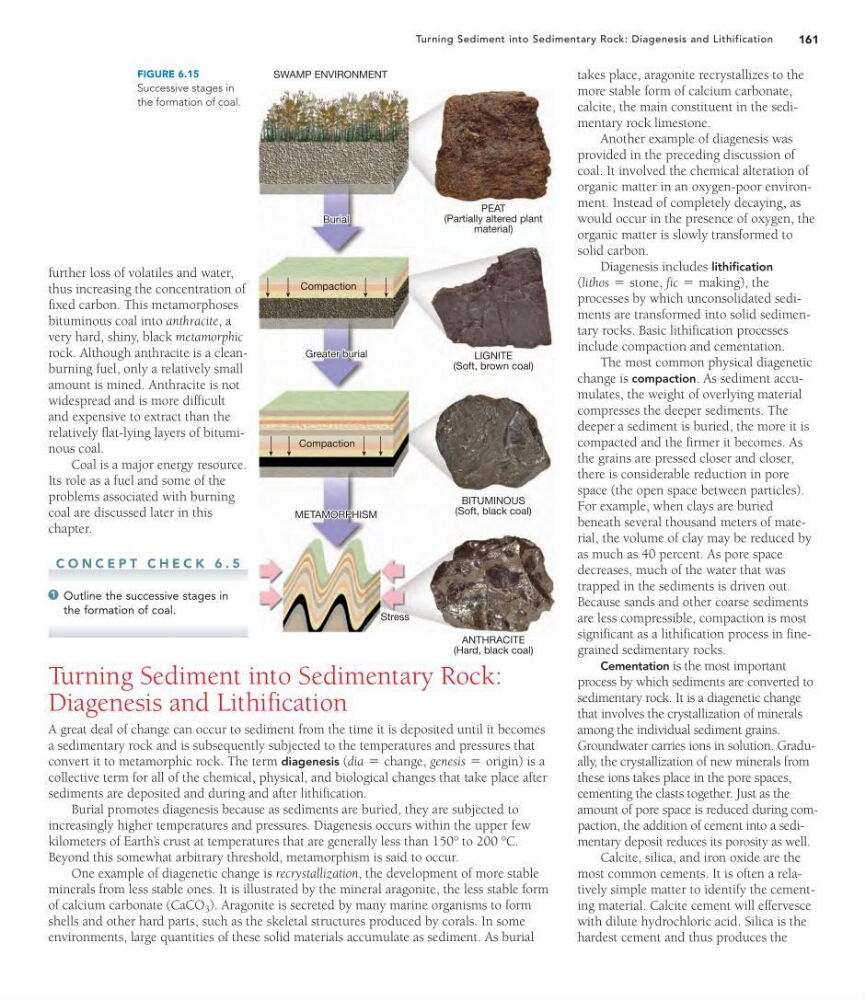
further loss of volatiles and water,
thus increasing the concentration of
fixed carbon. This metamorphoses
bituminous coal into anthracite, a
very hard, shiny, black metamorphic
rock. Although anthracite is a cleanburning fuel, only a relatively small
amount is mined. Anthracite is not
widespread and is more difficult
and expensive to extract than the
relatively flat-lying layers of bituminous coal.
Coal is a major energy resource.
Its role as a fuel and some of the
problems associated with burning
coal are discussed later in this
chapter.
C O N C E P T C H E C K 6 . 5
Outline the successive stages in
the formation of coal.
Turning Sediment into Sedimentary Rock:
Diagenesis and Lithification
A great deal of change can occur to sediment from the time it is deposited until it becomes
a sedimentary rock and is subsequently subjected to the temperatures and pressures that
convert it to metamorphic rock. The term diagenesis (
,
) is a
collective term for all of the chemical, physical, and biological changes that take place after
sediments are deposited and during and after lithification.
Burial promotes diagenesis because as sediments are buried, they are subjected to
increasingly higher temperatures and pressures. Diagenesis occurs within the upper few
kilometers of Earth’ s crust at temperatures that are generally less than 150° to 200 °C.
Beyond this somewhat arbitrary threshold, metamorphism is said to occur.
One example of diagenetic change is recrystallization, the development of more stable
minerals from less stable ones. It is illustrated by the mineral aragonite, the less stable form
of calcium carbonate (CaCO 3 ). Aragonite is secreted by many marine organisms to form
shells and other hard parts, such as the skeletal structures produced by corals. In some
environments, large quantities of these solid materials accumulate as sediment. As burial
genesis = origin
dia = change
1
161
Turning Sediment into Sedimentary Rock: Diagenesis and Lithification
takes place, aragonite recrystallizes to the
more stable form of calcium carbonate,
calcite, the main constituent in the sedimentary rock limestone.
Another example of diagenesis was
provided in the preceding discussion of
coal. It involved the chemical alteration of
organic matter in an oxygen-poor environment. Instead of completely decaying, as
would occur in the presence of oxygen, the
organic matter is slowly transformed to
solid carbon.
Diagenesis includes lithification
(
,
), the
processes by which unconsolidated sediments are transformed into solid sedimentary rocks. Basic lithification processes
include compaction and cementation.
The most common physical diagenetic
change is compaction. As sediment accumulates, the weight of overlying material
compresses the deeper sediments. The
deeper a sediment is buried, the more it is
compacted and the firmer it becomes. As
the grains are pressed closer and closer,
there is considerable reduction in pore
space (the open space between particles).
For example, when clays are buried
beneath several thousand meters of material, the volume of clay may be reduced by
as much as 40 percent. As pore space
decreases, much of the water that was
trapped in the sediments is driven out.
Because sands and other coarse sediments
are less compressible, compaction is most
significant as a lithification process in finegrained sedimentary rocks.
Cementation is the most important
process by which sediments are converted to
sedimentary rock. It is a diagenetic change
that involves the crystallization of minerals
among the individual sediment grains.
Groundwater carries ions in solution. Gradually, the crystallization of new minerals from
these ions takes place in the pore spaces,
cementing the clasts together. Just as the
amount of pore space is reduced during compaction, the addition of cement into a sedimentary deposit reduces its porosity as well.
Calcite, silica, and iron oxide are the
most common cements. It is often a relatively simple matter to identify the cementing material. Calcite cement will effervesce
with dilute hydrochloric acid. Silica is the
hardest cement and thus produces the
fic = making
lithos = stone
FIGURE 6.15
Successive stages in
the formation of coal.
SWAMP ENVIRONMENT
PEAT
(Partially altered plant
material)
LIGNITE
(Soft, brown coal)
Burial
Burial
Gr Greater burial
eater burial
MET METAMORPHISM AMORPHISM
Burial
Compaction
Greater burial
Compaction
BITUMINOUS
(Soft, black coal)
METAMORPHISM
Stress
ANTHRACITE
(Hard, black coal)
thus increasing the concentration of
fixed carbon. This metamorphoses
bituminous coal into anthracite, a
very hard, shiny, black metamorphic
rock. Although anthracite is a cleanburning fuel, only a relatively small
amount is mined. Anthracite is not
widespread and is more difficult
and expensive to extract than the
relatively flat-lying layers of bituminous coal.
Coal is a major energy resource.
Its role as a fuel and some of the
problems associated with burning
coal are discussed later in this
chapter.
C O N C E P T C H E C K 6 . 5
Outline the successive stages in
the formation of coal.
Turning Sediment into Sedimentary Rock:
Diagenesis and Lithification
A great deal of change can occur to sediment from the time it is deposited until it becomes
a sedimentary rock and is subsequently subjected to the temperatures and pressures that
convert it to metamorphic rock. The term diagenesis (
,
) is a
collective term for all of the chemical, physical, and biological changes that take place after
sediments are deposited and during and after lithification.
Burial promotes diagenesis because as sediments are buried, they are subjected to
increasingly higher temperatures and pressures. Diagenesis occurs within the upper few
kilometers of Earth’ s crust at temperatures that are generally less than 150° to 200 °C.
Beyond this somewhat arbitrary threshold, metamorphism is said to occur.
One example of diagenetic change is recrystallization, the development of more stable
minerals from less stable ones. It is illustrated by the mineral aragonite, the less stable form
of calcium carbonate (CaCO 3 ). Aragonite is secreted by many marine organisms to form
shells and other hard parts, such as the skeletal structures produced by corals. In some
environments, large quantities of these solid materials accumulate as sediment. As burial
genesis = origin
dia = change
1
161
Turning Sediment into Sedimentary Rock: Diagenesis and Lithification
takes place, aragonite recrystallizes to the
more stable form of calcium carbonate,
calcite, the main constituent in the sedimentary rock limestone.
Another example of diagenesis was
provided in the preceding discussion of
coal. It involved the chemical alteration of
organic matter in an oxygen-poor environment. Instead of completely decaying, as
would occur in the presence of oxygen, the
organic matter is slowly transformed to
solid carbon.
Diagenesis includes lithification
(
,
), the
processes by which unconsolidated sediments are transformed into solid sedimentary rocks. Basic lithification processes
include compaction and cementation.
The most common physical diagenetic
change is compaction. As sediment accumulates, the weight of overlying material
compresses the deeper sediments. The
deeper a sediment is buried, the more it is
compacted and the firmer it becomes. As
the grains are pressed closer and closer,
there is considerable reduction in pore
space (the open space between particles).
For example, when clays are buried
beneath several thousand meters of material, the volume of clay may be reduced by
as much as 40 percent. As pore space
decreases, much of the water that was
trapped in the sediments is driven out.
Because sands and other coarse sediments
are less compressible, compaction is most
significant as a lithification process in finegrained sedimentary rocks.
Cementation is the most important
process by which sediments are converted to
sedimentary rock. It is a diagenetic change
that involves the crystallization of minerals
among the individual sediment grains.
Groundwater carries ions in solution. Gradually, the crystallization of new minerals from
these ions takes place in the pore spaces,
cementing the clasts together. Just as the
amount of pore space is reduced during compaction, the addition of cement into a sedimentary deposit reduces its porosity as well.
Calcite, silica, and iron oxide are the
most common cements. It is often a relatively simple matter to identify the cementing material. Calcite cement will effervesce
with dilute hydrochloric acid. Silica is the
hardest cement and thus produces the
fic = making
lithos = stone
FIGURE 6.15
Successive stages in
the formation of coal.
SWAMP ENVIRONMENT
PEAT
(Partially altered plant
material)
LIGNITE
(Soft, brown coal)
Burial
Burial
Gr Greater burial
eater burial
MET METAMORPHISM AMORPHISM
Burial
Compaction
Greater burial
Compaction
BITUMINOUS
(Soft, black coal)
METAMORPHISM
Stress
ANTHRACITE
(Hard, black coal)