

159
Chemical Sedimentary Rocks
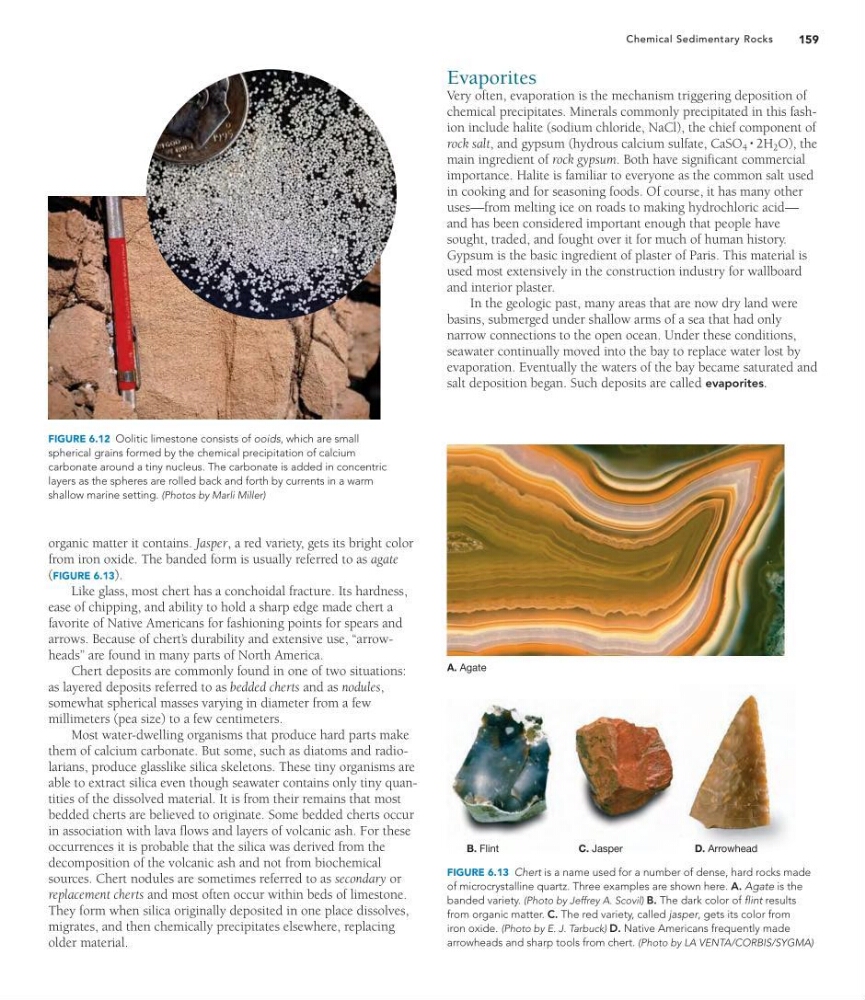
organic matter it contains. Jasper, a red variety, gets its bright color
from iron oxide. The banded form is usually referred to as agate
(FIGURE 6.13).
Like glass, most chert has a conchoidal fracture. Its hardness,
ease of chipping, and ability to hold a sharp edge made chert a
favorite of Native Americans for fashioning points for spears and
arrows. Because of chert’ s durability and extensive use, “arrowheads” are found in many parts of North America.
Chert deposits are commonly found in one of two situations:
as layered deposits referred to as bedded cherts and as nodules,
somewhat spherical masses varying in diameter from a few
millimeters (pea size) to a few centimeters.
Most water-dwelling organisms that produce hard parts make
them of calcium carbonate. But some, such as diatoms and radiolarians, produce glasslike silica skeletons. These tiny organisms are
able to extract silica even though seawater contains only tiny quantities of the dissolved material. It is from their remains that most
bedded cherts are believed to originate. Some bedded cherts occur
in association with lava flows and layers of volcanic ash. For these
occurrences it is probable that the silica was derived from the
decomposition of the volcanic ash and not from biochemical
sources. Chert nodules are sometimes referred to as secondary or
replacement cherts and most often occur within beds of limestone.
They form when silica originally deposited in one place dissolves,
migrates, and then chemically precipitates elsewhere, replacing
older material.
FIGURE 6.12 Oolitic limestone consists of ooids, which are small
spherical grains formed by the chemical precipitation of calcium
carbonate around a tiny nucleus. The carbonate is added in concentric
layers as the spheres are rolled back and forth by currents in a warm
shallow marine setting. (Photos by Marli Miller)
A. Agate
B. Flint
C. Jasper
D. Arrowhead
FIGURE 6.13 Chert is a name used for a number of dense, hard rocks made
of microcrystalline quartz. Three examples are shown here. A. Agate is the
banded variety. (Photo by Jeffrey A. Scovil) B. The dark color of flint results
from organic matter. C. The red variety, called jasper, gets its color from
iron oxide. (Photo by E. J. Tarbuck) D. Native Americans frequently made
arrowheads and sharp tools from chert. (Photo by LA VENTA/CORBIS/SYGMA)
Evaporites
Very often, evaporation is the mechanism triggering deposition of
chemical precipitates. Minerals commonly precipitated in this fashion include halite (sodium chloride, NaCl), the chief component of
rock salt, and gypsum (hydrous calcium sulfate, CaSO 4 2H 2 O), the
main ingredient of rock gypsum. Both have significant commercial
importance. Halite is familiar to everyone as the common salt used
in cooking and for seasoning foods. Of course, it has many other
uses—from melting ice on roads to making hydrochloric acid—
and has been considered important enough that people have
sought, traded, and fought over it for much of human history.
Gypsum is the basic ingredient of plaster of Paris. This material is
used most extensively in the construction industry for wallboard
and interior plaster.
In the geologic past, many areas that are now dry land were
basins, submerged under shallow arms of a sea that had only
narrow connections to the open ocean. Under these conditions,
seawater continually moved into the bay to replace water lost by
evaporation. Eventually the waters of the bay became saturated and
salt deposition began. Such deposits are called evaporites.
#
Chemical Sedimentary Rocks
organic matter it contains. Jasper, a red variety, gets its bright color
from iron oxide. The banded form is usually referred to as agate
(FIGURE 6.13).
Like glass, most chert has a conchoidal fracture. Its hardness,
ease of chipping, and ability to hold a sharp edge made chert a
favorite of Native Americans for fashioning points for spears and
arrows. Because of chert’ s durability and extensive use, “arrowheads” are found in many parts of North America.
Chert deposits are commonly found in one of two situations:
as layered deposits referred to as bedded cherts and as nodules,
somewhat spherical masses varying in diameter from a few
millimeters (pea size) to a few centimeters.
Most water-dwelling organisms that produce hard parts make
them of calcium carbonate. But some, such as diatoms and radiolarians, produce glasslike silica skeletons. These tiny organisms are
able to extract silica even though seawater contains only tiny quantities of the dissolved material. It is from their remains that most
bedded cherts are believed to originate. Some bedded cherts occur
in association with lava flows and layers of volcanic ash. For these
occurrences it is probable that the silica was derived from the
decomposition of the volcanic ash and not from biochemical
sources. Chert nodules are sometimes referred to as secondary or
replacement cherts and most often occur within beds of limestone.
They form when silica originally deposited in one place dissolves,
migrates, and then chemically precipitates elsewhere, replacing
older material.
FIGURE 6.12 Oolitic limestone consists of ooids, which are small
spherical grains formed by the chemical precipitation of calcium
carbonate around a tiny nucleus. The carbonate is added in concentric
layers as the spheres are rolled back and forth by currents in a warm
shallow marine setting. (Photos by Marli Miller)
A. Agate
B. Flint
C. Jasper
D. Arrowhead
FIGURE 6.13 Chert is a name used for a number of dense, hard rocks made
of microcrystalline quartz. Three examples are shown here. A. Agate is the
banded variety. (Photo by Jeffrey A. Scovil) B. The dark color of flint results
from organic matter. C. The red variety, called jasper, gets its color from
iron oxide. (Photo by E. J. Tarbuck) D. Native Americans frequently made
arrowheads and sharp tools from chert. (Photo by LA VENTA/CORBIS/SYGMA)
Evaporites
Very often, evaporation is the mechanism triggering deposition of
chemical precipitates. Minerals commonly precipitated in this fashion include halite (sodium chloride, NaCl), the chief component of
rock salt, and gypsum (hydrous calcium sulfate, CaSO 4 2H 2 O), the
main ingredient of rock gypsum. Both have significant commercial
importance. Halite is familiar to everyone as the common salt used
in cooking and for seasoning foods. Of course, it has many other
uses—from melting ice on roads to making hydrochloric acid—
and has been considered important enough that people have
sought, traded, and fought over it for much of human history.
Gypsum is the basic ingredient of plaster of Paris. This material is
used most extensively in the construction industry for wallboard
and interior plaster.
In the geologic past, many areas that are now dry land were
basins, submerged under shallow arms of a sea that had only
narrow connections to the open ocean. Under these conditions,
seawater continually moved into the bay to replace water lost by
evaporation. Eventually the waters of the bay became saturated and
salt deposition began. Such deposits are called evaporites.
#