

CHAPTER 6 Sedimentary Rocks
156
strata
Chemical Sedimentary Rocks
Sedimentary Rocks
Types of Sedimentary Rocks
In contrast to detrital rocks, which form from the solid products of weathering, chemical
sediments derive from ions that are carried in solution to lakes and seas. This material does
not remain dissolved in the water indefinitely, however. Some of it precipitates to form
chemical sediments. These become rocks such as limestone, chert, and rock salt.
This precipitation of material occurs in two ways. Inorganic processes such as evaporation
and chemical activity can produce chemical sediments. Organic (life) processes of waterdwelling organisms also form chemical sediments, said to be of biochemical origin.
One example of a deposit resulting from inorganic chemical processes is the dripstone
that decorates many caves (FIGURE 6.8). Another is the salt left behind as a body of seawater
evaporates. In contrast, many water-dwelling animals and plants extract dissolved mineral
matter to form shells and other hard parts. After the organisms die, their skeletons collect
by the millions on the floor of a lake or ocean as biochemical sediment (FIGURE 6.9).
GEODe
ESSENTIALS
OF GEOLOGY
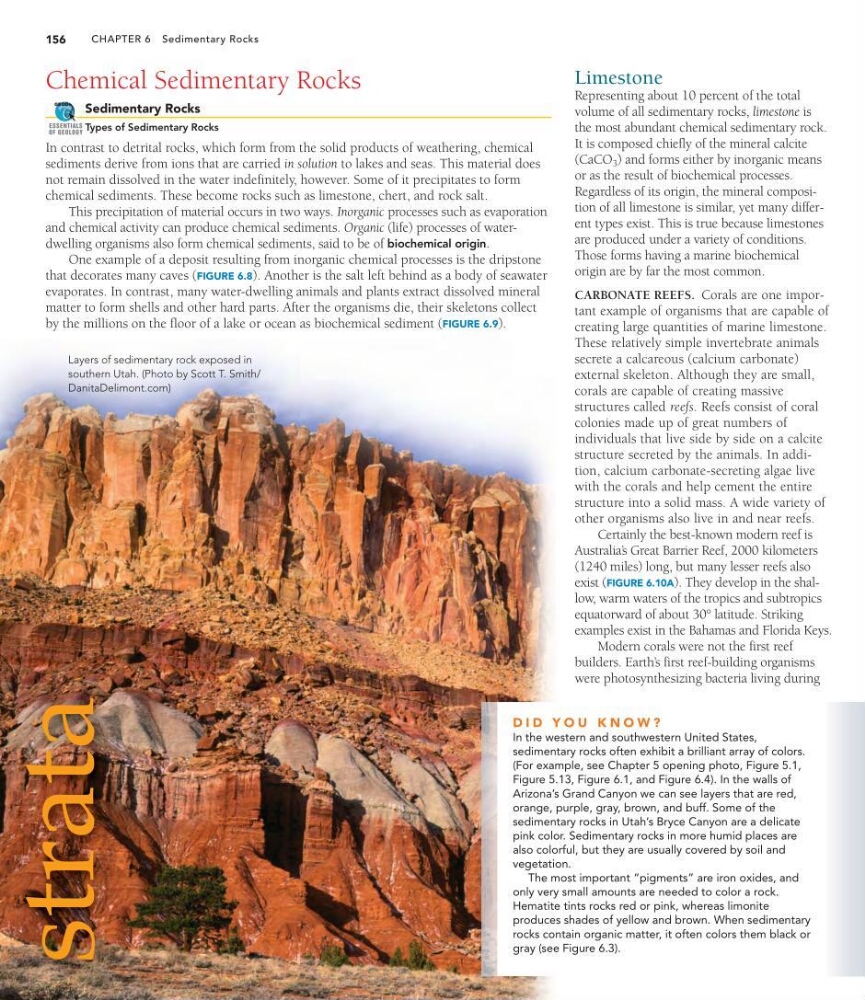
Layers of sedimentary rock exposed in
southern Utah. (Photo by Scott T. Smith/
DanitaDelimont.com)
Limestone
Representing about 10 percent of the total
volume of all sedimentary rocks, limestone is
the most abundant chemical sedimentary rock.
It is composed chiefly of the mineral calcite
(CaCO 3 ) and forms either by inorganic means
or as the result of biochemical processes.
Regardless of its origin, the mineral composition of all limestone is similar, yet many different types exist. This is true because limestones
are produced under a variety of conditions.
Those forms having a marine biochemical
origin are by far the most common.
CARBONATE REEFS. Corals are one important example of organisms that are capable of
creating large quantities of marine limestone.
These relatively simple invertebrate animals
secrete a calcareous (calcium carbonate)
external skeleton. Although they are small,
corals are capable of creating massive
structures called reefs. Reefs consist of coral
colonies made up of great numbers of
individuals that live side by side on a calcite
structure secreted by the animals. In addition, calcium carbonate-secreting algae live
with the corals and help cement the entire
structure into a solid mass. A wide variety of
other organisms also live in and near reefs.
Certainly the best-known modern reef is
Australia’ s Great Barrier Reef, 2000 kilometers
(1240 miles) long, but many lesser reefs also
exist (FIGURE 6.10A). They develop in the shallow, warm waters of the tropics and subtropics
equatorward of about 30° latitude. Striking
examples exist in the Bahamas and Florida Keys.
Modern corals were not the first reef
builders. Earth’ s first reef-building organisms
were photosynthesizing bacteria living during
D I D Y O U K N O W ?
In the western and southwestern United States,
sedimentary rocks often exhibit a brilliant array of colors.
(For example, see Chapter 5 opening photo, Figure 5.1,
Figure 5.13, Figure 6.1, and Figure 6.4). In the walls of
Arizona’s Grand Canyon we can see layers that are red,
orange, purple, gray, brown, and buff. Some of the
sedimentary rocks in Utah’s Bryce Canyon are a delicate
pink color. Sedimentary rocks in more humid places are
also colorful, but they are usually covered by soil and
vegetation.
The most important “pigments” are iron oxides, and
only very small amounts are needed to color a rock.
Hematite tints rocks red or pink, whereas limonite
produces shades of yellow and brown. When sedimentary
rocks contain organic matter, it often colors them black or
gray (see Figure 6.3).
156
strata
Chemical Sedimentary Rocks
Sedimentary Rocks
Types of Sedimentary Rocks
In contrast to detrital rocks, which form from the solid products of weathering, chemical
sediments derive from ions that are carried in solution to lakes and seas. This material does
not remain dissolved in the water indefinitely, however. Some of it precipitates to form
chemical sediments. These become rocks such as limestone, chert, and rock salt.
This precipitation of material occurs in two ways. Inorganic processes such as evaporation
and chemical activity can produce chemical sediments. Organic (life) processes of waterdwelling organisms also form chemical sediments, said to be of biochemical origin.
One example of a deposit resulting from inorganic chemical processes is the dripstone
that decorates many caves (FIGURE 6.8). Another is the salt left behind as a body of seawater
evaporates. In contrast, many water-dwelling animals and plants extract dissolved mineral
matter to form shells and other hard parts. After the organisms die, their skeletons collect
by the millions on the floor of a lake or ocean as biochemical sediment (FIGURE 6.9).
GEODe
ESSENTIALS
OF GEOLOGY
Layers of sedimentary rock exposed in
southern Utah. (Photo by Scott T. Smith/
DanitaDelimont.com)
Limestone
Representing about 10 percent of the total
volume of all sedimentary rocks, limestone is
the most abundant chemical sedimentary rock.
It is composed chiefly of the mineral calcite
(CaCO 3 ) and forms either by inorganic means
or as the result of biochemical processes.
Regardless of its origin, the mineral composition of all limestone is similar, yet many different types exist. This is true because limestones
are produced under a variety of conditions.
Those forms having a marine biochemical
origin are by far the most common.
CARBONATE REEFS. Corals are one important example of organisms that are capable of
creating large quantities of marine limestone.
These relatively simple invertebrate animals
secrete a calcareous (calcium carbonate)
external skeleton. Although they are small,
corals are capable of creating massive
structures called reefs. Reefs consist of coral
colonies made up of great numbers of
individuals that live side by side on a calcite
structure secreted by the animals. In addition, calcium carbonate-secreting algae live
with the corals and help cement the entire
structure into a solid mass. A wide variety of
other organisms also live in and near reefs.
Certainly the best-known modern reef is
Australia’ s Great Barrier Reef, 2000 kilometers
(1240 miles) long, but many lesser reefs also
exist (FIGURE 6.10A). They develop in the shallow, warm waters of the tropics and subtropics
equatorward of about 30° latitude. Striking
examples exist in the Bahamas and Florida Keys.
Modern corals were not the first reef
builders. Earth’ s first reef-building organisms
were photosynthesizing bacteria living during
D I D Y O U K N O W ?
In the western and southwestern United States,
sedimentary rocks often exhibit a brilliant array of colors.
(For example, see Chapter 5 opening photo, Figure 5.1,
Figure 5.13, Figure 6.1, and Figure 6.4). In the walls of
Arizona’s Grand Canyon we can see layers that are red,
orange, purple, gray, brown, and buff. Some of the
sedimentary rocks in Utah’s Bryce Canyon are a delicate
pink color. Sedimentary rocks in more humid places are
also colorful, but they are usually covered by soil and
vegetation.
The most important “pigments” are iron oxides, and
only very small amounts are needed to color a rock.
Hematite tints rocks red or pink, whereas limonite
produces shades of yellow and brown. When sedimentary
rocks contain organic matter, it often colors them black or
gray (see Figure 6.3).