

155
Detrital Sedimentary Rocks
A.
B.
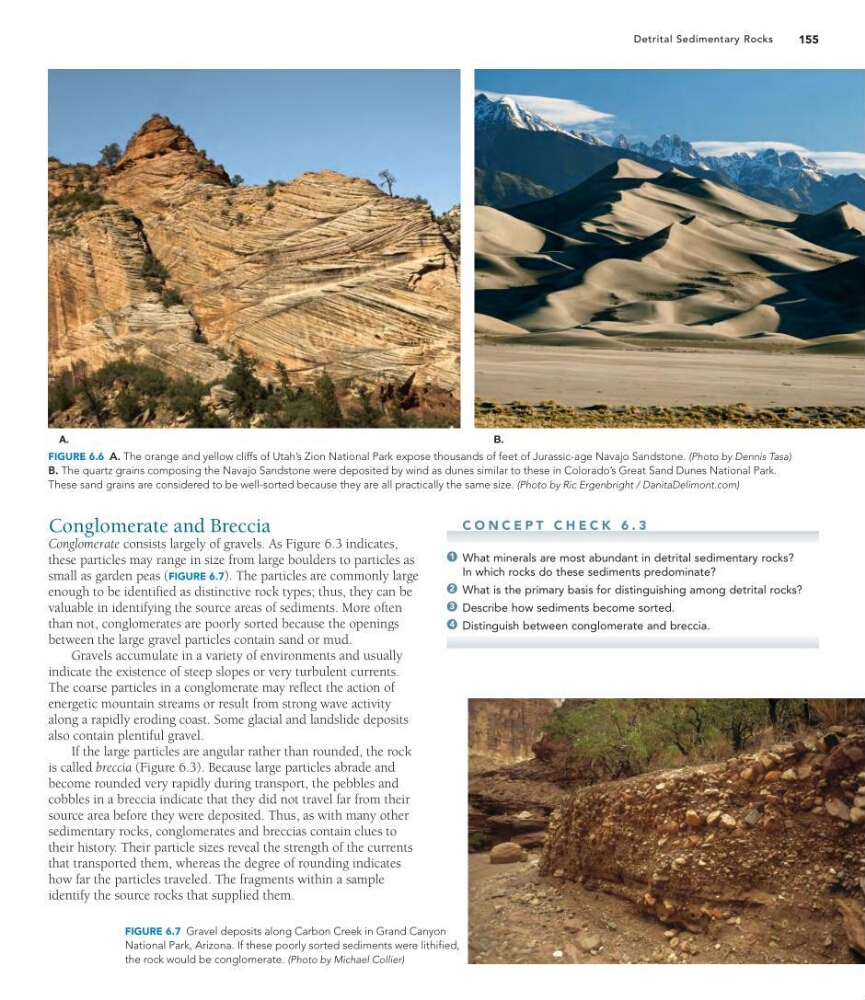
FIGURE 6.6 A. The orange and yellow cliffs of Utah’s Zion National Park expose thousands of feet of Jurassic-age Navajo Sandstone. (Photo by Dennis Tasa)
B. The quartz grains composing the Navajo Sandstone were deposited by wind as dunes similar to these in Colorado’s Great Sand Dunes National Park.
These sand grains are considered to be well-sorted because they are all practically the same size. (Photo by Ric Ergenbright / DanitaDelimont.com)
Conglomerate and Breccia
Conglomerate consists largely of gravels. As Figure 6.3 indicates,
these particles may range in size from large boulders to particles as
small as garden peas (FIGURE 6.7). The particles are commonly large
enough to be identified as distinctive rock types; thus, they can be
valuable in identifying the source areas of sediments. More often
than not, conglomerates are poorly sorted because the openings
between the large gravel particles contain sand or mud.
Gravels accumulate in a variety of environments and usually
indicate the existence of steep slopes or very turbulent currents.
The coarse particles in a conglomerate may reflect the action of
energetic mountain streams or result from strong wave activity
along a rapidly eroding coast. Some glacial and landslide deposits
also contain plentiful gravel.
If the large particles are angular rather than rounded, the rock
is called breccia (Figure 6.3). Because large particles abrade and
become rounded very rapidly during transport, the pebbles and
cobbles in a breccia indicate that they did not travel far from their
source area before they were deposited. Thus, as with many other
sedimentary rocks, conglomerates and breccias contain clues to
their history. Their particle sizes reveal the strength of the currents
that transported them, whereas the degree of rounding indicates
how far the particles traveled. The fragments within a sample
identify the source rocks that supplied them.
FIGURE 6.7 Gravel deposits along Carbon Creek in Grand Canyon
National Park, Arizona. If these poorly sorted sediments were lithified,
the rock would be conglomerate. (Photo by Michael Collier)
C O N C E P T C H E C K 6 . 3
What minerals are most abundant in detrital sedimentary rocks?
In which rocks do these sediments predominate?
What is the primary basis for distinguishing among detrital rocks?
Describe how sediments become sorted.
Distinguish between conglomerate and breccia.
4
3
2
1
Detrital Sedimentary Rocks
A.
B.
FIGURE 6.6 A. The orange and yellow cliffs of Utah’s Zion National Park expose thousands of feet of Jurassic-age Navajo Sandstone. (Photo by Dennis Tasa)
B. The quartz grains composing the Navajo Sandstone were deposited by wind as dunes similar to these in Colorado’s Great Sand Dunes National Park.
These sand grains are considered to be well-sorted because they are all practically the same size. (Photo by Ric Ergenbright / DanitaDelimont.com)
Conglomerate and Breccia
Conglomerate consists largely of gravels. As Figure 6.3 indicates,
these particles may range in size from large boulders to particles as
small as garden peas (FIGURE 6.7). The particles are commonly large
enough to be identified as distinctive rock types; thus, they can be
valuable in identifying the source areas of sediments. More often
than not, conglomerates are poorly sorted because the openings
between the large gravel particles contain sand or mud.
Gravels accumulate in a variety of environments and usually
indicate the existence of steep slopes or very turbulent currents.
The coarse particles in a conglomerate may reflect the action of
energetic mountain streams or result from strong wave activity
along a rapidly eroding coast. Some glacial and landslide deposits
also contain plentiful gravel.
If the large particles are angular rather than rounded, the rock
is called breccia (Figure 6.3). Because large particles abrade and
become rounded very rapidly during transport, the pebbles and
cobbles in a breccia indicate that they did not travel far from their
source area before they were deposited. Thus, as with many other
sedimentary rocks, conglomerates and breccias contain clues to
their history. Their particle sizes reveal the strength of the currents
that transported them, whereas the degree of rounding indicates
how far the particles traveled. The fragments within a sample
identify the source rocks that supplied them.
FIGURE 6.7 Gravel deposits along Carbon Creek in Grand Canyon
National Park, Arizona. If these poorly sorted sediments were lithified,
the rock would be conglomerate. (Photo by Michael Collier)
C O N C E P T C H E C K 6 . 3
What minerals are most abundant in detrital sedimentary rocks?
In which rocks do these sediments predominate?
What is the primary basis for distinguishing among detrital rocks?
Describe how sediments become sorted.
Distinguish between conglomerate and breccia.
4
3
2
1