

153
Detrital Sedimentary Rocks
oxygen-poor environment such as a
swamp, where organic materials do not
readily oxidize and decay.
As silt and clay accumulate, they tend
to form thin layers commonly referred to as
laminae. Initially the particles in the laminae are oriented randomly. This disordered
arrangement leaves a high percentage of
open space (called pore space) that is filled
with water. However, this situation usually
changes with time as additional layers of
sediment pile up and compact the
sediment below.
During this phase the clay and silt particles take on a more parallel alignment and
become tightly packed. This rearrangement
of grains reduces the size of the pore spaces
and forces out much of the water. Once the
grains are pressed closely together, the tiny
spaces between particles do not readily permit solutions containing cementing material to circulate. Therefore, shales are often
described as being weak because they are
poorly cemented and therefore not well
lithified. The inability of water to penetrate
its microscopic pore spaces explains why
shale often forms barriers to the subsurface
movement of water and petroleum. Indeed,
rock layers that contain groundwater are
commonly underlain by shale beds that
block further downward movement.
* The
opposite is true for underground reservoirs
of petroleum. They are often capped by
shale beds that effectively prevent oil and
gas from escaping to the surface.
It is common to apply the term shale to
all fine-grained sedimentary rocks, especially in a nontechnical context. However,
be aware that there is a more restricted use
of the term. In this narrower usage, shale
must exhibit the ability to split into thin
layers along well-developed, closely spaced
planes. This property is termed fissility. If
the rock breaks into chunks or blocks, the
name mudstone is applied. Another finegrained sedimentary rock that, like mudstone, is often grouped with shale but lacks
fissility is siltstone. As its name implies,
siltstone is composed largely of silt-size
particles and contains less clay-size
material than shale and mudstone.
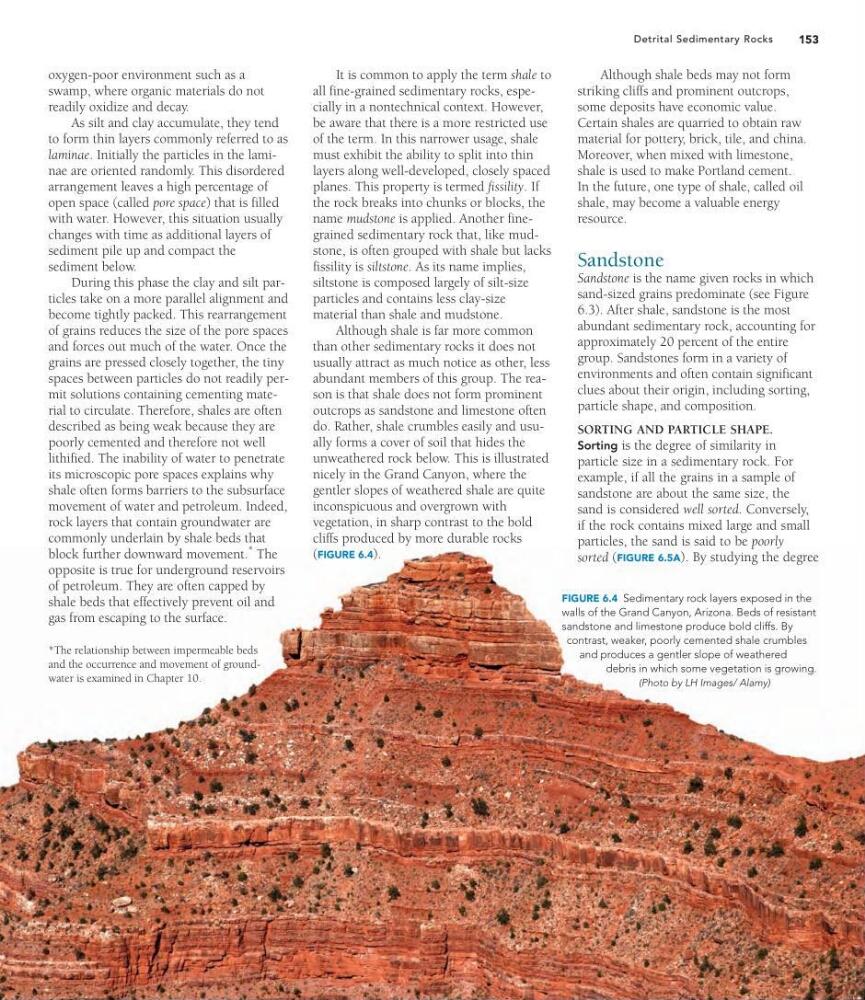
Although shale is far more common
than other sedimentary rocks it does not
usually attract as much notice as other, less
abundant members of this group. The reason is that shale does not form prominent
outcrops as sandstone and limestone often
do. Rather, shale crumbles easily and usually forms a cover of soil that hides the
unweathered rock below. This is illustrated
nicely in the Grand Canyon, where the
gentler slopes of weathered shale are quite
inconspicuous and overgrown with
vegetation, in sharp contrast to the bold
cliffs produced by more durable rocks
(FIGURE 6.4).
Although shale beds may not form
striking cliffs and prominent outcrops,
some deposits have economic value.
Certain shales are quarried to obtain raw
material for pottery, brick, tile, and china.
Moreover, when mixed with limestone,
shale is used to make Portland cement.
In the future, one type of shale, called oil
shale, may become a valuable energy
resource.
Sandstone
Sandstone is the name given rocks in which
sand-sized grains predominate (see Figure
6.3). After shale, sandstone is the most
abundant sedimentary rock, accounting for
approximately 20 percent of the entire
group. Sandstones form in a variety of
environments and often contain significant
clues about their origin, including sorting,
particle shape, and composition.
SORTING AND PARTICLE SHAPE.
Sorting is the degree of similarity in
particle size in a sedimentary rock. For
example, if all the grains in a sample of
sandstone are about the same size, the
sand is considered well sorted. Conversely,
if the rock contains mixed large and small
particles, the sand is said to be poorly
sorted (FIGURE 6.5A). By studying the degree
*The relationship between impermeable beds
and the occurrence and movement of groundwater is examined in Chapter 10.
FIGURE 6.4 Sedimentary rock layers exposed in the
walls of the Grand Canyon, Arizona. Beds of resistant
sandstone and limestone produce bold cliffs. By
contrast, weaker, poorly cemented shale crumbles
and produces a gentler slope of weathered
debris in which some vegetation is growing.
(Photo by LH Images/ Alamy)
Detrital Sedimentary Rocks
oxygen-poor environment such as a
swamp, where organic materials do not
readily oxidize and decay.
As silt and clay accumulate, they tend
to form thin layers commonly referred to as
laminae. Initially the particles in the laminae are oriented randomly. This disordered
arrangement leaves a high percentage of
open space (called pore space) that is filled
with water. However, this situation usually
changes with time as additional layers of
sediment pile up and compact the
sediment below.
During this phase the clay and silt particles take on a more parallel alignment and
become tightly packed. This rearrangement
of grains reduces the size of the pore spaces
and forces out much of the water. Once the
grains are pressed closely together, the tiny
spaces between particles do not readily permit solutions containing cementing material to circulate. Therefore, shales are often
described as being weak because they are
poorly cemented and therefore not well
lithified. The inability of water to penetrate
its microscopic pore spaces explains why
shale often forms barriers to the subsurface
movement of water and petroleum. Indeed,
rock layers that contain groundwater are
commonly underlain by shale beds that
block further downward movement.
* The
opposite is true for underground reservoirs
of petroleum. They are often capped by
shale beds that effectively prevent oil and
gas from escaping to the surface.
It is common to apply the term shale to
all fine-grained sedimentary rocks, especially in a nontechnical context. However,
be aware that there is a more restricted use
of the term. In this narrower usage, shale
must exhibit the ability to split into thin
layers along well-developed, closely spaced
planes. This property is termed fissility. If
the rock breaks into chunks or blocks, the
name mudstone is applied. Another finegrained sedimentary rock that, like mudstone, is often grouped with shale but lacks
fissility is siltstone. As its name implies,
siltstone is composed largely of silt-size
particles and contains less clay-size
material than shale and mudstone.
Although shale is far more common
than other sedimentary rocks it does not
usually attract as much notice as other, less
abundant members of this group. The reason is that shale does not form prominent
outcrops as sandstone and limestone often
do. Rather, shale crumbles easily and usually forms a cover of soil that hides the
unweathered rock below. This is illustrated
nicely in the Grand Canyon, where the
gentler slopes of weathered shale are quite
inconspicuous and overgrown with
vegetation, in sharp contrast to the bold
cliffs produced by more durable rocks
(FIGURE 6.4).
Although shale beds may not form
striking cliffs and prominent outcrops,
some deposits have economic value.
Certain shales are quarried to obtain raw
material for pottery, brick, tile, and china.
Moreover, when mixed with limestone,
shale is used to make Portland cement.
In the future, one type of shale, called oil
shale, may become a valuable energy
resource.
Sandstone
Sandstone is the name given rocks in which
sand-sized grains predominate (see Figure
6.3). After shale, sandstone is the most
abundant sedimentary rock, accounting for
approximately 20 percent of the entire
group. Sandstones form in a variety of
environments and often contain significant
clues about their origin, including sorting,
particle shape, and composition.
SORTING AND PARTICLE SHAPE.
Sorting is the degree of similarity in
particle size in a sedimentary rock. For
example, if all the grains in a sample of
sandstone are about the same size, the
sand is considered well sorted. Conversely,
if the rock contains mixed large and small
particles, the sand is said to be poorly
sorted (FIGURE 6.5A). By studying the degree
*The relationship between impermeable beds
and the occurrence and movement of groundwater is examined in Chapter 10.
FIGURE 6.4 Sedimentary rock layers exposed in the
walls of the Grand Canyon, Arizona. Beds of resistant
sandstone and limestone produce bold cliffs. By
contrast, weaker, poorly cemented shale crumbles
and produces a gentler slope of weathered
debris in which some vegetation is growing.
(Photo by LH Images/ Alamy)