

CHAPTER 6 Sedimentary Rocks
152
C O N C E P T C H E C K 6 . 2
Outline the steps that would transform an exposure of granite in
the mountains into various sedimentary rocks.
List and briefly distinguish among the three basic sedimentary rock
categories.
Detrital Sedimentary Rocks
Sedimentary Rocks
Types of Sedimentary Rocks
Though a wide variety of minerals and rock fragments (clasts) may
be found in detrital rocks, clay minerals and quartz are the chief
constituents of most sedimentary rocks in this category. Recall from
Chapter 5 that clay minerals are the most abundant product of the
chemical weathering of silicate minerals, especially the feldspars.
Clays are fine-grained minerals with sheetlike crystalline structures
similar to the micas. The other common mineral, quartz, is abundant because it is extremely durable and very resistant to chemical
weathering. Thus, when igneous rocks such as granite are attacked
by weathering processes, individual quartz grains are freed.
Other common minerals in detrital rocks are feldspars and
micas. Because chemical weathering rapidly transforms these
minerals into new substances, their presence in sedimentary
rocks indicates that erosion and deposition were fast enough to
preserve some of the primary minerals from the source rock
before they could be decomposed.
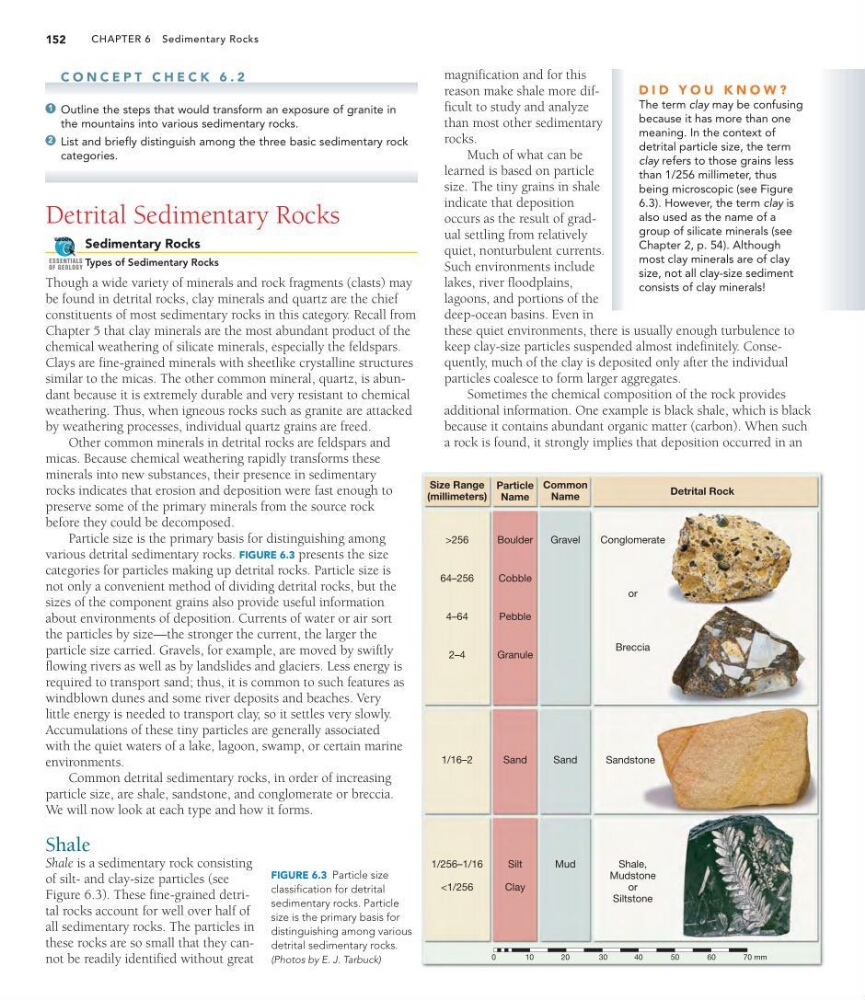
Particle size is the primary basis for distinguishing among
various detrital sedimentary rocks. FIGURE 6.3 presents the size
categories for particles making up detrital rocks. Particle size is
not only a convenient method of dividing detrital rocks, but the
sizes of the component grains also provide useful information
about environments of deposition. Currents of water or air sort
the particles by size—the stronger the current, the larger the
particle size carried. Gravels, for example, are moved by swiftly
flowing rivers as well as by landslides and glaciers. Less energy is
required to transport sand; thus, it is common to such features as
windblown dunes and some river deposits and beaches. Very
little energy is needed to transport clay, so it settles very slowly.
Accumulations of these tiny particles are generally associated
with the quiet waters of a lake, lagoon, swamp, or certain marine
environments.
Common detrital sedimentary rocks, in order of increasing
particle size, are shale, sandstone, and conglomerate or breccia.
We will now look at each type and how it forms.
Shale
Shale is a sedimentary rock consisting
of silt- and clay-size particles (see
Figure 6.3). These fine-grained detrital rocks account for well over half of
all sedimentary rocks. The particles in
these rocks are so small that they cannot be readily identified without great
GEODe
ESSENTIALS
OF GEOLOGY
2
1
Size Range
(millimeters)
Common
Name
Particle
Name
Gravel
Boulder
Cobble
Pebble
Granule
>256
64–256
4–64
2–4
Sand
Sand
0
10
20
30
40
50
60
70 mm
1/16–2
Silt
Clay
1/256–1/16
<1/256
Conglomerate
or
Breccia
Sandstone
Mud
Shale,
Mudstone
or
Siltstone
Detrital Rock
magnification and for this
reason make shale more difficult to study and analyze
than most other sedimentary
rocks.
Much of what can be
learned is based on particle
size. The tiny grains in shale
indicate that deposition
occurs as the result of gradual settling from relatively
quiet, nonturbulent currents.
Such environments include
lakes, river floodplains,
lagoons, and portions of the
deep-ocean basins. Even in
these quiet environments, there is usually enough turbulence to
keep clay-size particles suspended almost indefinitely. Consequently, much of the clay is deposited only after the individual
particles coalesce to form larger aggregates.
Sometimes the chemical composition of the rock provides
additional information. One example is black shale, which is black
because it contains abundant organic matter (carbon). When such
a rock is found, it strongly implies that deposition occurred in an
FIGURE 6.3 Particle size
classification for detrital
sedimentary rocks. Particle
size is the primary basis for
distinguishing among various
detrital sedimentary rocks.
(Photos by E. J. Tarbuck)
D I D Y O U K N O W ?
The term clay may be confusing
because it has more than one
meaning. In the context of
detrital particle size, the term
clay refers to those grains less
than 1/256 millimeter, thus
being microscopic (see Figure
6.3). However, the term clay is
also used as the name of a
group of silicate minerals (see
Chapter 2, p. 54). Although
most clay minerals are of clay
size, not all clay-size sediment
consists of clay minerals!
152
C O N C E P T C H E C K 6 . 2
Outline the steps that would transform an exposure of granite in
the mountains into various sedimentary rocks.
List and briefly distinguish among the three basic sedimentary rock
categories.
Detrital Sedimentary Rocks
Sedimentary Rocks
Types of Sedimentary Rocks
Though a wide variety of minerals and rock fragments (clasts) may
be found in detrital rocks, clay minerals and quartz are the chief
constituents of most sedimentary rocks in this category. Recall from
Chapter 5 that clay minerals are the most abundant product of the
chemical weathering of silicate minerals, especially the feldspars.
Clays are fine-grained minerals with sheetlike crystalline structures
similar to the micas. The other common mineral, quartz, is abundant because it is extremely durable and very resistant to chemical
weathering. Thus, when igneous rocks such as granite are attacked
by weathering processes, individual quartz grains are freed.
Other common minerals in detrital rocks are feldspars and
micas. Because chemical weathering rapidly transforms these
minerals into new substances, their presence in sedimentary
rocks indicates that erosion and deposition were fast enough to
preserve some of the primary minerals from the source rock
before they could be decomposed.
Particle size is the primary basis for distinguishing among
various detrital sedimentary rocks. FIGURE 6.3 presents the size
categories for particles making up detrital rocks. Particle size is
not only a convenient method of dividing detrital rocks, but the
sizes of the component grains also provide useful information
about environments of deposition. Currents of water or air sort
the particles by size—the stronger the current, the larger the
particle size carried. Gravels, for example, are moved by swiftly
flowing rivers as well as by landslides and glaciers. Less energy is
required to transport sand; thus, it is common to such features as
windblown dunes and some river deposits and beaches. Very
little energy is needed to transport clay, so it settles very slowly.
Accumulations of these tiny particles are generally associated
with the quiet waters of a lake, lagoon, swamp, or certain marine
environments.
Common detrital sedimentary rocks, in order of increasing
particle size, are shale, sandstone, and conglomerate or breccia.
We will now look at each type and how it forms.
Shale
Shale is a sedimentary rock consisting
of silt- and clay-size particles (see
Figure 6.3). These fine-grained detrital rocks account for well over half of
all sedimentary rocks. The particles in
these rocks are so small that they cannot be readily identified without great
GEODe
ESSENTIALS
OF GEOLOGY
2
1
Size Range
(millimeters)
Common
Name
Particle
Name
Gravel
Boulder
Cobble
Pebble
Granule
>256
64–256
4–64
2–4
Sand
Sand
0
10
20
30
40
50
60
70 mm
1/16–2
Silt
Clay
1/256–1/16
<1/256
Conglomerate
or
Breccia
Sandstone
Mud
Shale,
Mudstone
or
Siltstone
Detrital Rock
magnification and for this
reason make shale more difficult to study and analyze
than most other sedimentary
rocks.
Much of what can be
learned is based on particle
size. The tiny grains in shale
indicate that deposition
occurs as the result of gradual settling from relatively
quiet, nonturbulent currents.
Such environments include
lakes, river floodplains,
lagoons, and portions of the
deep-ocean basins. Even in
these quiet environments, there is usually enough turbulence to
keep clay-size particles suspended almost indefinitely. Consequently, much of the clay is deposited only after the individual
particles coalesce to form larger aggregates.
Sometimes the chemical composition of the rock provides
additional information. One example is black shale, which is black
because it contains abundant organic matter (carbon). When such
a rock is found, it strongly implies that deposition occurred in an
FIGURE 6.3 Particle size
classification for detrital
sedimentary rocks. Particle
size is the primary basis for
distinguishing among various
detrital sedimentary rocks.
(Photos by E. J. Tarbuck)
D I D Y O U K N O W ?
The term clay may be confusing
because it has more than one
meaning. In the context of
detrital particle size, the term
clay refers to those grains less
than 1/256 millimeter, thus
being microscopic (see Figure
6.3). However, the term clay is
also used as the name of a
group of silicate minerals (see
Chapter 2, p. 54). Although
most clay minerals are of clay
size, not all clay-size sediment
consists of clay minerals!