

CHAPTER 6 Sedimentary Rocks
150
D I D Y O U K N O W ?
Coal is responsible for slightly more
than half the electricity generated in
the United States.
The Importance of
Sedimentary Rocks
Most of solid Earth consists of igneous and
metamorphic rocks. Geologists estimate
these two categories represent 90 to 95 percent of the outer 16 kilometers (10 miles)
of the crust. Nevertheless, most of Earth’ s
solid surface consists of either sediment or
sedimentary rock! Across the ocean floor,
which represents about 70 percent of
Earth’ s solid surface, virtually everything is
covered by sediment. Igneous rocks are
exposed only at the crest of mid-ocean
ridges and at some volcanic areas. Thus,
while sediment and sedimentary rocks
make up only a small percentage of Earth’ s
crust, they are concentrated at or near the
surface—the interface among the geosphere,
hydrosphere, atmosphere, and biosphere.
Because of this unique position, sediments
and the rock layers that they eventually
form contain evidence of past conditions
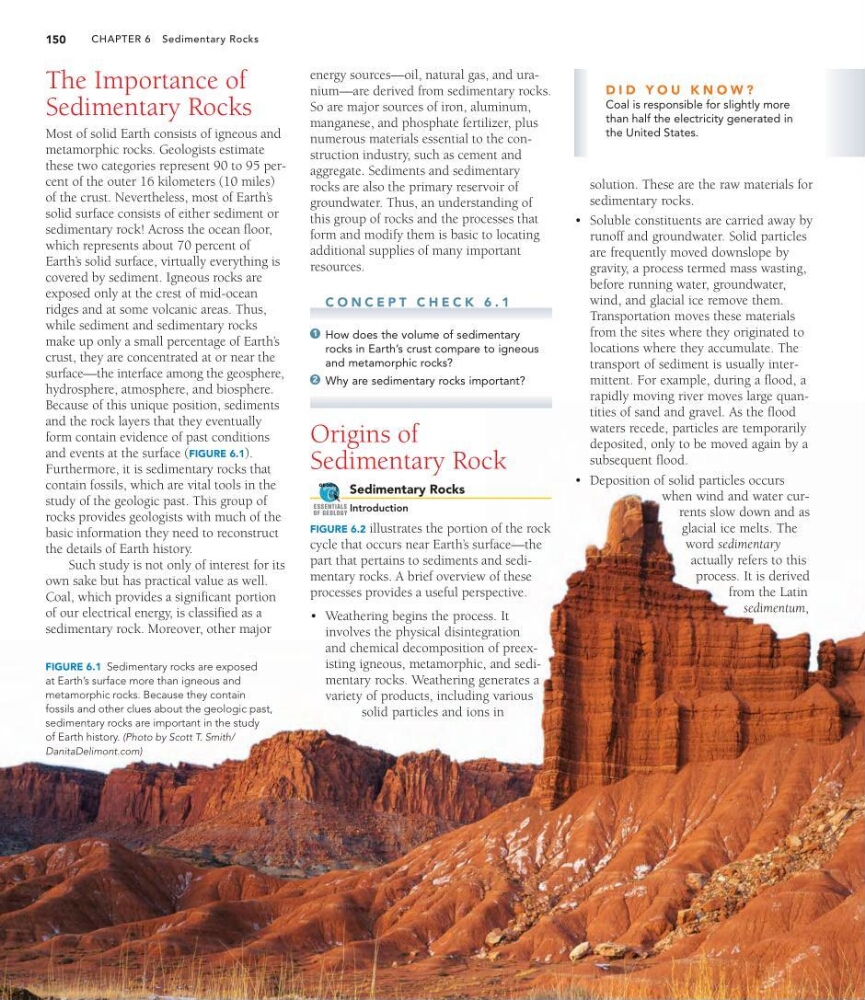
and events at the surface (FIGURE 6.1).
Furthermore, it is sedimentary rocks that
contain fossils, which are vital tools in the
study of the geologic past. This group of
rocks provides geologists with much of the
basic information they need to reconstruct
the details of Earth history.
Such study is not only of interest for its
own sake but has practical value as well.
Coal, which provides a significant portion
of our electrical energy, is classified as a
sedimentary rock. Moreover, other major
energy sources—oil, natural gas, and uranium—are derived from sedimentary rocks.
So are major sources of iron, aluminum,
manganese, and phosphate fertilizer, plus
numerous materials essential to the construction industry, such as cement and
aggregate. Sediments and sedimentary
rocks are also the primary reservoir of
groundwater. Thus, an understanding of
this group of rocks and the processes that
form and modify them is basic to locating
additional supplies of many important
resources.
C O N C E P T C H E C K 6 . 1
How does the volume of sedimentary
rocks in Earth’s crust compare to igneous
and metamorphic rocks?
Why are sedimentary rocks important?
Origins of
Sedimentary Rock
Sedimentary Rocks
Introduction
FIGURE 6.2 illustrates the portion of the rock
cycle that occurs near Earth’ s surface—the
part that pertains to sediments and sedimentary rocks. A brief overview of these
processes provides a useful perspective.
• Weathering begins the process. It
involves the physical disintegration
and chemical decomposition of preexisting igneous, metamorphic, and sedimentary rocks. Weathering generates a
variety of products, including various
solid particles and ions in
GEODe
ESSENTIALS
OF GEOLOGY
2
1
solution. These are the raw materials for
sedimentary rocks.
• Soluble constituents are carried away by
runoff and groundwater. Solid particles
are frequently moved downslope by
gravity, a process termed mass wasting,
before running water, groundwater,
wind, and glacial ice remove them.
Transportation moves these materials
from the sites where they originated to
locations where they accumulate. The
transport of sediment is usually intermittent. For example, during a flood, a
rapidly moving river moves large quantities of sand and gravel. As the flood
waters recede, particles are temporarily
deposited, only to be moved again by a
subsequent flood.
• Deposition of solid particles occurs
when wind and water currents slow down and as
glacial ice melts. The
word sedimentary
actually refers to this
process. It is derived
from the Latin
sedimentum,
FIGURE 6.1 Sedimentary rocks are exposed
at Earth’s surface more than igneous and
metamorphic rocks. Because they contain
fossils and other clues about the geologic past,
sedimentary rocks are important in the study
of Earth history. (Photo by Scott T. Smith/
DanitaDelimont.com)
150
D I D Y O U K N O W ?
Coal is responsible for slightly more
than half the electricity generated in
the United States.
The Importance of
Sedimentary Rocks
Most of solid Earth consists of igneous and
metamorphic rocks. Geologists estimate
these two categories represent 90 to 95 percent of the outer 16 kilometers (10 miles)
of the crust. Nevertheless, most of Earth’ s
solid surface consists of either sediment or
sedimentary rock! Across the ocean floor,
which represents about 70 percent of
Earth’ s solid surface, virtually everything is
covered by sediment. Igneous rocks are
exposed only at the crest of mid-ocean
ridges and at some volcanic areas. Thus,
while sediment and sedimentary rocks
make up only a small percentage of Earth’ s
crust, they are concentrated at or near the
surface—the interface among the geosphere,
hydrosphere, atmosphere, and biosphere.
Because of this unique position, sediments
and the rock layers that they eventually
form contain evidence of past conditions
and events at the surface (FIGURE 6.1).
Furthermore, it is sedimentary rocks that
contain fossils, which are vital tools in the
study of the geologic past. This group of
rocks provides geologists with much of the
basic information they need to reconstruct
the details of Earth history.
Such study is not only of interest for its
own sake but has practical value as well.
Coal, which provides a significant portion
of our electrical energy, is classified as a
sedimentary rock. Moreover, other major
energy sources—oil, natural gas, and uranium—are derived from sedimentary rocks.
So are major sources of iron, aluminum,
manganese, and phosphate fertilizer, plus
numerous materials essential to the construction industry, such as cement and
aggregate. Sediments and sedimentary
rocks are also the primary reservoir of
groundwater. Thus, an understanding of
this group of rocks and the processes that
form and modify them is basic to locating
additional supplies of many important
resources.
C O N C E P T C H E C K 6 . 1
How does the volume of sedimentary
rocks in Earth’s crust compare to igneous
and metamorphic rocks?
Why are sedimentary rocks important?
Origins of
Sedimentary Rock
Sedimentary Rocks
Introduction
FIGURE 6.2 illustrates the portion of the rock
cycle that occurs near Earth’ s surface—the
part that pertains to sediments and sedimentary rocks. A brief overview of these
processes provides a useful perspective.
• Weathering begins the process. It
involves the physical disintegration
and chemical decomposition of preexisting igneous, metamorphic, and sedimentary rocks. Weathering generates a
variety of products, including various
solid particles and ions in
GEODe
ESSENTIALS
OF GEOLOGY
2
1
solution. These are the raw materials for
sedimentary rocks.
• Soluble constituents are carried away by
runoff and groundwater. Solid particles
are frequently moved downslope by
gravity, a process termed mass wasting,
before running water, groundwater,
wind, and glacial ice remove them.
Transportation moves these materials
from the sites where they originated to
locations where they accumulate. The
transport of sediment is usually intermittent. For example, during a flood, a
rapidly moving river moves large quantities of sand and gravel. As the flood
waters recede, particles are temporarily
deposited, only to be moved again by a
subsequent flood.
• Deposition of solid particles occurs
when wind and water currents slow down and as
glacial ice melts. The
word sedimentary
actually refers to this
process. It is derived
from the Latin
sedimentum,
FIGURE 6.1 Sedimentary rocks are exposed
at Earth’s surface more than igneous and
metamorphic rocks. Because they contain
fossils and other clues about the geologic past,
sedimentary rocks are important in the study
of Earth history. (Photo by Scott T. Smith/
DanitaDelimont.com)