

T
HE PRECEDING CHAPTER
PROVIDED THE
BACKGROUND YOU
needed to understand the origin
of sedimentary rocks.
Recall that weathering of existing rocks
begins the process. Next, gravity and
erosional agents remove the products of
weathering and carry them to a new location
where they are deposited. Usually the
particles are broken down further during
this transport phase. Following deposition,
this material, which is now called sediment,
becomes lithified (turned to rock).
F O C U S O N C O N C E P T S
To assist you in learning
the important concepts in this
chapter, focus on the following
questions:
What is a sedimentary rock?
About what percentage of
Earth’s crust is sedimentary?
How is sediment turned into
sedimentary rock?
What are the two general
categories of sedimentary rocks,
and how does each type form?
What is the primary basis for
distinguishing among various
types of detrital sedimentary
rocks? What criterion is used to
subdivide the chemical rocks?
What are sedimentary
structures? Why are these
structures useful to geologists?
What are the two broad groups
of nonmetallic mineral resources?
Which energy resources are
associated with sedimentary
rocks?
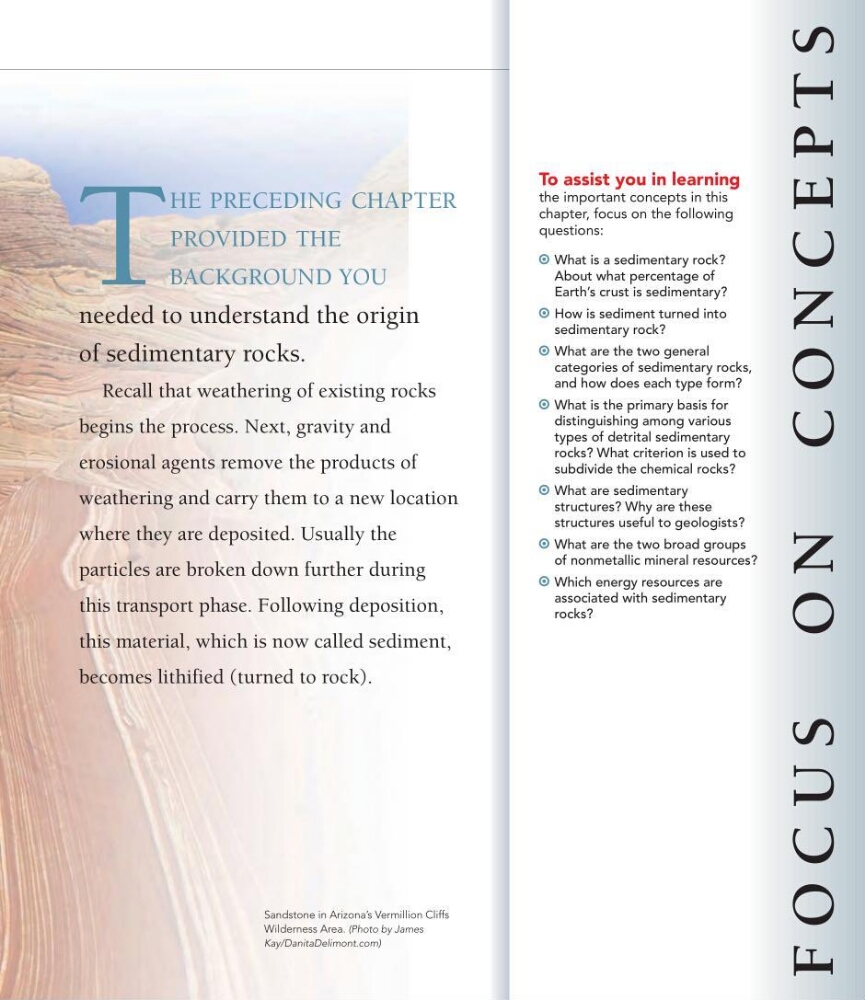
Sandstone in Arizona’s Vermillion Cliffs
Wilderness Area. (Photo by James
Kay/DanitaDelimont.com)
HE PRECEDING CHAPTER
PROVIDED THE
BACKGROUND YOU
needed to understand the origin
of sedimentary rocks.
Recall that weathering of existing rocks
begins the process. Next, gravity and
erosional agents remove the products of
weathering and carry them to a new location
where they are deposited. Usually the
particles are broken down further during
this transport phase. Following deposition,
this material, which is now called sediment,
becomes lithified (turned to rock).
F O C U S O N C O N C E P T S
To assist you in learning
the important concepts in this
chapter, focus on the following
questions:
What is a sedimentary rock?
About what percentage of
Earth’s crust is sedimentary?
How is sediment turned into
sedimentary rock?
What are the two general
categories of sedimentary rocks,
and how does each type form?
What is the primary basis for
distinguishing among various
types of detrital sedimentary
rocks? What criterion is used to
subdivide the chemical rocks?
What are sedimentary
structures? Why are these
structures useful to geologists?
What are the two broad groups
of nonmetallic mineral resources?
Which energy resources are
associated with sedimentary
rocks?
Sandstone in Arizona’s Vermillion Cliffs
Wilderness Area. (Photo by James
Kay/DanitaDelimont.com)