

CHAPTER 5 Weathering and Soils
140
Clearing the Tropical
Rain Forest—A Case
Study of Human
Impact on Soil
Thick red soils are common in the wet
tropics and subtropics. They are the end
product of extreme chemical weathering.
Because lush tropical rain forests are associated with these soils, we might assume they
are fertile and have great potential for agriculture. However, just the opposite is
true—they are among the poorest soils for
farming. How can this be?
Because rain forest soils develop under
conditions of high temperature and heavy
Equator
0
30°
30°
0
30°
60°
90°
120°
150°
0
30°
60°
90°
120°
150°
0
0
1,000
2,000
1,000 2,000
3,000 MILES
3,000 KILOMETERS
MILLER PROJECTION
150°
0°
Equator
30°
30°
60°
120°
90°
60°
30°
150°
120°
90°
60°
30°
Equator
0 0
30° 30 30
30° 30
0 0
30° 0
60° 0
90° 0
120° 2
150° 5
0 0
30° 0
60° 0
90° 0
120° 2
150° 5
0
0
1,000
2,000
1,000 0 2,000
3,000 MILES
3,000 KILOME M TERS
MILL M
ER PROJECTIO ON
150° 5
0° 0
Equator
30° 30
30° 30
60° 0 0 0 0°
60 0
120° 2
90° 0
60° 0
°
30 30 30° °
0 0 0
30 30° 30
150° 5
120° 2
90° 0
60° 0
°
30° °
0
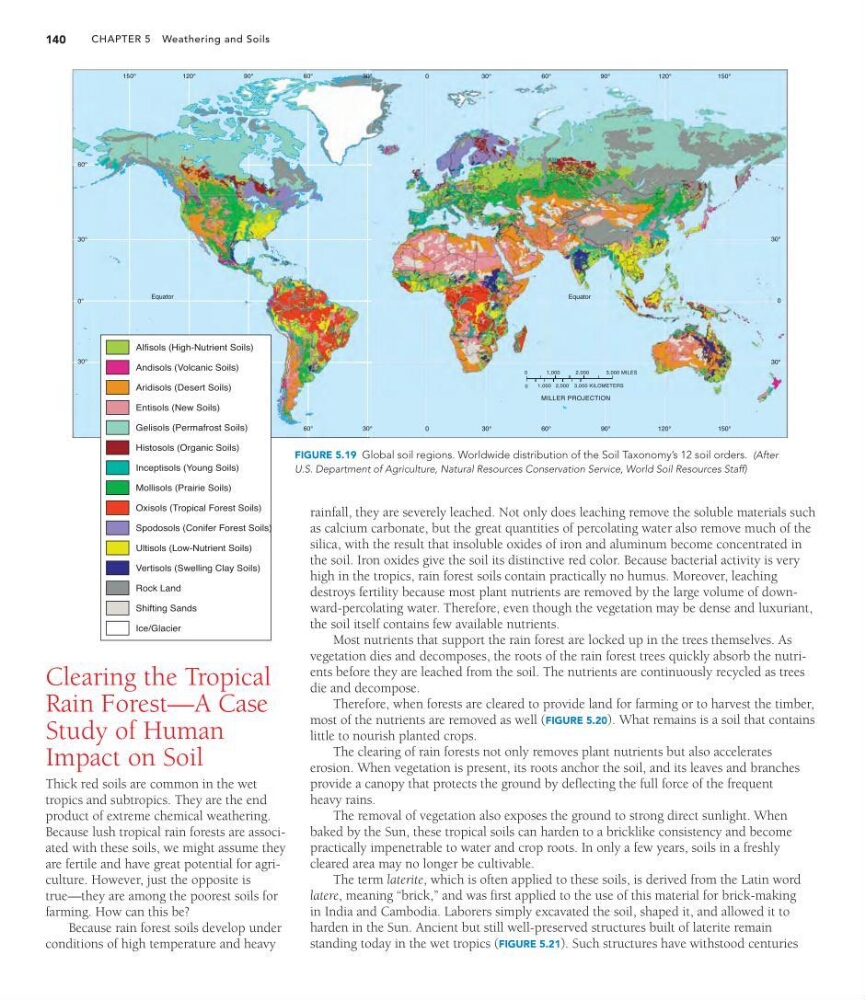
Alfisols (High-Nutrient Soils)
Andisols (Volcanic Soils)
Aridisols (Desert Soils)
Entisols (New Soils)
Gelisols (Permafrost Soils)
Histosols (Organic Soils)
Inceptisols (Young Soils)
Mollisols (Prairie Soils)
Oxisols (Tropical Forest Soils)
Spodosols (Conifer Forest Soils)
Ultisols (Low-Nutrient Soils)
Vertisols (Swelling Clay Soils)
Rock Land
Shifting Sands
Ice/Glacier
FIGURE 5.19 Global soil regions. Worldwide distribution of the Soil Taxonomy’s 12 soil orders. (After
U.S. Department of Agriculture, Natural Resources Conservation Service, World Soil Resources Staff)
rainfall, they are severely leached. Not only does leaching remove the soluble materials such
as calcium carbonate, but the great quantities of percolating water also remove much of the
silica, with the result that insoluble oxides of iron and aluminum become concentrated in
the soil. Iron oxides give the soil its distinctive red color. Because bacterial activity is very
high in the tropics, rain forest soils contain practically no humus. Moreover, leaching
destroys fertility because most plant nutrients are removed by the large volume of downward-percolating water. Therefore, even though the vegetation may be dense and luxuriant,
the soil itself contains few available nutrients.
Most nutrients that support the rain forest are locked up in the trees themselves. As
vegetation dies and decomposes, the roots of the rain forest trees quickly absorb the nutrients before they are leached from the soil. The nutrients are continuously recycled as trees
die and decompose.
Therefore, when forests are cleared to provide land for farming or to harvest the timber,
most of the nutrients are removed as well (FIGURE 5.20). What remains is a soil that contains
little to nourish planted crops.
The clearing of rain forests not only removes plant nutrients but also accelerates
erosion. When vegetation is present, its roots anchor the soil, and its leaves and branches
provide a canopy that protects the ground by deflecting the full force of the frequent
heavy rains.
The removal of vegetation also exposes the ground to strong direct sunlight. When
baked by the Sun, these tropical soils can harden to a bricklike consistency and become
practically impenetrable to water and crop roots. In only a few years, soils in a freshly
cleared area may no longer be cultivable.
The term laterite, which is often applied to these soils, is derived from the Latin word
latere, meaning “brick,” and was first applied to the use of this material for brick-making
in India and Cambodia. Laborers simply excavated the soil, shaped it, and allowed it to
harden in the Sun. Ancient but still well-preserved structures built of laterite remain
standing today in the wet tropics (FIGURE 5.21). Such structures have withstood centuries
140
Clearing the Tropical
Rain Forest—A Case
Study of Human
Impact on Soil
Thick red soils are common in the wet
tropics and subtropics. They are the end
product of extreme chemical weathering.
Because lush tropical rain forests are associated with these soils, we might assume they
are fertile and have great potential for agriculture. However, just the opposite is
true—they are among the poorest soils for
farming. How can this be?
Because rain forest soils develop under
conditions of high temperature and heavy
Equator
0
30°
30°
0
30°
60°
90°
120°
150°
0
30°
60°
90°
120°
150°
0
0
1,000
2,000
1,000 2,000
3,000 MILES
3,000 KILOMETERS
MILLER PROJECTION
150°
0°
Equator
30°
30°
60°
120°
90°
60°
30°
150°
120°
90°
60°
30°
Equator
0 0
30° 30 30
30° 30
0 0
30° 0
60° 0
90° 0
120° 2
150° 5
0 0
30° 0
60° 0
90° 0
120° 2
150° 5
0
0
1,000
2,000
1,000 0 2,000
3,000 MILES
3,000 KILOME M TERS
MILL M
ER PROJECTIO ON
150° 5
0° 0
Equator
30° 30
30° 30
60° 0 0 0 0°
60 0
120° 2
90° 0
60° 0
°
30 30 30° °
0 0 0
30 30° 30
150° 5
120° 2
90° 0
60° 0
°
30° °
0
Alfisols (High-Nutrient Soils)
Andisols (Volcanic Soils)
Aridisols (Desert Soils)
Entisols (New Soils)
Gelisols (Permafrost Soils)
Histosols (Organic Soils)
Inceptisols (Young Soils)
Mollisols (Prairie Soils)
Oxisols (Tropical Forest Soils)
Spodosols (Conifer Forest Soils)
Ultisols (Low-Nutrient Soils)
Vertisols (Swelling Clay Soils)
Rock Land
Shifting Sands
Ice/Glacier
FIGURE 5.19 Global soil regions. Worldwide distribution of the Soil Taxonomy’s 12 soil orders. (After
U.S. Department of Agriculture, Natural Resources Conservation Service, World Soil Resources Staff)
rainfall, they are severely leached. Not only does leaching remove the soluble materials such
as calcium carbonate, but the great quantities of percolating water also remove much of the
silica, with the result that insoluble oxides of iron and aluminum become concentrated in
the soil. Iron oxides give the soil its distinctive red color. Because bacterial activity is very
high in the tropics, rain forest soils contain practically no humus. Moreover, leaching
destroys fertility because most plant nutrients are removed by the large volume of downward-percolating water. Therefore, even though the vegetation may be dense and luxuriant,
the soil itself contains few available nutrients.
Most nutrients that support the rain forest are locked up in the trees themselves. As
vegetation dies and decomposes, the roots of the rain forest trees quickly absorb the nutrients before they are leached from the soil. The nutrients are continuously recycled as trees
die and decompose.
Therefore, when forests are cleared to provide land for farming or to harvest the timber,
most of the nutrients are removed as well (FIGURE 5.20). What remains is a soil that contains
little to nourish planted crops.
The clearing of rain forests not only removes plant nutrients but also accelerates
erosion. When vegetation is present, its roots anchor the soil, and its leaves and branches
provide a canopy that protects the ground by deflecting the full force of the frequent
heavy rains.
The removal of vegetation also exposes the ground to strong direct sunlight. When
baked by the Sun, these tropical soils can harden to a bricklike consistency and become
practically impenetrable to water and crop roots. In only a few years, soils in a freshly
cleared area may no longer be cultivable.
The term laterite, which is often applied to these soils, is derived from the Latin word
latere, meaning “brick,” and was first applied to the use of this material for brick-making
in India and Cambodia. Laborers simply excavated the soil, shaped it, and allowed it to
harden in the Sun. Ancient but still well-preserved structures built of laterite remain
standing today in the wet tropics (FIGURE 5.21). Such structures have withstood centuries