

139
Classifying Soils
TABLE 5.2
Basic Soil Orders
Alfisols
Moderately weathered soils that form under boreal forests or broadleaf deciduous forests, rich in iron and aluminum. Clay particles accumulate in a subsurface layer in response to leaching in moist environments. Fertile, productive soils, because they
are neither too wet nor too dry.
Andisols
Young soils in which the parent material is volcanic ash and cinders deposited by recent volcanic activity.
Aridosols
Soils that develop in dry places; insufficient water to remove soluble minerals; may have an accumulation of calcium carbonate,
gypsum, or salt in subsoil; low organic content. (see Figure 5.16B)
Entisols
Young soils having limited development and exhibiting properties of the parent material. Productivity ranges from very high for
some formed on recent river deposits to very low for those forming on shifting sand or rocky slopes.
Gelisols
Young soils with little profile development that occur in regions with permafrost. Low temperatures and frozen conditions for
much of the year slow soil-forming processes.
Histosols
Organic soils with little or no climatic implications. Can be found in any climate where organic debris can accumulate to form a
bog soil. Dark, partially decomposed organic material commonly referred to as peat.
Inceptisols
Weakly developed young soils in which the beginning (inception) of profile development is evident. Most common in humid
climates, they exist from the Arctic to the tropics. Native vegetation is most often forest.
Mollisols
Dark, soft soils that have developed under grass vegetation, generally found in prairie areas. Humus-rich surface horizon that is
rich in calcium and magnesium. Soil fertility is excellent. Also found in hardwood forests with significant earthworm activity.
Climatic range is boreal or alpine to tropical. Dry seasons are normal. (see Figure 5.17A)
Oxisols
Soils that occur on old land surfaces unless parent materials were strongly weathered before they were deposited. Generally
found in the tropics and subtropical regions. Rich in iron and aluminum oxides, oxisols are heavily leached, hence poor soils for
agricultural activity. (see Figure 5.17B)
Spodosols
Soils found only in humid regions on sandy material. Common in northern coniferous forests (see Figure 5.16A) and cool humid
forests. Beneath the dark upper horizon of weathered organic material lies a light-colored horizon of leached material, the
distinctive property of this soil.
Ultisols
Soils that represent the products of long periods of weathering. Water percolating through the soil concentrates clay particles
in the lower horizons (argillic horizons). Restricted to humid climates in the temperate regions and the tropics, where the growing season is long. Abundant water and a long frost-free period contribute to extensive leaching, hence poorer soil quality.
Vertisols
Soils containing large amounts of clay, which shrink upon drying and swell with the addition of water. Found in subhumid to
arid climates, provided that adequate supplies of water are available to saturate the soil after periods of drought. Soil expansion and contraction exert stresses on human structures.
data to be studied. By establishing groups
consisting of items that have certain
important characteristics in common,
order and simplicity are introduced. Bringing order to large quantities of information
not only aids comprehension and understanding but also facilitates analysis and
explanation.
In the United States, soil scientists have
devised a system for classifying soils known
as the Soil Taxonomy. It emphasizes the
physical and chemical properties of the soil
profile and is organized on the basis of
observable soil characteristics. There are
six hierarchical categories of classification,
ranging from order, the broadest category,
to series, the most specific category. The
system recognizes 12 soil orders and more
than 19,000 soil series.
The names of the classification units
are combinations of syllables, most of
which are derived from Latin or Greek.
The names are descriptive. For example,
soils of the order Aridosol (from the Latin
aridus, dry, and solum, soil) are characteristically dry soils in arid regions. Soils in the
order Inceptisols (from Latin inceptum,
beginning, and solum, soil) are soils with
only the beginning or inception of profile
development.
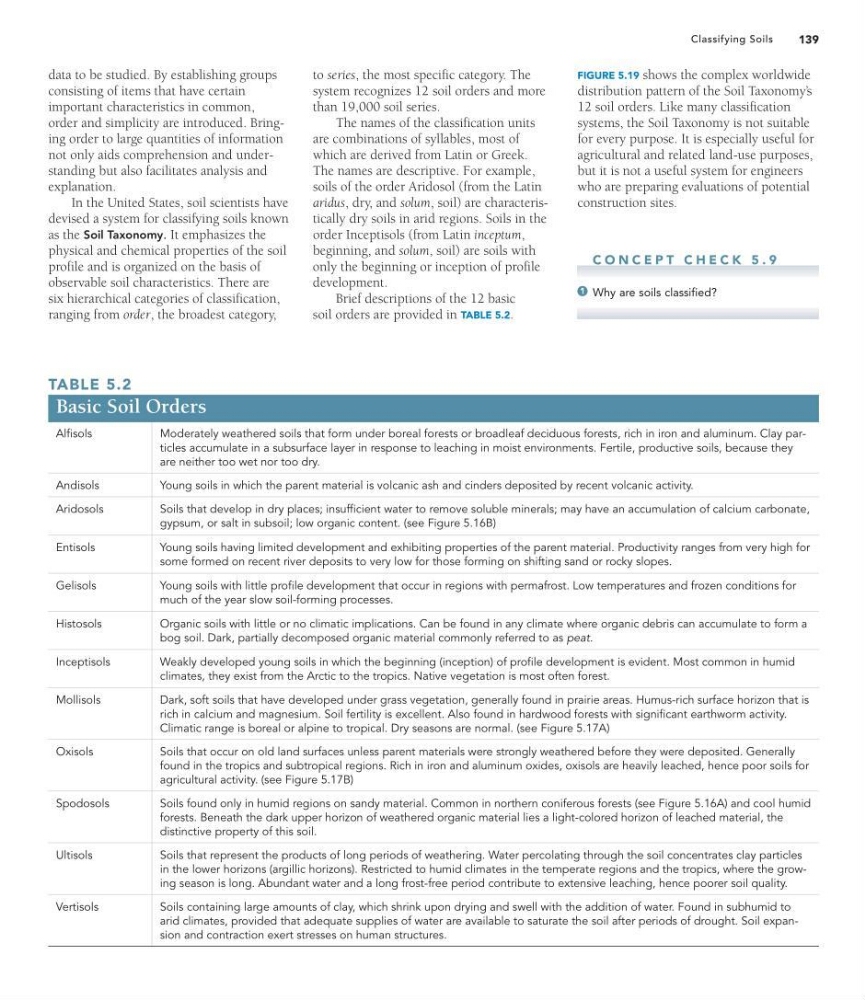
Brief descriptions of the 12 basic
soil orders are provided in TABLE 5.2.
FIGURE 5.19 shows the complex worldwide
distribution pattern of the Soil Taxonomy’ s
12 soil orders. Like many classification
systems, the Soil Taxonomy is not suitable
for every purpose. It is especially useful for
agricultural and related land-use purposes,
but it is not a useful system for engineers
who are preparing evaluations of potential
construction sites.
C O N C E P T C H E C K 5 . 9
Why are soils classified?
1
Classifying Soils
TABLE 5.2
Basic Soil Orders
Alfisols
Moderately weathered soils that form under boreal forests or broadleaf deciduous forests, rich in iron and aluminum. Clay particles accumulate in a subsurface layer in response to leaching in moist environments. Fertile, productive soils, because they
are neither too wet nor too dry.
Andisols
Young soils in which the parent material is volcanic ash and cinders deposited by recent volcanic activity.
Aridosols
Soils that develop in dry places; insufficient water to remove soluble minerals; may have an accumulation of calcium carbonate,
gypsum, or salt in subsoil; low organic content. (see Figure 5.16B)
Entisols
Young soils having limited development and exhibiting properties of the parent material. Productivity ranges from very high for
some formed on recent river deposits to very low for those forming on shifting sand or rocky slopes.
Gelisols
Young soils with little profile development that occur in regions with permafrost. Low temperatures and frozen conditions for
much of the year slow soil-forming processes.
Histosols
Organic soils with little or no climatic implications. Can be found in any climate where organic debris can accumulate to form a
bog soil. Dark, partially decomposed organic material commonly referred to as peat.
Inceptisols
Weakly developed young soils in which the beginning (inception) of profile development is evident. Most common in humid
climates, they exist from the Arctic to the tropics. Native vegetation is most often forest.
Mollisols
Dark, soft soils that have developed under grass vegetation, generally found in prairie areas. Humus-rich surface horizon that is
rich in calcium and magnesium. Soil fertility is excellent. Also found in hardwood forests with significant earthworm activity.
Climatic range is boreal or alpine to tropical. Dry seasons are normal. (see Figure 5.17A)
Oxisols
Soils that occur on old land surfaces unless parent materials were strongly weathered before they were deposited. Generally
found in the tropics and subtropical regions. Rich in iron and aluminum oxides, oxisols are heavily leached, hence poor soils for
agricultural activity. (see Figure 5.17B)
Spodosols
Soils found only in humid regions on sandy material. Common in northern coniferous forests (see Figure 5.16A) and cool humid
forests. Beneath the dark upper horizon of weathered organic material lies a light-colored horizon of leached material, the
distinctive property of this soil.
Ultisols
Soils that represent the products of long periods of weathering. Water percolating through the soil concentrates clay particles
in the lower horizons (argillic horizons). Restricted to humid climates in the temperate regions and the tropics, where the growing season is long. Abundant water and a long frost-free period contribute to extensive leaching, hence poorer soil quality.
Vertisols
Soils containing large amounts of clay, which shrink upon drying and swell with the addition of water. Found in subhumid to
arid climates, provided that adequate supplies of water are available to saturate the soil after periods of drought. Soil expansion and contraction exert stresses on human structures.
data to be studied. By establishing groups
consisting of items that have certain
important characteristics in common,
order and simplicity are introduced. Bringing order to large quantities of information
not only aids comprehension and understanding but also facilitates analysis and
explanation.
In the United States, soil scientists have
devised a system for classifying soils known
as the Soil Taxonomy. It emphasizes the
physical and chemical properties of the soil
profile and is organized on the basis of
observable soil characteristics. There are
six hierarchical categories of classification,
ranging from order, the broadest category,
to series, the most specific category. The
system recognizes 12 soil orders and more
than 19,000 soil series.
The names of the classification units
are combinations of syllables, most of
which are derived from Latin or Greek.
The names are descriptive. For example,
soils of the order Aridosol (from the Latin
aridus, dry, and solum, soil) are characteristically dry soils in arid regions. Soils in the
order Inceptisols (from Latin inceptum,
beginning, and solum, soil) are soils with
only the beginning or inception of profile
development.
Brief descriptions of the 12 basic
soil orders are provided in TABLE 5.2.
FIGURE 5.19 shows the complex worldwide
distribution pattern of the Soil Taxonomy’ s
12 soil orders. Like many classification
systems, the Soil Taxonomy is not suitable
for every purpose. It is especially useful for
agricultural and related land-use purposes,
but it is not a useful system for engineers
who are preparing evaluations of potential
construction sites.
C O N C E P T C H E C K 5 . 9
Why are soils classified?
1