

weathering
C O N C E P T C H E C K 5 . 7
List the five basic controls of soil formation.
Which factor is most influential in soil formation?
How might the direction a slope is facing influence soil formation?
The Soil Profile
Because soil-forming processes operate from the surface downward, variations in composition, texture, structure, and color gradually evolve at varying depths. These vertical differences, which usually become more pronounced as time passes, divide the soil into zones or
layers known as horizons. If you were to dig a trench in soil, you would see that its walls
are layered. Such a vertical section through all of the soil horizons constitutes the
soil profile (FIGURE 5.17).
FIGURE 5.18 presents an idealized view of a well-developed soil profile in which five
horizons are identified. From the surface downward, they are designated as O, A, E, B,
and C, respectively. These five horizons are common to soils in temperate regions.
The characteristics and extent of development of horizons vary in different environments.
Thus, different localities exhibit soil profiles that can contrast greatly with one another.
The O horizon consists largely of organic material. This is in contrast to the layers
beneath it that consist mainly of mineral matter. The upper portion of the O horizon is
primarily plant litter such as loose leaves and other organic debris that are still
recognizable. By contrast, the lower portion of the O horizon is made up of
partly decomposed organic matter (humus) in which plant structures can
no longer be identified. In addition to plants, the O horizon is teeming
with microscopic life, including bacteria, fungi, algae, and insects. All
of these organisms contribute oxygen, carbon dioxide, and organic
acids to the developing soil.
Underlying the organic-rich O horizon is the A horizon.
This zone is largely mineral matter, yet biological activity is
high and humus is generally present at up to 30 percent
in some instances. Together the O and A horizons
make up what is commonly called topsoil. Below the
A horizon, the E horizon is a light-colored layer
that contains little organic material. As water
percolates downward through this zone, finer
particles are carried away. This washing out
of the fine soil components is termed
eluviation. Water percolating downward also dissolves soluble inorganic soil components and
carries them to deeper
zones. This depletion
of soluble materials
from the upper
soil is termed
leaching.
3
2
1
137
The Soil Profile
organic portions of a soil. Earthworms, for
example, feed on organic matter and thoroughly mix soils in which they live, often
moving and enriching many tons per acre
each year. Burrows and holes also aid the
passage of water and air through the soil.
Topography
The lay of the land can vary greatly over
short distances. Such variations in topography can lead to the development of a variety of localized soil types. Many of
the differences exist because the length and
steepness of slopes have a significant
impact on the amount of erosion and the
water content of soil.
On steep slopes, soils are often poorly
developed. In such situations little water
can soak in; as a result, soil moisture may
be insufficient for vigorous plant growth.
Further, because of accelerated erosion on
steep slopes, the soils are thin or nonexistent (see Figure 5.15).
In contrast, waterlogged soils in poorly
drained bottomlands have a much different
character. Such soils are usually thick and
dark. The dark color results from the large
quantity of organic matter that accumulates
because saturated conditions retard the
decay of vegetation. The optimum terrain
for soil development is a flat-to-undulating
upland surface. Here we find good
drainage, minimum erosion, and sufficient
infiltration of water into the soil.
Slope orientation, or the direction a
slope is facing, also is significant. In the
midlatitudes of the Northern Hemisphere,
a south-facing slope receives a great deal
more sunlight than a north-facing slope. In
fact, a steep north-facing slope may receive
no direct sunlight at all. The difference in
the amount of solar radiation received
causes substantial differences in soil temperature and moisture, which in turn influence the nature of the vegetation and the
character of the soil.
Although we have dealt separately with
each of the soil-forming factors, remember
that all of them work together to form soil.
No single factor is responsible for a soil’ s
character. Rather, it is the combined influence of parent material, time, climate,
plants and animals, and topography that
determines this character.
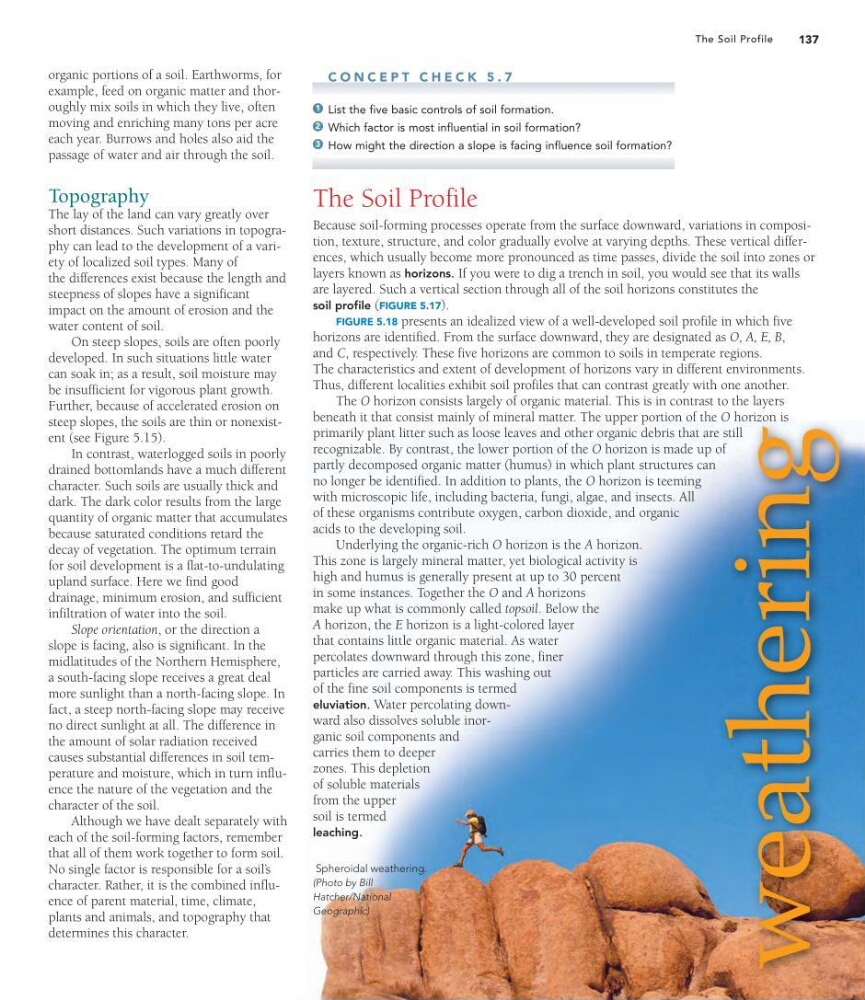
Spheroidal weathering.
(Photo by Bill
Hatcher/National
Geographic)
C O N C E P T C H E C K 5 . 7
List the five basic controls of soil formation.
Which factor is most influential in soil formation?
How might the direction a slope is facing influence soil formation?
The Soil Profile
Because soil-forming processes operate from the surface downward, variations in composition, texture, structure, and color gradually evolve at varying depths. These vertical differences, which usually become more pronounced as time passes, divide the soil into zones or
layers known as horizons. If you were to dig a trench in soil, you would see that its walls
are layered. Such a vertical section through all of the soil horizons constitutes the
soil profile (FIGURE 5.17).
FIGURE 5.18 presents an idealized view of a well-developed soil profile in which five
horizons are identified. From the surface downward, they are designated as O, A, E, B,
and C, respectively. These five horizons are common to soils in temperate regions.
The characteristics and extent of development of horizons vary in different environments.
Thus, different localities exhibit soil profiles that can contrast greatly with one another.
The O horizon consists largely of organic material. This is in contrast to the layers
beneath it that consist mainly of mineral matter. The upper portion of the O horizon is
primarily plant litter such as loose leaves and other organic debris that are still
recognizable. By contrast, the lower portion of the O horizon is made up of
partly decomposed organic matter (humus) in which plant structures can
no longer be identified. In addition to plants, the O horizon is teeming
with microscopic life, including bacteria, fungi, algae, and insects. All
of these organisms contribute oxygen, carbon dioxide, and organic
acids to the developing soil.
Underlying the organic-rich O horizon is the A horizon.
This zone is largely mineral matter, yet biological activity is
high and humus is generally present at up to 30 percent
in some instances. Together the O and A horizons
make up what is commonly called topsoil. Below the
A horizon, the E horizon is a light-colored layer
that contains little organic material. As water
percolates downward through this zone, finer
particles are carried away. This washing out
of the fine soil components is termed
eluviation. Water percolating downward also dissolves soluble inorganic soil components and
carries them to deeper
zones. This depletion
of soluble materials
from the upper
soil is termed
leaching.
3
2
1
137
The Soil Profile
organic portions of a soil. Earthworms, for
example, feed on organic matter and thoroughly mix soils in which they live, often
moving and enriching many tons per acre
each year. Burrows and holes also aid the
passage of water and air through the soil.
Topography
The lay of the land can vary greatly over
short distances. Such variations in topography can lead to the development of a variety of localized soil types. Many of
the differences exist because the length and
steepness of slopes have a significant
impact on the amount of erosion and the
water content of soil.
On steep slopes, soils are often poorly
developed. In such situations little water
can soak in; as a result, soil moisture may
be insufficient for vigorous plant growth.
Further, because of accelerated erosion on
steep slopes, the soils are thin or nonexistent (see Figure 5.15).
In contrast, waterlogged soils in poorly
drained bottomlands have a much different
character. Such soils are usually thick and
dark. The dark color results from the large
quantity of organic matter that accumulates
because saturated conditions retard the
decay of vegetation. The optimum terrain
for soil development is a flat-to-undulating
upland surface. Here we find good
drainage, minimum erosion, and sufficient
infiltration of water into the soil.
Slope orientation, or the direction a
slope is facing, also is significant. In the
midlatitudes of the Northern Hemisphere,
a south-facing slope receives a great deal
more sunlight than a north-facing slope. In
fact, a steep north-facing slope may receive
no direct sunlight at all. The difference in
the amount of solar radiation received
causes substantial differences in soil temperature and moisture, which in turn influence the nature of the vegetation and the
character of the soil.
Although we have dealt separately with
each of the soil-forming factors, remember
that all of them work together to form soil.
No single factor is responsible for a soil’ s
character. Rather, it is the combined influence of parent material, time, climate,
plants and animals, and topography that
determines this character.
Spheroidal weathering.
(Photo by Bill
Hatcher/National
Geographic)