

131
Rates of Weathering
Rates of Weathering
Weathering and Soil
Rates of Weathering
Several factors influence the type and rate
of rock weathering. We have already seen
how mechanical weathering affects the rate
of weathering. By breaking rock into
smaller pieces, the amount of surface
area exposed to chemical weathering is
increased. Other important factors
examined here include rock characteristics
and climate.
Rock Characteristics
Rock characteristics encompass all of the
chemical traits of rocks, including mineral
composition and solubility. In addition, any
physical features such as joints (cracks) can
be important because they allow water to
penetrate rock and start the process of
weathering long before the rock is exposed.
The variations in weathering rates due
to the mineral constituents can be demonstrated by comparing old headstones made
GEODe
ESSENTIALS
OF GEOLOGY
from different rock types. Headstones of granite, which are
composed of silicate minerals,
are relatively resistant to chemical weathering. We can see this
by examining the inscriptions
on the headstones shown in
FIGURE 5.11. In contrast to the
granite, the marble headstone
shows signs of extensive chemical alteration over a relatively
short period of time. Marble is
composed of calcite (calcium
carbonate), which readily dissolves even in a weakly acidic
solution.
The silicates, the most
abundant mineral group,
weather in essentially the same order as
their order of crystallization. By examining
Bowen’ s reaction series (see Figure 3.20,
p. 78), you can see that olivine crystallizes
first and is therefore the least resistant to
chemical weathering, whereas quartz,
which crystallizes last, is the most
resistant.
A.
B.
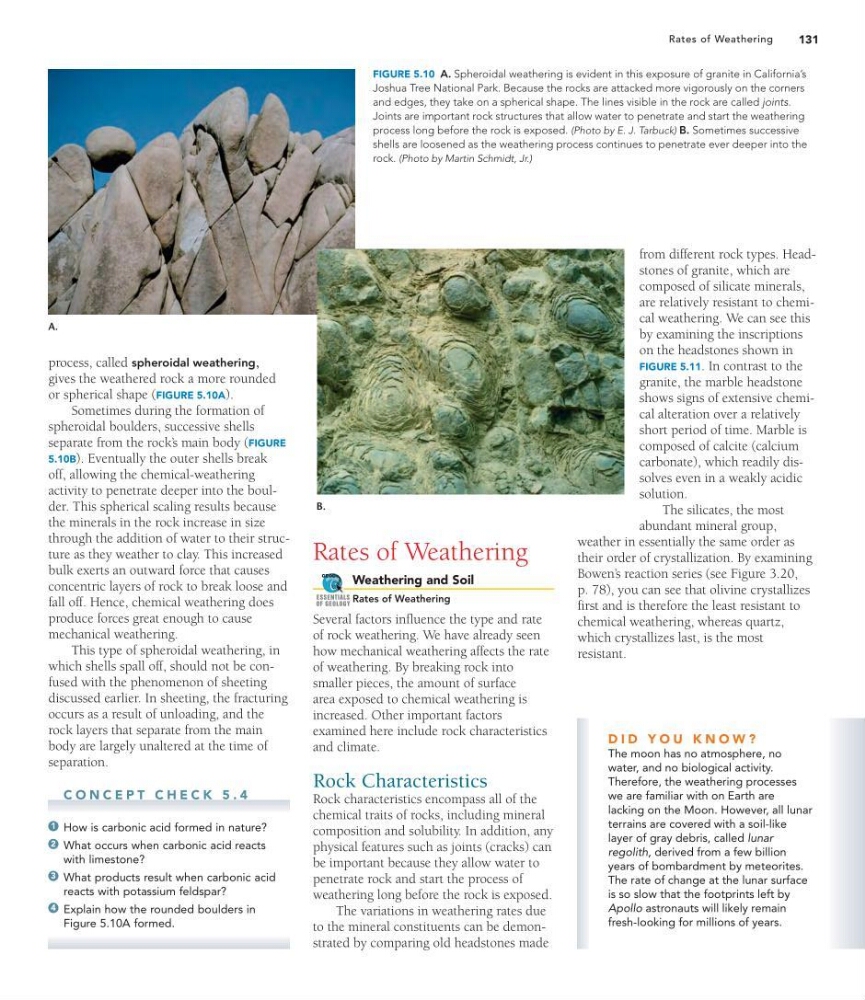
FIGURE 5.10 A. Spheroidal weathering is evident in this exposure of granite in California’s
Joshua Tree National Park. Because the rocks are attacked more vigorously on the corners
and edges, they take on a spherical shape. The lines visible in the rock are called joints.
Joints are important rock structures that allow water to penetrate and start the weathering
process long before the rock is exposed. (Photo by E. J. Tarbuck) B. Sometimes successive
shells are loosened as the weathering process continues to penetrate ever deeper into the
rock. (Photo by Martin Schmidt, Jr.)
process, called spheroidal weathering,
gives the weathered rock a more rounded
or spherical shape (FIGURE 5.10A).
Sometimes during the formation of
spheroidal boulders, successive shells
separate from the rock’ s main body (FIGURE
5.10B). Eventually the outer shells break
off, allowing the chemical-weathering
activity to penetrate deeper into the boulder. This spherical scaling results because
the minerals in the rock increase in size
through the addition of water to their structure as they weather to clay. This increased
bulk exerts an outward force that causes
concentric layers of rock to break loose and
fall off. Hence, chemical weathering does
produce forces great enough to cause
mechanical weathering.
This type of spheroidal weathering, in
which shells spall off, should not be confused with the phenomenon of sheeting
discussed earlier. In sheeting, the fracturing
occurs as a result of unloading, and the
rock layers that separate from the main
body are largely unaltered at the time of
separation.
C O N C E P T C H E C K 5 . 4
How is carbonic acid formed in nature?
What occurs when carbonic acid reacts
with limestone?
What products result when carbonic acid
reacts with potassium feldspar?
Explain how the rounded boulders in
Figure 5.10A formed.
4
3
2
1
D I D Y O U K N O W ?
The moon has no atmosphere, no
water, and no biological activity.
Therefore, the weathering processes
we are familiar with on Earth are
lacking on the Moon. However, all lunar
terrains are covered with a soil-like
layer of gray debris, called lunar
regolith, derived from a few billion
years of bombardment by meteorites.
The rate of change at the lunar surface
is so slow that the footprints left by
Apollo astronauts will likely remain
fresh-looking for millions of years.
Rates of Weathering
Rates of Weathering
Weathering and Soil
Rates of Weathering
Several factors influence the type and rate
of rock weathering. We have already seen
how mechanical weathering affects the rate
of weathering. By breaking rock into
smaller pieces, the amount of surface
area exposed to chemical weathering is
increased. Other important factors
examined here include rock characteristics
and climate.
Rock Characteristics
Rock characteristics encompass all of the
chemical traits of rocks, including mineral
composition and solubility. In addition, any
physical features such as joints (cracks) can
be important because they allow water to
penetrate rock and start the process of
weathering long before the rock is exposed.
The variations in weathering rates due
to the mineral constituents can be demonstrated by comparing old headstones made
GEODe
ESSENTIALS
OF GEOLOGY
from different rock types. Headstones of granite, which are
composed of silicate minerals,
are relatively resistant to chemical weathering. We can see this
by examining the inscriptions
on the headstones shown in
FIGURE 5.11. In contrast to the
granite, the marble headstone
shows signs of extensive chemical alteration over a relatively
short period of time. Marble is
composed of calcite (calcium
carbonate), which readily dissolves even in a weakly acidic
solution.
The silicates, the most
abundant mineral group,
weather in essentially the same order as
their order of crystallization. By examining
Bowen’ s reaction series (see Figure 3.20,
p. 78), you can see that olivine crystallizes
first and is therefore the least resistant to
chemical weathering, whereas quartz,
which crystallizes last, is the most
resistant.
A.
B.
FIGURE 5.10 A. Spheroidal weathering is evident in this exposure of granite in California’s
Joshua Tree National Park. Because the rocks are attacked more vigorously on the corners
and edges, they take on a spherical shape. The lines visible in the rock are called joints.
Joints are important rock structures that allow water to penetrate and start the weathering
process long before the rock is exposed. (Photo by E. J. Tarbuck) B. Sometimes successive
shells are loosened as the weathering process continues to penetrate ever deeper into the
rock. (Photo by Martin Schmidt, Jr.)
process, called spheroidal weathering,
gives the weathered rock a more rounded
or spherical shape (FIGURE 5.10A).
Sometimes during the formation of
spheroidal boulders, successive shells
separate from the rock’ s main body (FIGURE
5.10B). Eventually the outer shells break
off, allowing the chemical-weathering
activity to penetrate deeper into the boulder. This spherical scaling results because
the minerals in the rock increase in size
through the addition of water to their structure as they weather to clay. This increased
bulk exerts an outward force that causes
concentric layers of rock to break loose and
fall off. Hence, chemical weathering does
produce forces great enough to cause
mechanical weathering.
This type of spheroidal weathering, in
which shells spall off, should not be confused with the phenomenon of sheeting
discussed earlier. In sheeting, the fracturing
occurs as a result of unloading, and the
rock layers that separate from the main
body are largely unaltered at the time of
separation.
C O N C E P T C H E C K 5 . 4
How is carbonic acid formed in nature?
What occurs when carbonic acid reacts
with limestone?
What products result when carbonic acid
reacts with potassium feldspar?
Explain how the rounded boulders in
Figure 5.10A formed.
4
3
2
1
D I D Y O U K N O W ?
The moon has no atmosphere, no
water, and no biological activity.
Therefore, the weathering processes
we are familiar with on Earth are
lacking on the Moon. However, all lunar
terrains are covered with a soil-like
layer of gray debris, called lunar
regolith, derived from a few billion
years of bombardment by meteorites.
The rate of change at the lunar surface
is so slow that the footprints left by
Apollo astronauts will likely remain
fresh-looking for millions of years.