

weathering
surface conditions. Consequently, clay
minerals make up a high percentage of the
inorganic material in soils. Moreover, the
most abundant sedimentary rock, shale,
contains a high proportion of clay minerals.
In addition to the formation of clay
minerals during the weathering of feldspar,
some silica is removed from the feldspar
structure and is carried away by groundwater (water beneath Earth’ s surface). This
dissolved silica will eventually precipitate
to produce nodules of chert or flint, or it
will fill in the pore spaces between sediment grains, or it will be carried to the
ocean, where microscopic animals will
remove it from the water to build hard
silica shells.
To summarize, the weathering of potassium feldspar generates a residual clay mineral, a soluble salt (potassium bicarbonate),
and some silica, which enters into solution.
CHAPTER 5 Weathering and Soils
130
TABLE 5.1
Products of Weathering
Mineral
Residual Products
Material in Solution
Quartz
Quartz grains
Silica
Feldspars
Clay minerals
Silica, K , Na ,Ca
2+
+
+
Amphibole (hornblende)
Clay minerals
Silica, Ca , Mg
2+
2+
Limonite
Hematite
Olivine
Limonite
Silica, Mg
2+
Hematite
Quartz, the other main component of granite, is very resistant to chemical weathering; it
remains substantially unaltered when attacked
by weak acidic solutions. As a result, when
granite weathers, the feldspar crystals dull and
slowly turn to clay, releasing the once-interlocked quartz grains, which still retain their fresh, glassy appearance. Although some quartz
remains in the soil, much is eventually transported to the sea or to other sites of deposition,
where it becomes the main constituent of such features as sandy beaches and sand dunes.
In time these quartz grains may become lithified to form the sedimentary rock sandstone.
Weathering of Silicate Minerals
TABLE 5.1 lists the weathered products of some of the most common silicate minerals.
Remember that silicate minerals make up most of Earth’ s crust and that these minerals are
composed essentially of only eight elements. When chemically weathered, silicate minerals
yield sodium, calcium, potassium, and magnesium ions that form soluble products,
which may be removed by groundwater. The element iron combines with oxygen, producing relatively insoluble iron
oxides, which give soil a reddish-brown or yellowish
color. Under most conditions the three remaining elements—aluminum, silicon, and oxygen—join with
water to produce residual clay minerals. However,
even the highly insoluble clay minerals are very
slowly removed by subsurface water.
Spheroidal Weathering
In addition to altering the internal structure of
minerals, chemical weathering causes physical
changes. For instance, when angular rock masses
chemically weather as water enters along joints,
they tend to take on a spherical shape. Gradually
the corners and edges of the angular blocks
become more rounded. The corners are attacked
most readily because of their greater surface
area, as compared to the edges and faces. This
D I D Y O U K N O W ?
The only common mineral that is very
resistant to both mechanical and
chemical weathering is quartz.
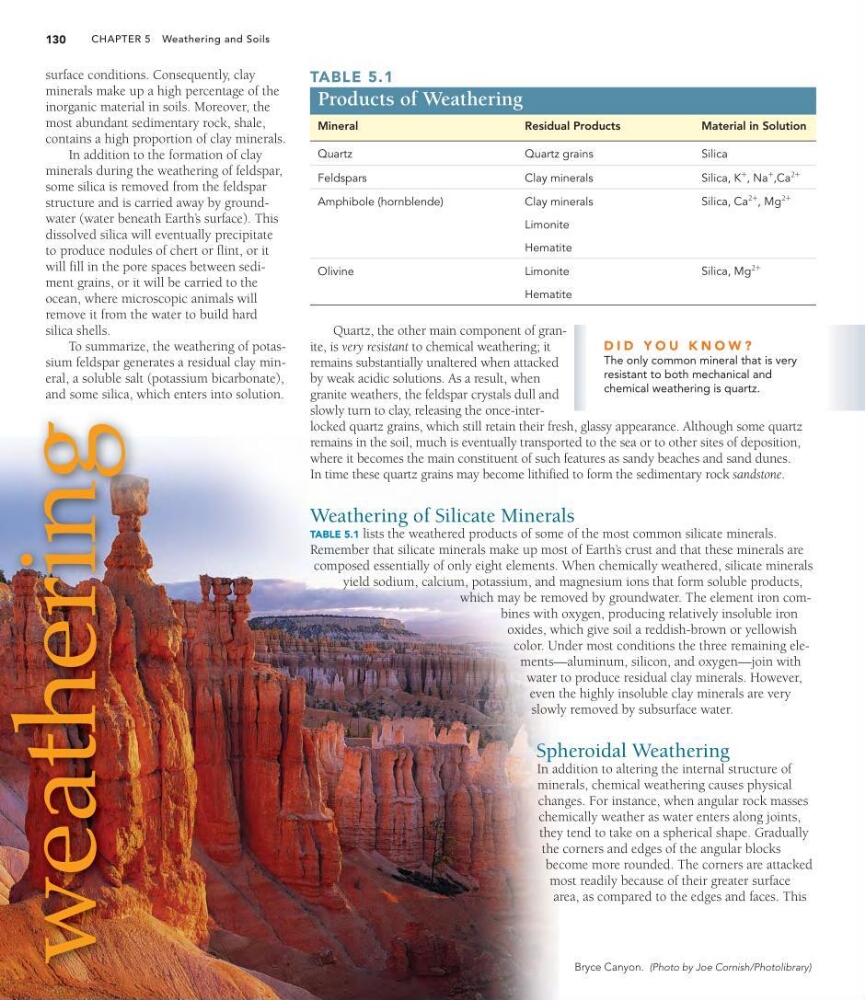
Bryce Canyon. (Photo by Joe Cornish/Photolibrary)
surface conditions. Consequently, clay
minerals make up a high percentage of the
inorganic material in soils. Moreover, the
most abundant sedimentary rock, shale,
contains a high proportion of clay minerals.
In addition to the formation of clay
minerals during the weathering of feldspar,
some silica is removed from the feldspar
structure and is carried away by groundwater (water beneath Earth’ s surface). This
dissolved silica will eventually precipitate
to produce nodules of chert or flint, or it
will fill in the pore spaces between sediment grains, or it will be carried to the
ocean, where microscopic animals will
remove it from the water to build hard
silica shells.
To summarize, the weathering of potassium feldspar generates a residual clay mineral, a soluble salt (potassium bicarbonate),
and some silica, which enters into solution.
CHAPTER 5 Weathering and Soils
130
TABLE 5.1
Products of Weathering
Mineral
Residual Products
Material in Solution
Quartz
Quartz grains
Silica
Feldspars
Clay minerals
Silica, K , Na ,Ca
2+
+
+
Amphibole (hornblende)
Clay minerals
Silica, Ca , Mg
2+
2+
Limonite
Hematite
Olivine
Limonite
Silica, Mg
2+
Hematite
Quartz, the other main component of granite, is very resistant to chemical weathering; it
remains substantially unaltered when attacked
by weak acidic solutions. As a result, when
granite weathers, the feldspar crystals dull and
slowly turn to clay, releasing the once-interlocked quartz grains, which still retain their fresh, glassy appearance. Although some quartz
remains in the soil, much is eventually transported to the sea or to other sites of deposition,
where it becomes the main constituent of such features as sandy beaches and sand dunes.
In time these quartz grains may become lithified to form the sedimentary rock sandstone.
Weathering of Silicate Minerals
TABLE 5.1 lists the weathered products of some of the most common silicate minerals.
Remember that silicate minerals make up most of Earth’ s crust and that these minerals are
composed essentially of only eight elements. When chemically weathered, silicate minerals
yield sodium, calcium, potassium, and magnesium ions that form soluble products,
which may be removed by groundwater. The element iron combines with oxygen, producing relatively insoluble iron
oxides, which give soil a reddish-brown or yellowish
color. Under most conditions the three remaining elements—aluminum, silicon, and oxygen—join with
water to produce residual clay minerals. However,
even the highly insoluble clay minerals are very
slowly removed by subsurface water.
Spheroidal Weathering
In addition to altering the internal structure of
minerals, chemical weathering causes physical
changes. For instance, when angular rock masses
chemically weather as water enters along joints,
they tend to take on a spherical shape. Gradually
the corners and edges of the angular blocks
become more rounded. The corners are attacked
most readily because of their greater surface
area, as compared to the edges and faces. This
D I D Y O U K N O W ?
The only common mineral that is very
resistant to both mechanical and
chemical weathering is quartz.
Bryce Canyon. (Photo by Joe Cornish/Photolibrary)