

¯˚˚˚˚˚˚˘˚˚˚˚˚˚˙
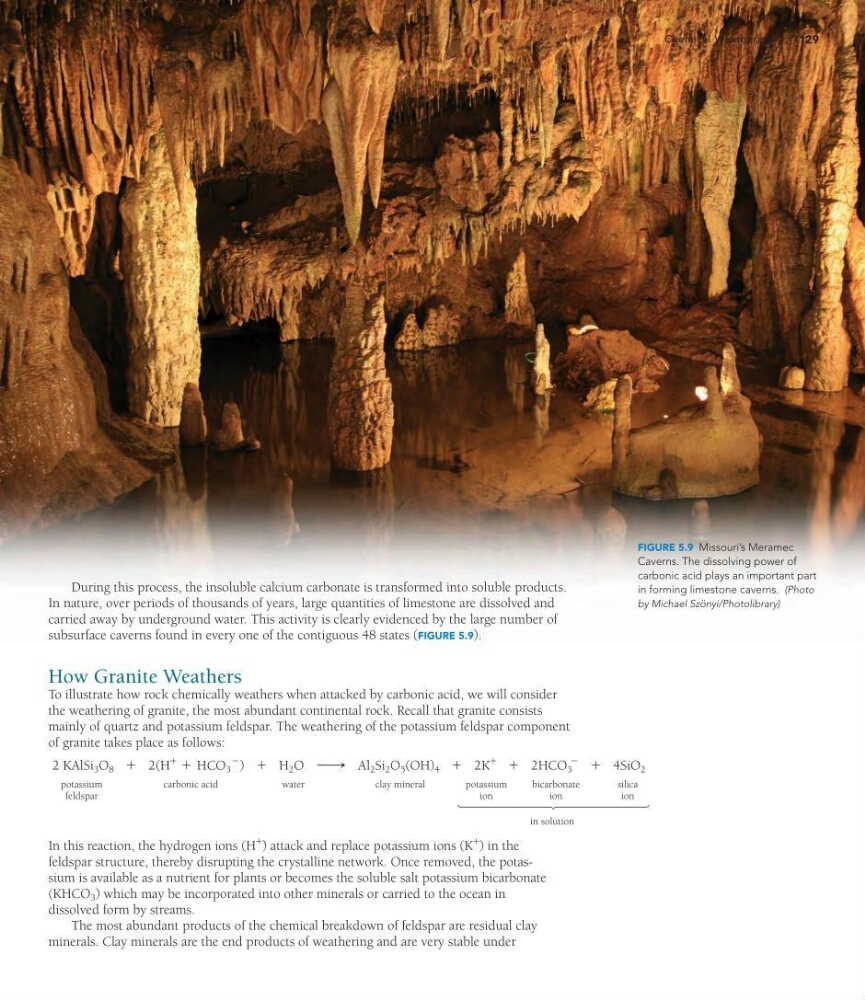
FIGURE 5.9 Missouri’s Meramec
Caverns. The dissolving power of
carbonic acid plays an important part
in forming limestone caverns. (Photo
by Michael Szönyi/Photolibrary)
During this process, the insoluble calcium carbonate is transformed into soluble products.
In nature, over periods of thousands of years, large quantities of limestone are dissolved and
carried away by underground water. This activity is clearly evidenced by the large number of
subsurface caverns found in every one of the contiguous 48 states (FIGURE 5.9).
How Granite Weathers
To illustrate how rock chemically weathers when attacked by carbonic acid, we will consider
the weathering of granite, the most abundant continental rock. Recall that granite consists
mainly of quartz and potassium feldspar. The weathering of the potassium feldspar component
of granite takes place as follows:
potassium
carbonic acid
water
clay mineral
potassium
bicarbonate
silica
feldspar
ion
ion
ion
in solution
2 KAlSi 3 O 8 + 2(H
+
+ HCO 3
- ) + H 2 O ¡ Al 2 Si 2 O 5 (OH) 4 + 2K
+
+ 2HCO 3
-
+ 4SiO 2
In this reaction, the hydrogen ions (H ) attack and replace potassium ions (K ) in the
feldspar structure, thereby disrupting the crystalline network. Once removed, the potassium is available as a nutrient for plants or becomes the soluble salt potassium bicarbonate
(KHCO 3 ) which may be incorporated into other minerals or carried to the ocean in
dissolved form by streams.
The most abundant products of the chemical breakdown of feldspar are residual clay
minerals. Clay minerals are the end products of weathering and are very stable under
+
+
129
Chemical Weathering
FIGURE 5.9 Missouri’s Meramec
Caverns. The dissolving power of
carbonic acid plays an important part
in forming limestone caverns. (Photo
by Michael Szönyi/Photolibrary)
During this process, the insoluble calcium carbonate is transformed into soluble products.
In nature, over periods of thousands of years, large quantities of limestone are dissolved and
carried away by underground water. This activity is clearly evidenced by the large number of
subsurface caverns found in every one of the contiguous 48 states (FIGURE 5.9).
How Granite Weathers
To illustrate how rock chemically weathers when attacked by carbonic acid, we will consider
the weathering of granite, the most abundant continental rock. Recall that granite consists
mainly of quartz and potassium feldspar. The weathering of the potassium feldspar component
of granite takes place as follows:
potassium
carbonic acid
water
clay mineral
potassium
bicarbonate
silica
feldspar
ion
ion
ion
in solution
2 KAlSi 3 O 8 + 2(H
+
+ HCO 3
- ) + H 2 O ¡ Al 2 Si 2 O 5 (OH) 4 + 2K
+
+ 2HCO 3
-
+ 4SiO 2
In this reaction, the hydrogen ions (H ) attack and replace potassium ions (K ) in the
feldspar structure, thereby disrupting the crystalline network. Once removed, the potassium is available as a nutrient for plants or becomes the soluble salt potassium bicarbonate
(KHCO 3 ) which may be incorporated into other minerals or carried to the ocean in
dissolved form by streams.
The most abundant products of the chemical breakdown of feldspar are residual clay
minerals. Clay minerals are the end products of weathering and are very stable under
+
+
129
Chemical Weathering