

CHAPTER 5 Weathering and Soils
128
Biological Activity
Both mechanical and chemical weathering
are accomplished by the activities of organisms. Plant roots in search of minerals and
water grow into fractures, and as the
roots grow, they wedge the rock apart
(FIGURE 5.7). Burrowing animals further
break down the rock by moving fresh
material to the surface, where physical
and chemical processes can more effectively
attack it. Of course, where rock has been
blasted in search of minerals or for
construction, the impact of humans is
particularly noticeable.
There are numerous ways that organisms play a role in chemical weathering.
For example, plant roots, fungi, and lichens
that occupy fractures or may encrust a rock
produce acids that promote decomposition.
Moreover, some bacteria are capable of
extracting compounds from minerals and
using the energy from the compound’ s
chemical bonds to supply their life needs.
These primitive “mineral-eating” life
forms can live at depths as great as a few
kilometers.
C O N C E P T C H E C K 5 . 3
When a rock is mechanically weathered,
how does its surface area change? How
does this influence chemical weathering?
Explain how water can cause mechanical
weathering.
How does an exfoliation dome form?
How do joints promote weathering?
How does biological activity contribute
to weathering?
Chemical Weathering
Weathering and Soil
Chemical Weathering
In the preceding discussion of mechanical weathering you learned that breaking rock into
smaller pieces aids chemical weathering by increasing the surface area available for chemical attack. It should also be pointed out that chemical weathering contributes to mechanical
weathering. It does so by weakening the outer portions of some rocks which, in turn,
makes them more susceptible to being broken by mechanical weathering processes.
Chemical weathering involves the complex processes that break down rock components
and internal structures of minerals. Such processes convert the constituents to new
minerals or release them to the surrounding environment. During this transformation,
the original rock decomposes into substances that are stable in the surface environment.
Consequently, the products of chemical weathering will remain essentially unchanged as
long as they remain in an environment similar to the one in which they formed.
Water and Carbonic Acid
Water is by far the most important agent of chemical weathering. Although pure water is
nonreactive, a small amount of dissolved material is generally all that is needed to activate
it. Oxygen dissolved in water will oxidize some materials. For example, when an iron nail is
found in moist soil, it will have a coating of rust (iron oxide), and if the time of exposure
has been long, the nail will be so weak that it can be broken as easily as a toothpick. When
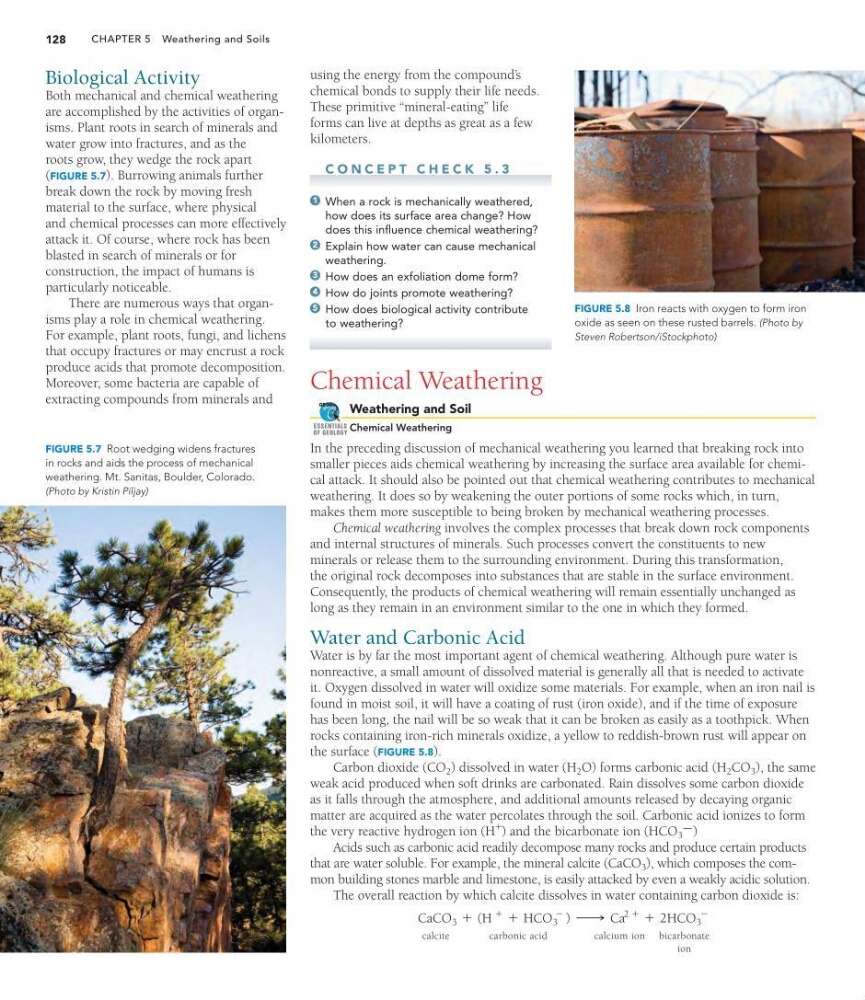
rocks containing iron-rich minerals oxidize, a yellow to reddish-brown rust will appear on
the surface (FIGURE 5.8).
Carbon dioxide (CO 2 ) dissolved in water (H 2 O) forms carbonic acid (H 2 CO 3 ), the same
weak acid produced when soft drinks are carbonated. Rain dissolves some carbon dioxide
as it falls through the atmosphere, and additional amounts released by decaying organic
matter are acquired as the water percolates through the soil. Carbonic acid ionizes to form
the very reactive hydrogen ion (H ) and the bicarbonate ion (HCO 3 )
Acids such as carbonic acid readily decompose many rocks and produce certain products
that are water soluble. For example, the mineral calcite (CaCO 3 ), which composes the common building stones marble and limestone, is easily attacked by even a weakly acidic solution.
The overall reaction by which calcite dissolves in water containing carbon dioxide is:
calcite
carbonic acid
calcium ion bicarbonate
ion
CaCO 3 + (H
+
+ HCO 3
- ) ¡ Ca
2 +
+ 2HCO 3
-
-
+
GEODe
ESSENTIALS
OF GEOLOGY
5
4
3
2
1
FIGURE 5.7 Root wedging widens fractures
in rocks and aids the process of mechanical
weathering. Mt. Sanitas, Boulder, Colorado.
(Photo by Kristin Piljay)
FIGURE 5.8 Iron reacts with oxygen to form iron
oxide as seen on these rusted barrels. (Photo by
Steven Robertson/iStockphoto)
128
Biological Activity
Both mechanical and chemical weathering
are accomplished by the activities of organisms. Plant roots in search of minerals and
water grow into fractures, and as the
roots grow, they wedge the rock apart
(FIGURE 5.7). Burrowing animals further
break down the rock by moving fresh
material to the surface, where physical
and chemical processes can more effectively
attack it. Of course, where rock has been
blasted in search of minerals or for
construction, the impact of humans is
particularly noticeable.
There are numerous ways that organisms play a role in chemical weathering.
For example, plant roots, fungi, and lichens
that occupy fractures or may encrust a rock
produce acids that promote decomposition.
Moreover, some bacteria are capable of
extracting compounds from minerals and
using the energy from the compound’ s
chemical bonds to supply their life needs.
These primitive “mineral-eating” life
forms can live at depths as great as a few
kilometers.
C O N C E P T C H E C K 5 . 3
When a rock is mechanically weathered,
how does its surface area change? How
does this influence chemical weathering?
Explain how water can cause mechanical
weathering.
How does an exfoliation dome form?
How do joints promote weathering?
How does biological activity contribute
to weathering?
Chemical Weathering
Weathering and Soil
Chemical Weathering
In the preceding discussion of mechanical weathering you learned that breaking rock into
smaller pieces aids chemical weathering by increasing the surface area available for chemical attack. It should also be pointed out that chemical weathering contributes to mechanical
weathering. It does so by weakening the outer portions of some rocks which, in turn,
makes them more susceptible to being broken by mechanical weathering processes.
Chemical weathering involves the complex processes that break down rock components
and internal structures of minerals. Such processes convert the constituents to new
minerals or release them to the surrounding environment. During this transformation,
the original rock decomposes into substances that are stable in the surface environment.
Consequently, the products of chemical weathering will remain essentially unchanged as
long as they remain in an environment similar to the one in which they formed.
Water and Carbonic Acid
Water is by far the most important agent of chemical weathering. Although pure water is
nonreactive, a small amount of dissolved material is generally all that is needed to activate
it. Oxygen dissolved in water will oxidize some materials. For example, when an iron nail is
found in moist soil, it will have a coating of rust (iron oxide), and if the time of exposure
has been long, the nail will be so weak that it can be broken as easily as a toothpick. When
rocks containing iron-rich minerals oxidize, a yellow to reddish-brown rust will appear on
the surface (FIGURE 5.8).
Carbon dioxide (CO 2 ) dissolved in water (H 2 O) forms carbonic acid (H 2 CO 3 ), the same
weak acid produced when soft drinks are carbonated. Rain dissolves some carbon dioxide
as it falls through the atmosphere, and additional amounts released by decaying organic
matter are acquired as the water percolates through the soil. Carbonic acid ionizes to form
the very reactive hydrogen ion (H ) and the bicarbonate ion (HCO 3 )
Acids such as carbonic acid readily decompose many rocks and produce certain products
that are water soluble. For example, the mineral calcite (CaCO 3 ), which composes the common building stones marble and limestone, is easily attacked by even a weakly acidic solution.
The overall reaction by which calcite dissolves in water containing carbon dioxide is:
calcite
carbonic acid
calcium ion bicarbonate
ion
CaCO 3 + (H
+
+ HCO 3
- ) ¡ Ca
2 +
+ 2HCO 3
-
-
+
GEODe
ESSENTIALS
OF GEOLOGY
5
4
3
2
1
FIGURE 5.7 Root wedging widens fractures
in rocks and aids the process of mechanical
weathering. Mt. Sanitas, Boulder, Colorado.
(Photo by Kristin Piljay)
FIGURE 5.8 Iron reacts with oxygen to form iron
oxide as seen on these rusted barrels. (Photo by
Steven Robertson/iStockphoto)